26
G
B
If DIP 11 is turned ON the blackout function is ENABLED.
In case of a blackout occurs and the blackout function is enabled (DIP11 ON), when the main
power returns, automatically the operator will function according to the CHART 2.
CHART 2
During blackout
At the return of the main power
supply
If the gate is totally closed It will remain closed
If the gate is opening It will continue opening
If the gate is totally open (with DIP3 OFF)
It will remain open, waiting for any
command
If the gate is totally open (with DIP3 ON)
It will remain open and then, when the time
of the Automatic Closing is expired, the
gate will close
If the gate is closing It will continue closing
If the gate is in the safety edge alarm state The safety edge alarm will renewed
TECHNICAL SPECIFICATIONS
- Temperature range -10 ÷ + 55°C
- Humidity < 95% without condensation
- Power supply voltage 230 o 120V~ ±10%
- Frequency 50/60 Hz
- Maximum absorption 36 mA
- Interruptions in electricity supply 100ms
- Maximum power of gate open indicator 24 Vdc 3W (equivalent to 1 bulb of
3W or 5 LED with serial resistance
of 2,2 Kohm)
- Maximum load of blinker output 40W with resistive charge
- Current available for photocells and accessories 500mA 24 Vdc
- Current available on radio connector 200mA 24 Vdc
TECHNICAL RADIO SPECIFICATIONS (Only CRX models)
- Reception frequency 433,92MHz
- Impedance 52 ohm
- Sensitivity >2.24µV
- Excitation time 300ms
- De-excitation time 300ms
- Codes in store N° 62 total
- All the inputs must be used as clean contacts because the power supply is generated
internally (safe voltage) in the card and it is set in a way to guarantee the use of the double
insulation and reinforced in relation to parts with hazardous voltage.
- Any external circuits connected to the outputs of the control board, must be carried out to
make sure the double or reinforced insulation is used in relation to parts with hazardous
voltage.
- All the inputs are run by a programmed integrated circuit which carries out a self-check at
the beginning of each operation.
TROUBLE SHOOTING
After having carried out all connections, by carefully following the layout and having
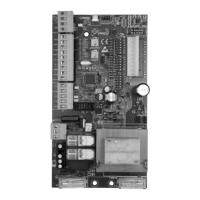
positioned the gate in intermediate position, check the correct ignition of LEDS DL7, DL8.
In case of no ignition of the LEDS, always with gate in intermediate position, check the
following and replace any faulty components.
DL7 switched off Faulty photocells
DL8 switched off Faulty safety edge (In case the edge is not connected, carry out
jumper between COM and EDGE)
During functioning with personnel present, with DIP 1 at ON, check that during opening of
M1 and M2 the green DL5 and DL3 LEDS switch on and that during closing of M1 and M2
the red DL6 and DL4 LEDS switch on.
If not, invert clamps V and W on the motor terminal board of the interested motor.
FAULT SOLUTION
After having carried out the various connections and having supplied voltage, all the LEDS
are switched off.
Check the integrity of fuses F1 and F2. In case of interrupted fuse use only of adequate value
F2 = 5A F1 = T315mA.
The motor opens and closes, but it has no strength and moves slowly. Check trimmers TORQUE and LOW-SPEED adjustment.
The gate opens but does not close after the time set.
Ensure to have set DIP 3 at ON. Button K BUTTON always inserted in automatic functioning
mode (DIP 6 OFF). Replace button or switch of the selector switch.
Failed edge self-test => check the connections between electronic board and edge feeder.
Attention: if not using a feeder for edges, DIP 10 must be at OFF position.
The gate does not open or close by activating the various K and RADIO buttons.
Faulty safety edge contact. Faulty photocells contact with DIP 4 OFF.
Fix or replace the relative contact.
By activating the K button the gate does not move. Impulse K always inserted. Check and replace any buttons or micro-switches of the selector switch.
The electric lock does not work. Ensure to have enabled DIP 8 at ON.



 To Next Page