Need help?
Do you have a question about the RIDGID EB44242 and is the answer not in the manual?
Guidelines for using extension cords with power tools.
Information on tool speed and electrical wiring requirements.
Safety instructions for proper grounding of the tool.
Details on connecting the tool to a power supply.
Lists technical specifications of the sander.
Instructions for safely unpacking the tool.
Steps for attaching rubber feet to the sander's base.
Instructions for securely mounting the sander to a workbench.
Alternative method to secure sander to a workbench using clamps.
How to support the sander on sawhorses.
Information on onboard storage for accessories.
Steps for installing the sanding belt assembly.
Steps for removing the sanding belt assembly.
Guide to installing larger sanding sleeves.
Steps for installing 1/2 in. sanding sleeves.
Guidance on selecting correct throat plates and washers.
Explains the function and use of the ON-OFF switch.
What to do and observe while the sander is operating.
Safety procedures for clearing jammed material.
Steps to take before leaving the sander unattended.
Safety advice for sanding metal.
Safety advice for sanding paint.
General guidance on the sanding process.
How to perform surface sanding using the belt.
Technique for end sanding on the belt.
How to sand curved surfaces.
Correct workpiece feed direction for sanding.
How to square the front table to the sanding belt.
Steps to align the sanding belt with the miter gauge slot.
Instructions for belt removal and installation.
General cleaning and care guidelines.
Information on the tool's lubrication needs.
Details on the dust collection port and its use.
Advice on safely moving the sander.
Exclusions from the warranty coverage.
Legal limitations and disclaimers for the warranty.
Instructions for getting the tool serviced.
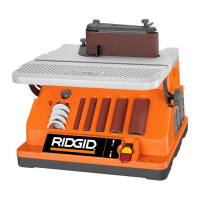
This document is the operator's manual for the RIDGID Oscillating Edge Belt/Spindle Sander, models EB44241, EB44242, and EB44243. It provides comprehensive information on the tool's features, assembly, operation, adjustments, maintenance, and troubleshooting.
The RIDGID Oscillating Edge Belt/Spindle Sander is a versatile woodworking tool designed for sanding edges, faces, contours, and inside and outside curves. It utilizes both oscillating edge belt sanding and oscillating spindle sanding motions to provide fast, burn-free finishes. The oscillation feature, moving 3/4 inch up and down, helps to sand faster and prevents burning of the workpiece. The tool is engineered for dependability, ease of operation, and operator safety, making it suitable for a variety of sanding applications in a workshop environment.
The sander offers several features to enhance usability and safety:
The manual outlines several maintenance aspects to ensure the longevity and performance of the sander:


 To Next Page
 General