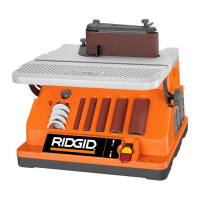
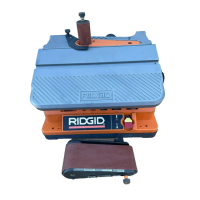
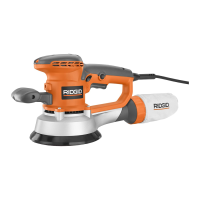
The RIDGID Oscillating Edge Belt/Spindle Sander is a versatile power tool designed for precision sanding on various wood surfaces. Engineered to RIDGID's high standards for dependability, ease of operation, and operator safety, this sander offers years of rugged, trouble-free performance when properly cared for. Its primary function is to provide fast, burn-free finishes on edges, faces, contours, and both inside and outside curves, utilizing both oscillating and rotary motion.
Function Description:
The device operates as an oscillating edge belt sander and a spindle sander, allowing users to switch between these two modes depending on the task at hand. In belt sanding mode, it uses a continuous sanding belt to remove material from wood, with the belt oscillating up and down to sand faster and prevent burning of the workpiece. This mode is ideal for surface sanding and end sanding on flat edges. For sanding curved edges, especially inside curves, the spindle sanding mode is recommended. In this mode, sanding sleeves of various diameters are mounted on a rotating and oscillating drum, providing flexibility for different curve sizes. The oscillation feature, common to both modes, ensures even wear of the abrasive and reduces heat buildup, contributing to a smoother finish and longer abrasive life.
Usage Features:
The sander is equipped with several features designed to enhance its usability and safety. The Worktable provides a stable surface for supporting workpieces during sanding operations. It can be tilted for bevel sanding, with a Table Lock Knob to secure it at the desired angle. The Throat Plate fits around the sanding drum or belt to provide additional workpiece support and prevent small pieces from falling into the mechanism. Multiple throat plate inserts are provided to match different sanding sleeve diameters, ensuring a snug fit and preventing accidental pinching or wedging of small workpieces.
Switching between belt and spindle sanding modes is facilitated by the Spindle Knob, which allows for easy removal and installation of the sanding belt assembly or sanding drums. The Belt Tension Lever is used to release and apply tension to the sanding belt, simplifying belt changes. A Tracking Knob allows for precise adjustment of the sanding belt's position on the drums, ensuring it runs true and prevents it from sliding off.
For dust management, the sander includes a Dust Exhaust Port (2-1/2 inches) for connecting a wet/dry vacuum, enabling dustless sanding and maintaining a cleaner work environment. This helps protect the user's lungs and keeps the work area clear.
The ON-OFF Switch features a locking mechanism, requiring a Switch Key to operate. This safety feature helps prevent unauthorized use and accidental starting, especially important for childproofing the workshop. Users are advised to remove the switch key when the tool is not in use or during power failures to prevent unexpected restarts.
The sander emphasizes proper workpiece feeding. When sanding, workpieces should be fed against the direction of the sanding sleeve's rotation (from left to right for clockwise rotation) to prevent kickback and maintain control. For accuracy, accessories like a miter gauge (not included) can be used. The work rest can be adjusted to maintain a small clearance (no more than 1/16 inch) from the sanding surface to prevent slips, jams, or thrown pieces.
Maintenance Features:
Maintaining the RIDGID Oscillating Edge Belt/Spindle Sander is straightforward, focusing on cleanliness and proper part replacement to ensure longevity and safe operation.
Regular cleaning is crucial. Users are instructed to keep the tool dry, clean, and free from oil and grease, using only clean cloths for cleaning. It is explicitly warned against using brake fluids, gasoline, petroleum-based products, or any solvents on plastic parts, as these can cause damage, weakening, or destruction of the plastic, leading to personal injury. Sawdust buildup in the table recess should be periodically cleaned to ensure the belt or spindle oscillates completely and to prevent premature wear.
For those sanding metals, it is essential to disconnect any dust collecting hose and thoroughly remove all traces of wood dust from inside the unit before sanding metals, and vice-versa, to prevent fire hazards. When sanding paint, especially lead-based paint, specific precautions are outlined, including wearing appropriate dust masks or respirators, ensuring children and pregnant women are not in the work area, and maintaining strict hygiene to prevent ingestion of contaminated paint particles.
The tool's bearings are factory-lubricated with a high-grade lubricant for the life of the unit under normal operating conditions, meaning no further lubrication is required by the user.
In terms of part replacement, the manual emphasizes using only identical RIDGID replacement parts for servicing to avoid creating hazards or causing product damage. This applies to sanding belts, sleeves, and any other components. Instructions are provided for removing and installing sanding belts and sleeves, including guidance on tensioning and tracking the belt to ensure it runs correctly.
The sander also includes convenient on-board storage for various parts, such as washers, spacers, drums, sleeves, and hex keys. The sanding belt assembly can be stored in a pocket at the rear of the base, while front-loaded parts can be protected by lowering the table until it rests against the base and tightening the knob. This organized storage helps prevent loss of accessories and keeps them readily accessible.
Overall, the RIDGID Oscillating Edge Belt/Spindle Sander is designed for both robust performance and user-friendly maintenance, ensuring a reliable tool for woodworking projects.



 To Next Page
 General