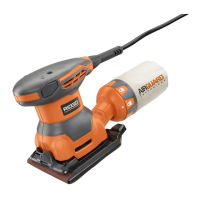
The RIDGID R2600 Variable Speed Random Orbit Sander is a power tool designed for sanding wood, wood product, and steel surfaces, as well as for removing rust from steel. It has been engineered for dependability, ease of operation, and operator safety, offering years of rugged, trouble-free performance when properly cared for.
Function Description:
The random orbit sander utilizes a sanding disc that moves in a random orbit pattern, which helps to prevent swirl marks and provides a smooth finish. The variable speed feature allows the user to adjust the sanding disc speed from A to F, providing greater control for different applications and materials. The tool is equipped with a dust collection system, including a dust bag, to minimize airborne dust and maintain a cleaner work area. It also features an integrated brake pad to prevent pad "overspin" when applying or removing the sander from a work surface, thereby reducing sanding scratches.
Important Technical Specifications:
- Sanding Disc Diameter: 5 inches (12.7 cm)
- Orbit Diameter: 3/32 inches (0.24 cm)
- No Load Speed: 7,000 - 12,000 orbits per minute (min)
- Input: 120 Volts, 60 Hz, AC only, 3 Amps
- Net Weight: 3.0 lbs (1.4 kg)
- Electrical: Double insulated, eliminating the need for a three-wire grounded power cord. It should be connected to a 120-volt, 60 Hz, AC only power supply.
- Extension Cords: For optimal performance and safety, an extension cord of at least 16 AWG is recommended for lengths up to 50 feet. Cords exceeding 100 feet are not recommended. When working outdoors, use an extension cord marked "W-A" or "W".
Usage Features:
- Variable Speed Switch: Located on the motor housing, this dial allows for easy adjustment of sanding disc speed from A (lower speed) to F (higher speed) to match the application.
- ON/OFF Switch: A conveniently located switch to turn the sander on (push left) and off (push right).
- Backing Pad: The sander comes assembled with a Micro-Fiber™ hook and loop pad, which accepts standard hook and loop sanding discs. A supplied PSA (Pressure Sensitive Adhesive) pad is also included for use with pressure sensitive adhesive sanding discs.
- Dust Bag: Attaches to the sander to collect sanding dust, keeping the work area cleaner. It should be emptied frequently (every 10-15 minutes during sanding) and thoroughly cleaned after each use and before storage to prevent fire hazards from collected dust.
- Vacuum Adaptor: A built-in adaptor allows connection to a 1-1/4 inch or 2-1/2 inch diameter vacuum hose for enhanced dust collection.
- Ergonomic Design: The sander is designed for comfortable and easy handling in various positions and angles.
- Power Cord: A 12-foot cord with a built-in cord wrap for convenient storage.
- Lighted Plug: Helps to easily identify when the tool is live.
- Sanding Disc Selection: Users should select the correct grit and type of sanding disc for the desired finish. Aluminum oxide, silicon carbide, and other synthetic abrasives are recommended. Coarse grit removes more material, while finer grits produce a smoother finish. Always continue sanding with each grit until the surface is uniform.
- Operation Guidelines: Secure the workpiece, place the sander with the entire disc surface in contact with the workpiece, turn it on, and move it slowly in parallel lines, circles, or crosswise movements. Do not force the tool; its weight provides adequate pressure. Allow the sanding disc to come to a complete stop before removing it from the workpiece.
Maintenance Features:
- General Cleaning: Avoid using solvents on plastic parts. Use clean cloths to remove dirt and carbon dust.
- Bearing Lubrication: All bearings are pre-lubricated for the life of the tool under normal operating conditions, requiring no further lubrication.
- Brush Replacement: Carbon brushes should be checked for wear and replaced when either brush has less than 1/4 inch of carbon remaining. Both brush assemblies should be replaced simultaneously. The manual provides detailed instructions for accessing and replacing the brushes, including removing the top cover, clamp screws, brush tube clamps, and disconnecting lead terminals.
- Sanding Pad Replacement: Instructions are provided for replacing the Micro-Fiber™ hook and loop pad with the PSA pad, which involves removing four screws, cleaning dust particles, and applying lightweight grease.
- Sanding Disc Storage: It is recommended to remove sanding discs after use, especially PSA discs, to prevent the adhesive from setting up and making removal difficult or causing tearing. If a PSA disc is difficult to remove, sanding for a few minutes can soften the adhesive.
- Dust Bag Cleaning: The dust bag should be emptied frequently during operation and thoroughly cleaned after use. For a deeper clean, the dust bag can be removed from its frame.
- Tool Inspection: Periodically inspect tool cords for damage and have them repaired by an authorized service center if necessary. Before each use, check for damaged parts, misalignment, binding, or any other condition that may affect operation.
- Service: Tool service, especially for double-insulated tools, must be performed by qualified repair personnel using identical replacement parts to maintain safety and prevent electric shock or injury.
Safety Precautions:
The manual emphasizes critical safety precautions, including wearing safety goggles or glasses with side shields and a full face shield, a dust mask in dusty conditions, and hearing protection during extended operation. It warns against operating the tool while tired or under the influence of drugs, alcohol, or medication. Users are advised to keep the work area clean and well-lit, avoid operating in explosive atmospheres, and keep bystanders away. Electrical safety includes understanding double insulation, avoiding body contact with grounded surfaces, and using appropriate extension cords. The manual also highlights the risks associated with certain types of dust (e.g., from lead-based paints, crystalline silica) and advises working in well-ventilated areas with approved safety equipment.

 Need help?

 To Next Page
 General