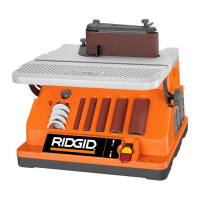
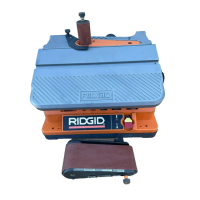
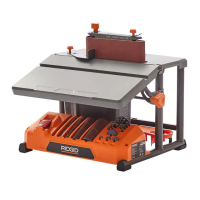
The RIDGID EB4424 Oscillating Edge Belt/Spindle Sander is a versatile woodworking tool designed for sanding various shapes and edges with precision and efficiency. It combines the functionality of an edge belt sander and a spindle sander, allowing users to switch between modes to suit different project requirements. The oscillating action of both the belt and spindle helps to prevent burning of the workpiece and extends the life of the abrasive.
Function Description:
The primary function of this sander is to remove material and smooth edges on wood workpieces. It achieves this through two main abrasive mechanisms: an oscillating sanding belt and oscillating sanding drums (spindles).
In edge belt sanding mode, a 4-inch by 24-inch sanding belt moves continuously in a clockwise direction while also oscillating vertically. This mode is ideal for surface sanding, end sanding, and working on longer, straighter edges. The backstop provides support for the workpiece, and its adjustability allows for precise control over the sanding depth. The oscillating motion ensures that the entire surface of the belt is utilized, preventing grooves and uneven wear, and reducing heat buildup on the workpiece.
In spindle sanding mode, various sizes of sanding drums (spindles) with corresponding abrasive sleeves are used. These drums also oscillate vertically while rotating, making them perfect for sanding curved edges, intricate shapes, and internal contours. The interchangeable drums, ranging from 1/2 inch to 2 inches in diameter, allow for adaptability to a wide range of workpiece sizes and curve radii. Spacer ring inserts are used to minimize the gap between the sanding sleeve and the table, preventing small pieces from getting wedged.
The tool is equipped with a 3/8 HP AC motor that provides sufficient power for typical woodworking tasks. The motor's relay start mechanism ensures reliable operation. A dust collection port is integrated into the design, allowing for connection to a wet/dry vacuum to keep the work area clean and reduce airborne dust, which is crucial for both safety and maintaining a clear view of the workpiece.
Usage Features:
The RIDGID EB4424 sander is designed with several features to enhance user experience, safety, and precision:
- Dual Sanding Modes: The ability to easily switch between edge belt and spindle sanding modes makes this a highly adaptable tool for various sanding applications, from large flat surfaces to intricate curves.
- Oscillating Action: The oscillation feature is a key advantage, distributing wear evenly across the abrasive surface and preventing the workpiece from overheating or burning, which is common with non-oscillating sanders.
- Adjustable Front Table: The front table can be tilted for bevel sanding, providing flexibility for angled work. It also features detents for common angles, simplifying setup. The table's alignment with the sanding belt can be adjusted to ensure parallelism, crucial for accurate sanding.
- Interchangeable Sanding Drums and Sleeves: A range of sanding drums (1/2", 3/4", 1", 1-1/2", 2") and corresponding sandpaper sleeves are provided, allowing users to select the appropriate size for the specific curve or detail being sanded.
- Spacer Ring Inserts: These inserts are critical for safety and precision in spindle sanding mode. They fit around the sanding drum, reducing the gap between the abrasive and the table to prevent small workpieces or fingers from getting caught.
- Sanding Belt Tensioning and Tracking: The sander includes a tension lever to easily release and apply tension to the sanding belt, facilitating quick belt changes. A tracking knob allows for fine adjustment of the belt's position to prevent it from running off the drums.
- Backstop: The adjustable backstop provides essential support for workpieces during belt sanding, ensuring stability and control. It can be pivoted out of the way for sanding longer pieces.
- On-Off Switch with Safety Key: The power switch is designed with a locking feature that requires a removable safety key to operate. This prevents unauthorized use, especially by children, and adds an extra layer of safety by allowing the user to disable the tool when not in use or during maintenance.
- Workpiece Feeding Direction: For optimal results and safety, workpieces should always be fed against the direction of the abrasive's rotation (from left to right for spindle sanding, and from right to left against the belt's rotation). This prevents the workpiece from being thrown back.
- On-Board Storage: The sander features convenient on-board storage for various accessories, including washers, spacers, drums, sleeves, and hex wrenches, keeping them organized and readily accessible.
- Mounting Options: The sander can be securely bolted to a workbench or clamped to sawhorses, providing stable support during operation. Rubber feet are also included for basic tabletop use, though secure mounting is recommended for heavy-duty tasks.
Maintenance Features:
Proper maintenance is essential for the longevity and safe operation of the RIDGID EB4424 sander. The manual outlines several key maintenance practices:
- Regular Cleaning: Frequent cleaning of sawdust and debris from the table recess and inside the unit is crucial. Sawdust buildup can interfere with the oscillation mechanism and lead to premature wear or motor damage. The dust collection port helps manage this, but manual cleaning is also necessary.
- Motor Ventilation: The motor should be periodically blown out or vacuumed to prevent sawdust from accumulating and obstructing ventilation, which could lead to overheating.
- Lubrication: All bearings in the tool are self-lubricating and do not require additional lubrication, simplifying maintenance.
- Cord Inspection: The power cord should be regularly inspected for wear, cuts, or damage. Any damaged cord must be replaced immediately by a qualified service technician to prevent electrical hazards.
- Part Inspection: Before each use, the sander should be inspected for alignment of moving parts, binding, broken or damaged components, and loose fasteners. Any issues should be addressed before operating the tool.
- Abrasive Replacement: Sanding belts and sleeves should be replaced when they show signs of wear, such as grooves, tears, or rips, to ensure effective sanding and prevent damage to the workpiece or tool.
- Electrical System Maintenance: Any repairs to the electrical system must be performed by qualified service technicians to ensure safety and adherence to factory specifications.
- Troubleshooting Guide: The manual includes a comprehensive troubleshooting guide to help users identify and resolve common issues, such as excessive noise, motor stalls, or improper sanding performance.



 To Next Page

 General