Need help?
Do you have a question about the RIDGID R84001 and is the answer not in the manual?
Overview of the tool's design priorities for usability and safety.
Guidelines for maintaining a safe and clear workspace.
Rules for safe use of battery-powered tools and chargers.
Essential safety measures for the operator's well-being.
Proper methods for operating and maintaining the tool.
Additional safety measures for tool operation.
Specific safety instructions for battery-powered tools.
Critical warnings for safe charger operation and maintenance.
Requirements for using extension cords with the charger.
Procedures for handling damaged chargers and service.
Definitions of symbols related to electrical units and measurements.
Explanations of symbols indicating safety precautions and warnings.
Technical details and measurements of the drill-driver.
Steps for safely unpacking the tool and checking contents.
List of items included in the tool package.
Various tasks and materials the drill-driver is designed for.
How to use the hand-tightened chuck for bits.
Details on the variable speed switch and trigger lock.
Explanation of the two speed settings for drilling/driving.
How to use the forward/reverse selector for rotation.
Information on the included auxiliary handle for stability.
Location and use of the onboard bit storage.
How to store the charger conveniently.
Instructions and tips for charging the battery pack.
Guidelines for charging batteries that have been in use.
Procedures for charging batteries below normal temperature.
Explanation of the charger's LED lights and their meanings.
Steps for safely inserting and removing the battery pack.
How to operate the trigger switch and adjust speed.
How to change drill rotation direction and speed settings.
Instructions for attaching and adjusting the auxiliary handle.
Procedures for securely fitting and removing drill bits.
How to adjust torque for different driving tasks.
Using the built-in storage for drill bits.
Step-by-step guide for performing drilling operations.
Steps for removing, installing, and fixing the drill chuck.
Basic cleaning and care for the tool's exterior.
Tips for battery longevity and proper disposal/recycling.
Details of the limited service warranty coverage.
Policy for returns and exchanges within 90 days.
How to obtain service and warranty repairs.
What is not covered by the warranty and legal disclaimers.
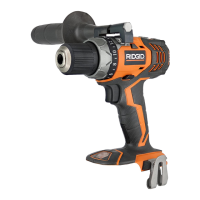
This document is an operator's manual for a RIDGID 3/8 inch 18 Volt Drill-Driver, model R84001. It provides comprehensive instructions for safe operation, maintenance, and troubleshooting, ensuring years of rugged, trouble-free performance. The manual emphasizes safety precautions, proper tool usage, and care to reduce the risk of injury and extend the tool's lifespan.
The drill-driver is designed for versatility, featuring a two-speed gear train for optimal performance in various applications. It can be used for drilling in wood, ceramics, plastics, fiberglass, laminates, and both hard and soft metals. Additionally, it is suitable for driving screws with screwdriver bits and mixing paints, making it a valuable tool for a wide range of tasks.
One of the key features of this drill-driver is its keyless chuck, which allows for easy hand tightening or release of drill bits. This eliminates the need for a chuck key, streamlining bit changes and improving efficiency. The tool is equipped with a variable speed switch, providing greater control over drilling and driving applications. The speed and torque increase with trigger pressure, allowing users to adapt to different materials and tasks.
For enhanced safety, the drill-driver includes a switch lock feature that secures the switch trigger in the OFF position, preventing accidental starting when not in use. The forward/reverse selector, conveniently located above the switch trigger, allows for quick changes in the direction of rotation, which is essential for both drilling and driving. This selector also serves as a lock-off mechanism when placed in the center position.
The two-speed gear train is a significant advantage, offering a LO (1) speed range for high power and torque applications, and a HI (2) speed range for faster drilling and driving. A slide switch on top of the drill allows users to easily select the desired speed. This adaptability ensures that the tool can handle a variety of materials and tasks efficiently.
An auxiliary handle is included with the drill for improved ease of operation and to prevent loss of control, especially during high-torque applications. The handle can be adjusted to the desired angle by turning its clamping ring, providing a secure and comfortable grip. The manual stresses the importance of periodically checking the handle's tightness to prevent thread damage and maintain control.
The drill-driver also features an adjustable torque clutch with 24 settings, allowing users to precisely control the torque for driving different types of screws into various materials. This prevents overtightening and damage to fasteners or workpieces. The settings range from 1-4 for small screws, 5-8 for screws into soft material, 9-12 for screws into soft and hard materials, 13-16 for screws in hard wood, 17-20 for large screws, and 21- for heavy drilling.
For convenience, the drill-driver has a bit storage area located at the rear of the motor housing, where the provided double-ended bit can be kept when not in use.
The battery pack for this tool utilizes nickel-cadmium rechargeable batteries, designed for maximum trouble-free life. The manual provides detailed instructions on charging the battery pack, including information on normal charging, handling hot battery packs, and cool battery packs. It advises charging the battery pack only with the specified charger and emphasizes the importance of proper charging conditions to prolong battery life. The charger itself features a "key hole" for space-saving storage.
Maintenance instructions include general cleaning practices, emphasizing the importance of keeping the tool dry, clean, and free from oil and grease. It warns against using brake fluids, gasoline, or strong solvents, as these can damage plastic parts. The manual also provides detailed steps for chuck removal and retightening, which may be necessary for certain accessories or if the chuck becomes loose.
Safety is a paramount concern throughout the manual. It highlights general safety rules such as keeping the work area clean, avoiding explosive atmospheres, and keeping bystanders away. Electrical safety rules for battery-operated tools are provided, including guidelines for charging and handling battery packs. Personal safety measures, such as staying alert, dressing properly, and wearing eye protection, are strongly emphasized. The manual also includes specific warnings regarding foreign objects being thrown into eyes, binding or bit breakthrough during drilling, and the proper disposal and recycling of nickel-cadmium batteries.
The manual concludes with warranty information, outlining the RIDGID 3-Year Limited Service Warranty, which covers defects in workmanship or materials and normal wear items. It also details a 90-Day Satisfaction Guarantee Policy and provides instructions on how to obtain service. Customer service information, including a toll-free number and website, is provided for assistance with parts, service, and authorized service center locations.
 General
| Voltage | 18V |
|---|---|
| Battery Type | Lithium-ion |
| Chuck Size | 1/2 inch |
| Speed Settings | 2 |
| Chuck Type | Keyless |
| Brushless Motor | Yes |
| Length | 8.5 inches |


 To Next Page