Column
Charact
er
istic X-rays
X-rays are generated by accelerating elec
tr
ons to very high speeds
in
a vacuum and dir
ec
ting them against the
anode (target
).
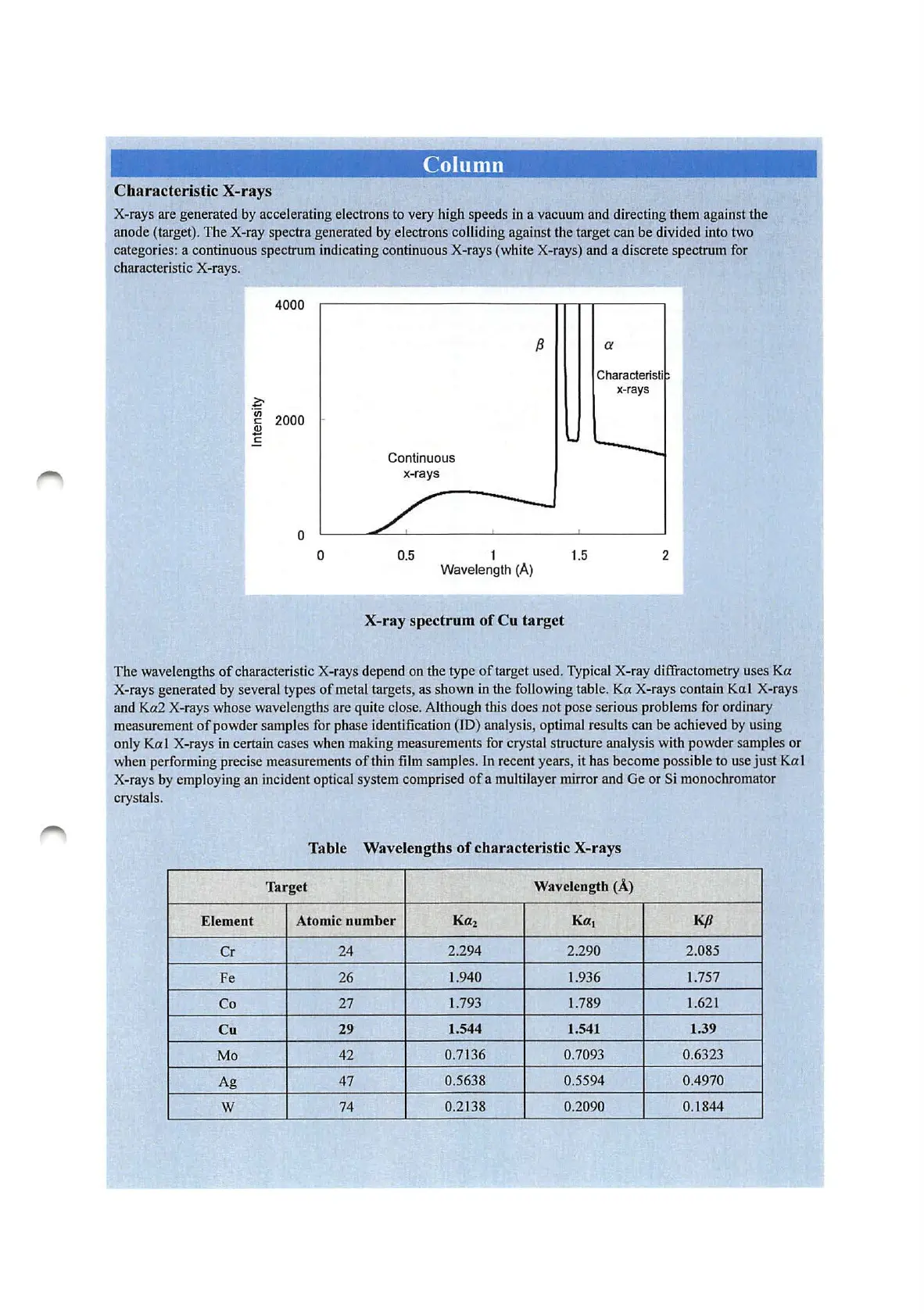
The X-ray spectra generated by elec
tr
ons colliding against the target can be divided into two
categories: a continuous spectrum indica
ti
ng
co
ntinuous X
-r
ays (white X-rays) and a discrete spectrum for
ch
ar
acteristic X-rays.
40
00
~
·~ 2000
.l!!
c
0
0
/3
a
Continuous
x-rays
0
.5
1
Wavelength (A)
X-ray spectrum
of
Cu t
ar
get
1.5
Characterisli
x-rays
2
The
wa
velengths of characteri
st
ic X-rays depend on the type
of
target used. Typical X-ray diffractometry uses Ka
X
-r
ays generated by several types
of
metal targets,
as
shown in the foll
ow
ing table.
Ka
X-rays
co
ntain
Ka
i X-rays
and
Ka2 X
-r
ays whose wavelengths are quite close. Although th
is
does not pose
se
ri
ous problems for ordinary
measurement
of
powder samples
fo
r phase identifica
ti
on
(ID
) analysis, optimal results can be achieved by using
onJy
Ka
i X
-r
ays in certain cases when making measurements for crystal struc
tu
re analysis with powder samples or
when performing precise measurements
of
thin film
sa
mples.
In
recent years, it has become possible to use just
Ka
I
X
-r
ays by em
pl
oying an incident optical system comp
ri
sed
ofa
multilayer mirror and Ge or Si monochromator
crystals.
Table Wavelengths
of
ch
ara
cterist
ic
X-
rays
T
ar
g
et
Wavelen
gt
h (A)
Element
Atomic
num
b
er
K
a2
Ka
1
KfJ
Cr
24
2.294 2.290 2.085
Fe
26 1.940
1.
936
1.
757
Co
27
1.
793
1.789 1.621
Cu
29
1.544 1.5
41
1.39
Mo
42
0.71
36
0.7093 0.6323
Ag
47
0.5638 0.5594 0.4970
w 74
0.21
38
0.2090 0.1844



 To Next Page