Need help?
Do you have a question about the Riley RS3 and is the answer not in the manual?
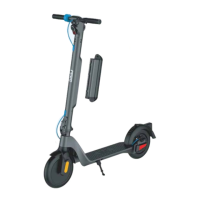
This document is the user manual for the Riley RS3 Electric Scooter, a British-designed e-scooter aimed at providing a viable, smarter, and cleaner urban transportation solution.
The Riley RS3 is an all-electric scooter designed for urban transportation. It features a detachable battery, allowing for convenient charging and potentially extended range with a spare battery. The scooter is equipped with a throttle for acceleration, a brake lever for stopping, and a rear fender that can be used to assist braking. It offers three riding modes: Beginner (10km/h limit), Normal (15km/h limit), and Sports (25km/h limit), which can be switched via a function button. Headlights and tail lights are integrated for visibility, and a cruise mode can be activated by maintaining a set speed for 6 seconds. The scooter is foldable for easy storage and transport. An accompanying Riley Scooter App connects via Bluetooth, offering features like key riding info, scooter lock and trace, and ride tracking.
The RS3 is designed for ease of use and safety. Riders are recommended to be 14+ years old. Assembly involves unfolding the stem, securing the folding spanner, and clicking the handlebars into place. Folding is a reverse process, allowing the scooter to be compact for storage. The detachable battery can be easily uninstalled and installed by pushing a clip and sliding it in or out of the stem. To ride, users press the power button for two seconds, place one foot on the base plate, push off with the other leg, balance both feet, and then gently press the throttle to accelerate. Turning is achieved by rotating the handlebars. Braking is done by applying pressure to the brake lever, with the option to assist by lightly stepping on the rear fender. Safety precautions include wearing sportswear, a helmet, knee pads, and elbow pads. Riders are advised not to ride with a load, with more than one rider, or if pregnant. It's crucial to avoid riding after consuming alcohol or medicine, and to be cautious on uneven, loose, slippery surfaces, slopes, stairs, and poorly lit areas. The scooter should not be submerged in water. Listening to music while riding is discouraged.
Regular maintenance ensures the longevity and performance of the RS3. Before riding, users should check the tyres for damage and ensure all fixings are tight. Tyre pressure should be maintained at 35 P.S.I. (2.41 Bar). The brake system and tyres should be checked at least once a month. For cleaning, the shell can be wiped with a soft damp cloth to remove dust and dirt, which can impact performance. The e-scooter should not be cleaned with a jet wash or by soaking it in water, as this can cause permanent damage. For storage, the e-scooter should be charged before storing and at least once every three months. It should be kept indoors in a dry place at an appropriate temperature. Charging should not occur if the storage temperature is below 0°C. Battery safety is paramount: the battery should not be disassembled, opened, or have anything inserted into it. In case of a leak or overheating, the battery should not be used or charged, and the manufacturer should be contacted. Exhausted batteries must be taken to an approved battery recycle centre, not thrown in general rubbish. Only the original charging equipment should be used. The battery should not be charged at high temperatures or in a high-temperature environment. Children should only clean and maintain the e-scooter under adult supervision. Any conversion of the e-scooter is prohibited as it may cause serious injury and invalidate the warranty.

 To Next Page
 General