Need help?
Do you have a question about the Rinnai R94LSI and is the answer not in the manual?
Crucial warning about fire or explosion risk if instructions are not followed exactly.
Step-by-step guide on what to do if you smell gas, including immediate actions and contact information.
Detailed comparison of Rinnai models R50LSi, R75LSi, R94LSi, R98LSi, and R98LSi-ASME specifications.
Explains safety alert symbols like DANGER, WARNING, and CAUTION used in the manual.
Guidelines for safe usage including clearance, grounding, and avoiding water submersion.
Details on the appliance's safety features like Overheat, Flame Failure, Power Failure, and Fuse protection.
Explains the continuous hot water supply, direct vent system, and electronic ignition features.
Overview of features available on Rinnai temperature controllers like Call, Clock, Error Codes, and ON/OFF functions.
Details on the standard and commercial temperature controllers, including dimensions and integration.
Description and layout of the BC-100V wireless temperature controller, highlighting its water-resistant feature.
Description and layout of the MC-100V wired temperature controller, showing its functions and display.
Step-by-step guide on using the Priority button and Temp buttons to set desired water temperature.
How to set temperature to 140°F or 120°F using dip switches when no controller is installed.
Table showing the temperature ranges available for different Rinnai models.
Recommendations for kitchen, shower, and bath fill temperatures, with notes on mixing hot and cold water.
Instructions on how to adjust the voice prompt volume using the Function or Sound Vol. buttons.
Explains the exclusive BC-100V feature for filling a tub with a preset volume and temperature.
Table showing the limited temperature settings available for the bath fill function.
Steps to set the desired water volume (10-120 gallons) for the bath fill function using the controller.
Detailed steps on how to initiate and complete the bath filling process using the controller.
How to enable or disable key press beeps by holding specific buttons on MC-91 and MCC-91 controllers.
Instructions to set the clock using the Function and arrow buttons on the MC-100V controller.
Steps for cleaning the appliance, including electrical disconnection, filter cleaning, and using pressurized air.
Guidance on inspecting the vent system annually and cleaning the motors for dust and dirt.
Tips for scale build-up (LC error) and visual checks for satisfactory flame patterns.
Lists common error codes and their corresponding faults and suggested remedies.
Details on additional error codes and their faults and troubleshooting steps.
Addresses issues like no hot water, water getting cold, or immediate lack of hot water after opening tap.
Guidelines for water quality testing and how to retrieve operating data from the controller.
Detailed step-by-step instructions for flushing the heat exchanger using vinegar or citric acid to remove scale.
Emphasizes the need for qualified installers and Rinnai's recommendation for product knowledge classes.
Covers requirements for materials, location, ventilation, electrical grounding, and gas supply testing.
Table detailing required clearances from the appliance to combustible and non-combustible materials.
Instructions on how to securely attach the water heater to the wall using the provided brackets.
Specifies the need for a standard 3-prong 120 VAC, 60 Hz grounded wall outlet for the unit.
Guidelines for installing gas lines, including manual shutoff valves, gas type verification, and leak testing.
Explains how to determine cubic feet per hour and use sizing tables for natural gas and propane supply lines.
Requirements for water control valves, approved piping, and purging debris from water lines.
Details on selecting, installing, and testing an approved pressure relief valve according to standards.
Information on built-in freeze protection and the recommendation for optional auto drain down solenoid valves.
Illustrates the recommended piping setup for freeze protection, including solenoid valves and vacuum breaker.
Diagram showing the recommended piping for a basic installation, including gas and water connections.
Diagram illustrating piping for circulation systems, including pump control and return line connection.
Diagram for optional circulation systems, noting warranty implications and storage tank usage.
Rules for direct vent system components, installation, and support of vent runs.
Instructions for managing condensate formation, including drain pipe requirements and the use of condensate collectors.
How to calculate maximum vent length based on the number of 90-degree elbows and dip switch settings.
Lists tested vent products by manufacturer for different Rinnai models and contact information.
Table detailing required clearances for flue terminals in Canadian and US installations based on ANSI/CSA standards.
Visual guide for vent terminal placement, showing clearances to corners, soffits, and other terminals.
Illustrates horizontal venting with and without a condensate collector, noting height and elbow limitations.
Details requirements for vertical terminations, emphasizing condensate collector use and adjustment procedures.
Instructions for assembling and connecting the 4-inch diameter air intake system, noting zero clearance to combustibles.
Diagram showing horizontal termination for intake and exhaust, including slope and grade clearance requirements.
Diagram illustrating horizontal venting with concentric termination, showing slope and grade clearances.
Diagrams showing vertical termination requirements for intake and exhaust pipes, including clearances.
Table and diagrams showing dip switch settings (2 and 3) required for different altitude ranges.
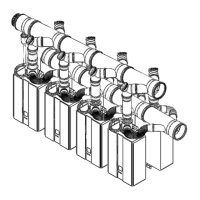
Information on using EZConnect™ and MSA accessories to connect multiple water heaters and operational guidelines.
Guidelines for controller placement and how up to 4 controllers can be wired in parallel, with example combinations.
Specifications for the temperature controller cable, including gauge and maximum allowable lengths based on the number of controllers.
Step-by-step instructions for mounting MC-91 or MCC-91 controllers, including cable routing and connections.
Critical safety warnings and procedures before operating the appliance, including gas leak response.
Step-by-step guide for turning on the appliance, setting the thermostat, and opening a hot water tap.
Instructions for safely shutting off the gas supply to the appliance when necessary.
Graph showing pressure loss in psi versus water flow rate in GPM for different Rinnai models.
Graph illustrating outlet flow in GPM versus delta T (temperature rise) for different Rinnai models.
Guidelines for using the water heater for potable water heating and space heating, including piping and mixing valve requirements.
Warning against using iron components in space heating applications due to potential clogging of the inlet filter.
Tables providing detailed dimensions (width, depth, height, connection locations) for Rinnai models.
Visual representation of the appliance's electrical components and their interconnections, including CPU and sensors.
Fields for recording purchase and installation details to keep for warranty records.
Details on what the warranty covers (defects) and the coverage periods for residential and commercial applications.
Explains what Rinnai will do for warranty claims and how to obtain service, including exclusions.
Lists items not covered by warranty (e.g., improper installation, accident) and limitations on implied warranties.
Highlights key features of Rinnai tankless water heaters, such as efficiency and digital temperature control.
Information on Rinnai's direct vent furnaces and fireplaces, including efficiency and installation features.
Details on Rinnai's hydronic air handlers designed for Rinnai systems, including features like programmable thermostats.
 General
| Type | Tankless |
|---|---|
| Energy Factor | 0.82 |
| Category | Residential |
| Venting | Direct Vent or Power Vent |
| Fuel Type | Natural Gas |
| Temperature Range | 98°F to 140°F (adjustable) |
| Gas Type | Natural Gas |
| Maximum BTU Input | 199, 000 BTU/hr |
| Warranty | 12 years heat exchanger, 5 years parts, 1 year labor |


 To Next Page