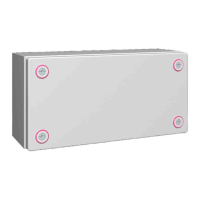
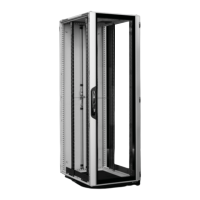
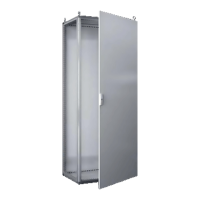
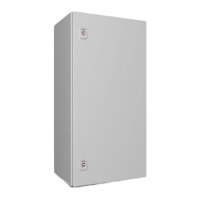
The Rittal AE enclosure system is designed for a wide range of industrial applications, offering robust protection for electrical and electronic components. These enclosures are built to house power distribution, climate control, and IT infrastructure, ensuring reliable operation in various environments. The "Faster – better – worldwide" slogan emphasizes Rittal's commitment to efficient, high-quality, and globally available solutions.
Function Description
The Rittal AE enclosures serve as protective housings for sensitive equipment, shielding them from dust, water, and mechanical impact. They are designed for both indoor and outdoor use, depending on the specific model and its ingress protection (IP) rating. The modular design allows for flexible configuration and easy integration of various components such as mounting plates, gland plates, and cable entry systems. The enclosures facilitate organized wiring and component installation, contributing to system reliability and ease of maintenance.
Important Technical Specifications
The manual provides detailed technical data for various AE enclosure models, including dimensions, volume, mounting plate thickness, and load capacities.
- Dimensions (Width x Height x Depth): Enclosures are available in a wide range of sizes, from compact units like 200x300x120 mm (AE 1032.500) to larger models such as 1000x1400x300 mm (AE 1114.500).
- Volume: The internal volume varies significantly with the dimensions, ranging from 7.20 liters for the smallest model to 420.00 liters for the largest.
- Mounting Plate Thickness: Mounting plate thicknesses are typically 2.0 mm, 2.5 mm, or 3.0 mm, depending on the enclosure size and intended load.
- Load Capacity:
- Total Load (Entirely): Ranges from 900 N for smaller enclosures (e.g., AE 1032.500) to 3000 N for larger ones (e.g., AE 1213.500).
- Mounting Plate Load: Ranges from 600 N to 2500 N.
- Door Load: Ranges from 250 N to 400 N.
- Thermal Energy Dissipation (W): The manual includes a table detailing the thermal energy dissipation for various models under different conditions (W (Delta/T = 20 K)). For example, an AE 1032.500 can dissipate 23 W, while an AE 1114.500 can dissipate 407 W. These values are crucial for thermal management and ensuring the longevity of internal components.
- Degrees of Protection (Schutzgrad):
- IP Rating (IEC 60529): Most AE enclosures are rated IP66, indicating complete protection against dust ingress and protection against powerful water jets. Some models, particularly larger ones, are rated IP55, offering protection against dust ingress (not entirely dust-tight) and protection against low-pressure water jets from any direction.
- IK Rating (DIN EN 50102): All listed models have an IK08 rating, meaning they are protected against 5 joules of impact (equivalent to the impact of a 1.7 kg mass dropped from 300 mm).
- NEMA Rating (NEMA-Standards Publication Nr. 250): Most models are NEMA 4 rated, providing protection against windblown dust and rain, splashing water, and hose-directed water, and are undamaged by the formation of ice on the enclosure. Some IP55 models are NEMA 12 rated, offering protection against circulating dust, falling dirt, and dripping non-corrosive liquids.
- Transport Load Capacity (Eyebolt):
- For symmetrical loading, the permissible load is 3200 N at a 60° angle from vertical (F) or 2400 N at a 45° angle from vertical (F).
- For symmetrical loading with a transport eyebolt (SZ 2509.000), the permissible load is 2000 N.
- For asymmetrical loading, the permissible load vertically upwards (F) per eyebolt (SZ 2509.000) is 2000 N.
Usage Features
- Mounting and Operating Instructions: The manual provides comprehensive instructions for assembly, operation, and maintenance in multiple languages (German, English, French, Italian, Spanish, Portuguese, and Japanese).
- Door Hinge Swapping: Detailed steps are provided for swapping door hinges in both single and double-door configurations, allowing for flexible door opening directions (e.g., 180° opening). This feature enhances accessibility depending on the installation environment.
- Cam Lock Conversion: Instructions are included for converting the cam lock, which is important for security and access control.
- Mounting Plate and Gland Plate Installation: Clear guidance is given for installing mounting plates and gland plates, essential for securing internal components and managing cable entries.
- Earthing Connection: The manual emphasizes the importance of proper earthing connections for safety, providing instructions for connecting the protective conductor.
- Flange Plate Installation: Instructions for installing flange plates are provided, which are used for specific cable entry requirements.
- Sealing Bungs: The use of sealing bungs is detailed to maintain the enclosure's IP rating.
- Transport: The manual illustrates proper methods for transporting the enclosures, including using pallets and securing the units to prevent damage. It also highlights incorrect transport methods to avoid.
- Load Table: A load table is provided for proper setup and loading, ensuring the enclosure's stability and safety.
- Installation/Setting Up: Instructions for setting up the enclosure are included, likely covering aspects like leveling and securing to the floor or wall.
Maintenance Features
- Torque Specifications: The manual specifies torque values for various fasteners (e.g., M8 x 30, M6 x 25, M6 x 12, M5 x 6, M5 x 12, M5 x 24, M4 x 8), ensuring correct and secure assembly. For example, the door hinge screws require a torque of 2.2 Nm, while the gland plate screws require 2.5 Nm. Specific torque values are also given for different components like the cam lock (8 Nm or 4 Nm depending on the model) and the earthing connection (10 Nm).
- Tool Requirements: The manual indicates the necessary tools, such as PH2 screwdrivers, PZ2 screwdrivers, and wrenches (SW 10, SW 13).
- Regular Checks: While not explicitly detailed as a "maintenance section," the emphasis on correct assembly, torque values, and sealing implies the need for regular checks to ensure the enclosure maintains its protective qualities over time. The high IP and IK ratings suggest that the enclosures are designed for durability and minimal maintenance under normal operating conditions, but proper installation is key to achieving this.
- Notes Section: Dedicated pages for "Notizen / Notes" are included, allowing users to record specific maintenance schedules, observations, or modifications relevant to their installation.

 Need help?




 To Next Page
 General