FS Pag. 60 Rev 00 02/12
UK
TELEMANAGEMENT SYSTEM
Enables monitoring and programming of the Blocksystem FS via a PC or data recorder. It gives the possibility of advanced
management (communication via modem or GSM) of all the Blocksystem FS alarms.
8
8
.
.
F
F
a
a
u
u
l
l
t
t
s
s
s
s
e
e
a
a
r
r
c
c
h
h
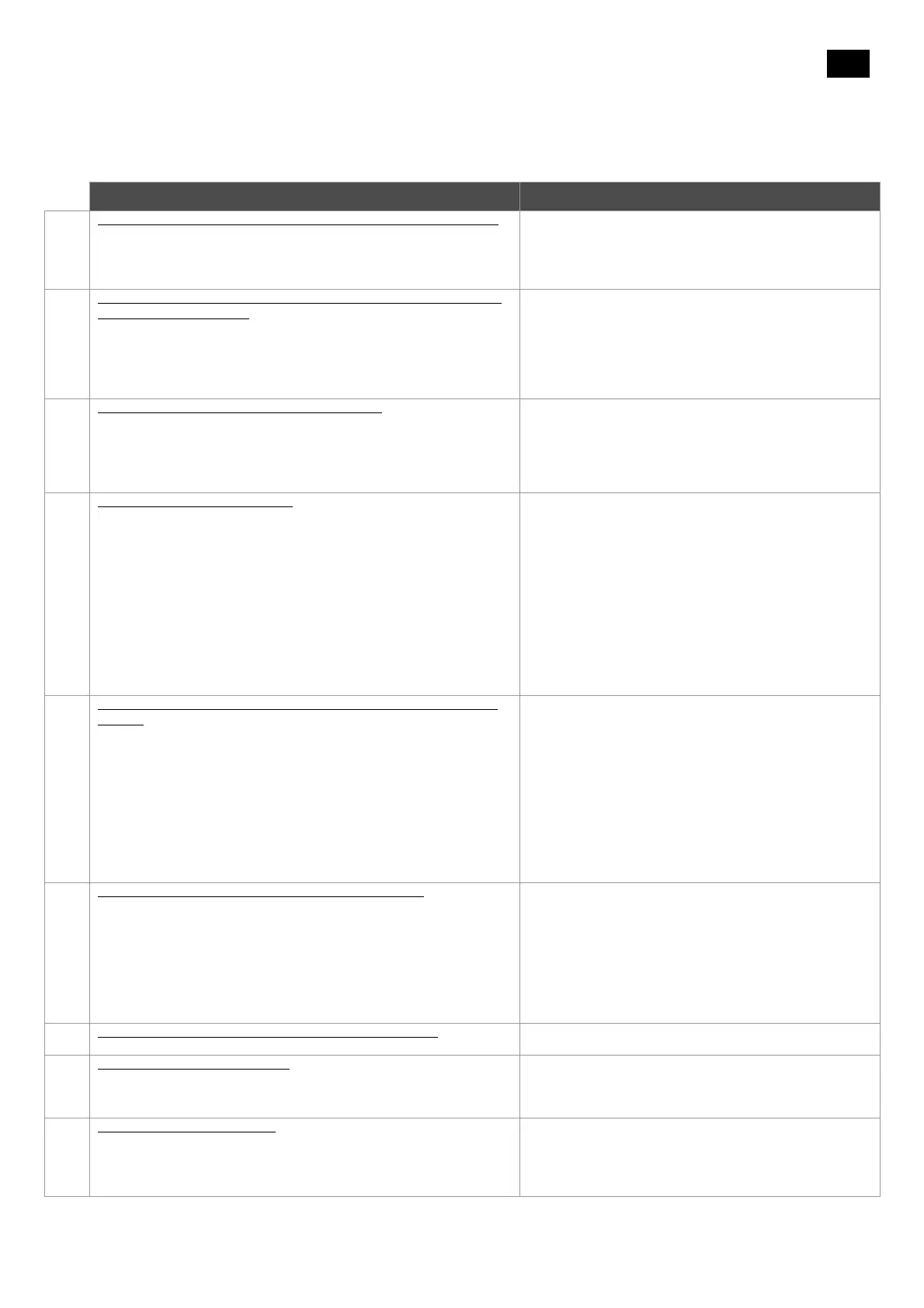
POSSIBLE CAUSES SOLUTIONS
A
The compressor does not start up and does not release a humming sound
1 Lack of voltage. Start-up relay with open contacts.
2 Thermal protector is intervening.
3 Loose electrical connections or wrong electrical connections.
1 Check the supply line or substitute the relay.
2 Check the electrical connections.
3 Tighten the connections or carry them out again in
compliance to the electrical wiring diagram.
B
The compressor does not start up (but releases a humming sound) and the
thermal protector intervenes
1 Wrong electrical connections.
2 Low voltage supply to the compressor.
3 Faulty start-up of the condenser.
4 The relay doesn’t close.
5 The winding on the electrical motor is interrupted or in short circuit.
1 Re-do the connections.
2 Identify the cause and eliminate it.
3 Identify the cause and replace the condenser.
4 Identify the cause and substitute the relay if necessary.
5 Substitute the compressor.
C
The compressor starts up, but the relay doesn’t open
1 Wrong electrical connections.
2 Low voltage supply to the compressor.
3 Relay blocked in closure.
4 Excessive discharge pressure.
5 The winding on the electrical motor is interrupted or in short circuit.
1 Check the electrical circuit.
2 Identify the cause and eliminate it.
3 Identify the cause and eliminate it.
4 Identify the cause and substitute the relay if necessary.
5 Replace the compressor.
D
Intervention of the thermal protector
1 Low voltage supply to the compressor (unbalanced phases on the tri-
phase motors).
2 Defective thermal protector.
3 Defective electric-run condenser.
4 Excessive discharge pressure.
5 High suction pressure.
6 Overheated compressor, hot return gas.
7 Winding of the compressor motor in short circuit.
1 Identify the cause and eliminate it.
2 Check its characteristics and replace it if necessary.
3 Identify the cause and eliminate it.
4 Check the ventilation and any potential restrictions or
obstructions in the system circuit.
5 Check the sizing of the system. Replace the condensing
unit with a more powerful one, if necessary.
6 Check the refrigerant load; if need be, repair the loss
and add gas if necessary till the charge stated in the
label.
7 Replace the compressor.
E
The compressor starts up and circulates, the functioning cycles are of brief
duration
1 Thermal protector.
2 Thermostat.
3 Intervention of the high pressure switch, due to the insufficient cooling
of the condenser.
4 Intervention of the high pressure switch, due to the excessive load
of refrigerant gas.
5 Intervention of the low pressure switch, due to the scarce load of
refrigerant gas.
6 Intervention of the low pressure switch, due to the restriction or
clogging of the expansion valve.
1 See previous point (thermal protector intervention).
2 Small differential; correct the regulation.
3 Check the correct functioning of the motor fan or clean
the condenser.
4 Reduce the load of refrigerant gas.
5 Repair the loss and add refrigerant gas.
6 Replace the expansion valve.
F
The compressor operates uninterruptedly or for long periods
1 Scarce load of refrigerant gas.
2 Thermostat with contacts locked in closure.
3 System not sufficiently sized in function of the load.
4 Excessive load to cool or insufficient insulation.
5 Evaporator covered with ice.
6 Restriction in the system circuit.
7 Clogged condenser.
1 Repair the loss and add refrigerant gas till the charge
stated in the label.
2 Replace the thermostat.
3 Replace the system with a more powerful one.
4 Reduce the load and improve insulation, if possible.
5 Perform defrosting till the charge stated in the label .
6 Identify the resistance and eliminate it.
7 Clean the condenser.
G
Electric-run condenser damaged, interrupted, or in short circuit
1 Wrong electric-run condenser.
1 Replace the condenser with the correct type.
H
Start-up relay defective or burnt out
1 Wrong relay.
2 Relay mounted in the incorrect position.
3 Wrong lectric-run condenser.
1 Replace the relay with the correct one.
2 Re-assemble the relay in the correct position.
3 Replace the condenser with the correct type.
I
Cold-room temperature too high
1 Thermostat regulated too high.
2 Undersized expansion valve.
3 Undersized evaporator.
4 Insufficient air circulation.
1 Regulate it correctly.
2 Replace the expansion valve with a suitable one.
3 Replace it, increasing the surface of the evaporator.
4 Improve air circulation,


 To Next Page
 Loading...