Need help?
Do you have a question about the Rocket Espresso Boxer 2 and is the answer not in the manual?
Step-by-step guide for preparing a single cup of espresso using programmed portions.
Step-by-step guide for preparing two cups of espresso using programmed portions.
Instructions for dispensing espresso using semi-automatic controls.
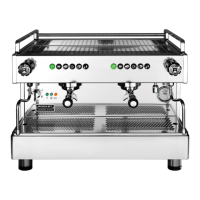
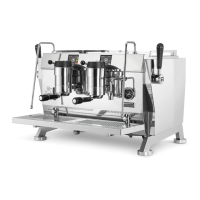
The Rocket Boxer series espresso machine is designed for professional use, offering automatic portion control for brewing espresso and dispensing hot water, along with steam for frothing or heating liquids. It is available in both 1-group and 2-group configurations, each equipped with automatic portion control for consistent beverage preparation.
The primary function of the Rocket Boxer series is to produce espresso, hot water, and steam for various hot beverages. The machine features an electronic control board that manages automatic coffee and hot water portion dispensing. For espresso, users can select between one-cup and two-cup portions, with the machine automatically stopping the flow once the programmed quantity is reached. A semi-automatic mode is also available, allowing the user to manually stop the coffee dispensing. For hot water, the machine dispenses a programmed quantity and stops automatically, though manual stoppage is also possible. Steam dispensing is controlled via a steam valve, enabling users to froth milk or heat other liquids. The machine includes a pressure gauge to monitor boiler and pump pressure, ensuring optimal operating conditions. An on/off switch controls the machine's power and heating element, with indicator lights providing visual feedback on the machine's status, including power, boiler fill level, and boiler filling activity.
Operating the Rocket Boxer series begins with ensuring proper installation, including opening the water tap and switching on the main electrical supply. The machine's on/off switch has three positions: "0" for off, "1" for on and filling (heating element off), and "2" for heating element on. Upon startup, indicator lights confirm the machine is on and the boiler is filling. Once the boiler is filled and the working pressure (around 0.9 bar) is reached, the machine is ready for use. Before brewing, it is recommended to open and close the steam handle briefly to clear any condensation and avoid milk re-suction into the boiler.
For brewing espresso, users select the appropriate filter handle (one-cup or two-cup) and basket, add the desired amount of ground coffee, tamp it, and secure the filter handle into the brewing group. A cup is placed under the spout, and the corresponding portion key on the touchpad is pressed. The machine then dispenses the programmed quantity of hot coffee. In semi-automatic mode, the user presses a specific key to start dispensing and any coffee portion key to stop it manually. The machine also features a by-pass key for manual operation of one group, overriding the electronic control board.
Hot water dispensing involves positioning the hot water wand's nozzle into a suitable pitcher and pressing the hot water key. The machine dispenses a programmed quantity, stopping automatically, or can be stopped manually by pressing the key again.
Steam dispensing for frothing or heating liquids requires filling a stainless steel pitcher with the liquid, positioning the steam wand's nozzle just below the liquid's surface, and turning on the steam valve. Users should pay attention to hot sprays and close the valve once done. For steaming milk, it is advised to use cold, fresh milk, insert the nozzle into the milk, open the valve rapidly, and lift the pitcher progressively to keep the nozzle below the surface. Once sufficient foam is achieved, the nozzle is submerged to finish heating the milk, ensuring the temperature does not exceed approximately 76°C (168°F) to prevent scalding.
Proper care and maintenance are crucial for the machine's performance and longevity. After each use, the steam wand should be wiped immediately with a non-abrasive damp cloth to prevent milk from baking onto it and to avoid injury from hot surfaces. The steam wand should also be "burped" by opening and closing the steam valve briefly to remove milk residue from the nozzle. Used coffee grounds should be knocked out from the filter holder, which should then be rinsed. It is recommended to store the filter holder in the brewing head to keep it warm, but to remove it when the machine is not in operation for several hours.
Throughout the day, the screens inside the group head should be wiped with a damp clean towel to remove excess grounds, taking care not to touch hot metal parts.
Before shutting down the machine for the night, a back-flushing procedure is recommended. This involves removing the filter basket, fitting a blind filter into the handle, and securing it into the espresso machine. The user then presses the semi-automatic dispensing key (Fig. 3-1) for 15 seconds and switches it off. This process pushes fresh brewing water back through the group head and out through the exhaust solenoid valve, cleaning the brewing group. This procedure should be repeated several times until the discarded water is clean and fresh. Weekly, a small amount of special detergent for espresso machines can be added to the blind filter during this process, ensuring all detergent residues are washed away afterwards.
For operations requiring the machine to be switched off, unplugged, and completely cooled down, users should clean showers, group gaskets, and group flanges with a dedicated clean brush. The filter holder and metal filter baskets should be removed and cleaned with a pot scourer to remove black coffee oils. If excessive oil buildup occurs, soaking these parts in hot water with a special espresso machine detergent for about 30 minutes, followed by thorough rinsing, is recommended. All cleaning products used must be food-grade.
The drip tray and grid should be cleaned with a non-abrasive damp cloth, and the drain tray (located under the drip tray) should be cleaned with a damp cloth and brush. The machine's surface should be wiped with a non-abrasive clean cloth, avoiding aggressive cleaners or scouring powders.
For long-term storage or dismantling, the machine must be switched off, disconnected from mains and water supply, and cooled down. The boiler drain valve should be opened to completely drain the hydraulic systems, especially if storing in temperatures below freezing, to prevent damage from freezing. Dismantling should only be carried out by an authorized technician.
 General
| Type | Commercial Espresso Machine |
|---|---|
| Boiler Type | Heat Exchange |
| Material | Stainless Steel |
| Weight | 30 kg |
| Group Head | E61 |
| Number of Groups | 2 |
| Boiler Material | Copper |
| Pump Type | Rotary |
| Portafilter Size | 58 mm |
| Steam Wand | Yes |
| Hot Water Dispenser | Yes |
| Water Reservoir Capacity | Direct Water Line Connection |
| Voltage | 220-240 V |
| Water Source | Direct Water Line Connection |


 To Next Page