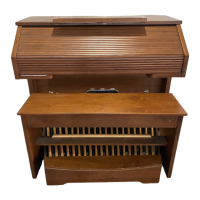
THE
RODGERS WINDSOR
840
The
RODGERS
WINDSOR
840
combines
the
finest
organ
traditions
and
classical tonal
schemes
with current
elec-
tronic
technology
to
give
the
organist
and
the
listener truly
fine
organ
sound.
This
instrument's
design
began
with the
development
of a
comprehensive
specification that
allows
music
from
all
periods
and
performance
schools
to
be
played
in
an
accul'ate
and
authentic
manner
.
.;\LL
RODGERS
ORGANS
are
manufactured
to
console
specifications
set
forth
by
the
American
Guild
of Organists.
These
specifications create auniformity
as
to
cOlnpass
of
keyboards
(61
notes)
and
pedalboard
(32
pedals),
and
the
place-
ment of
keyboards
in
relation
to
the
pedalboard.
The
latter requirement allows
people
of various
sizes
to play
an
organ
comfortably.
There
are
also
specifications for
the
placement
of
stop
tablets
and
couplers.
Rodgers
has
always
adhered
to
these
specifications
in
its
classic
organs
to
provide
comfortable
organs
for all
who
play.
~
Your
organ
contains
the
follo\ving divisions:
The
Great
Organ;
the
Choir/Positiv
Organ;
the
Swell
Organ:
and
the
Pedal
Organ.
Each
division
derives
its
name
from its function
in
the
tonal
scheme
of
the
organ.
The
GREAT
ORGAN
has
the
boldest Principal
(Diapason)
ensemble
and
asolid Flute
ensemble
to support
the
Prin-
cipals.
An
appropriate
word
for
ensemble
is "chorus:'
which
generally
means
that
two
or
more
pitch
levels
(8',4',2',
etc.)
of
a tonal family
are
sounding simultaneously.
There
are
softer accompanimental stops of Flute
and
Principal
tone
which
provide a
subtle
texture to support
the
solo
stops
of
the
Swell
Organ.
The
CHOIR/POSITIV
ORGAN
functions
as
a
secondary
division
to
the
Great
Organ,
and
serves
as
an
expressive
acconlpanimental division
as
well.
Its
resources
include both Principal
and
Flute
ensembles,
enhanced
by
the
addition of
the
Erzahler
Celeste,
and
Krummhorn.
Full couplers
expand
the
resources
of this division.
It
contains bright high-pitched
stops
which
add
clarity to contrapuntal lines
and
are
valuable
in
the
accompaniment of congregational
hymn
singing.
The
name
for
the
SWELL
ORGAN
originated
when
pipes
were
placed
inside
a
special
chamber called a swellbox.
One
side
of
the
swellbox
has
Venetian
shutters
which
are
controlled
by
a
pedal
called
the
S\vell
Pedal.
This
pedal
enables
the
organist
to
control
the
dynamic
level
(loudness
and
softness)
of this division
by
gradually
opening
and
closing the
shutters,
thereby
creating
crescendos
and
decrescendos.
This
was
not
possible
in
earlier
organs,
as
the
dynamics
were
determined solely
by
the
number
of
stops
drawn.
The
modern
Swell
Organ
has
a
secondary
Principal
Chorus,
complete
Flute
Chorus,
Celeste
and
Reed
voices,
and
couplers
at
the
'16'
and
4'
pitches,
which
give
this division large tonal flexibility.
The
PEDAL
ORGAN
was
so
named
because
its
keys
are
played
by
the
feet.
All
Rodgers
Organs
have
a complete
pedal
organ
which
will provide a suitable foundation for
any
manual
registration,
and
provide appropriate
independence
for all literature.
1



 To Next Page