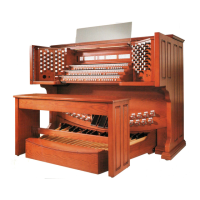
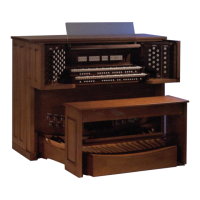
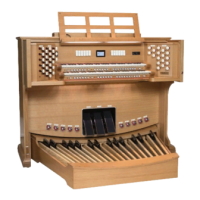
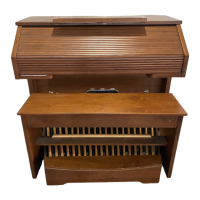
RODGERS HANDCRAFTED
PIPES
At
the
heart of
Rodgers
tradition of organ-making
are
the
pipes,
exquisitely built
to
Rodgers
exacting standards
from
the
finest metals
and
\voods.
Our
techniques
originate \vith old-world
organ
builders,
\vhose
pipe-making
methods
go
back
centuries. Their
expe-
rience
led
to
Rodgers'
integrated
pipe
augmented
designs.
which
combine
time-honored
pipe
practices with electl'onic
technology.
To
preserve
classical pipe-making practices,
we
keep
cut-ups
as
low
as
possible
and
use
low
wind
pressures.
This
allows
the
whole
pipe
to
resonate
with a greater
richness
of
tone,
and
provides a rich palette of harmonics.
Perhaps
the
most
crucial
step
in
pipe
making
is
the
scaling.
Rodgers
metal
pipes
are
variably
scaled,
or
sized,
according to
the
specific requirements for their
role
in
the
tonal
scheme.
Variable
mouths,
cut-ups
and
tapering
are
used
in
the
scaling, tailoring
each
rank
to
its
most
useful
musicality.
The
resulting effect
is
a
sound
much
more
full-bodied and
emphatic
than
the
size
or
number
of ranks
would
suggest.
Finally,
when
all
the
ranks
of
pipes
have
been
completed
and
passed
numerous
inspections,
they
are
ready for
installation.
Under
the
strict supervision of
Rodgers
experts,
pipes
are
voiced
according
to
the
specific characteristics of
their surroundings.
It
is
this
classic
blend
that
rnakes
the
Rodgers
Pipe
Augmented
Organs
stunning masterpieces of visual
and
acoustical art.
SPECIAL FEATURES
TURN-ON/TURN-OFF
To
turn
the
organ
on,
press
the
POWER
switch firmly for a
couple
of
seconds
and
then
release
it.
The
power
switch
will light
up
after a
second
and
the
organ
is
ready
to
play.
To
turn off
the
organ,
press
and
release
the
POWER
switch again.
The
organ
automatically turns itself off if left idle for
more
than
two
hours.
Just
before
turning off,
the
computer
flashes
the
POWER
lamp
as
awarning to
the
organist.
Pressing
any
piston or
key
will
prevent
the
organ
from turning
off
for
another two
hours.
This
feature
prevents
the
organ
from
being
left
on
by
mistake.
COUPLERS
There
are
two
kinds of
couplers
on
your
Rodgers
Organ:
intermanual
and
intramanual
couplers.
The
function of
an
Intermanual
Coupler
is
to
enable
the
stops
of
one
division or
keyboard
to
be
played
on
another
keyboard
or
the
pedalboard.
Examples
of Intermanual
Couplers
are
SWELL
TO
GREAT
8'
and
SWELL
TO
GREAT
4~
Intra-
manual couplers allow
voices
to
be
played
at a different pitch
level
or
levels
on
those
voices'
home
manual. Examples
of
Intramanual
Couplers
are
SWELL
TO
SWELL
16'
and
S\VELL
TO
SWELL
4~Couplers
greatly
increase
the
flexibility of the
WINDSOR
840.
DUAL
MEMORY
COMBINATION ACTION
One
of
the
exciting features of your
Rodgers
Organ
is
its combination
action
which
is
adjustable
by
the
organist
from
the
console.
The
organist
can
select
favorite registrations
and
make
rapid
changes
in
tone
color using this advanced
system.
Rodgers
Microprocessor Combination
Action
is
a specially refined dual
memory
system.
This
gives
the
organist a
total of 20
General
pistons
and
ten
independent
Divisional pistons
each
for
the
Swell,
Great,
Choir/Positiv,
and
Pedal.
The
pistons
can
only
be
set
if
the
organist
possesses
the
proper
code
for unlocking
the
combination action's
memo-
ries.
For
further information
see
the
section
below.
Both
memories
can
be
used
at
any
time,
but
they
can
only
be
changed
if
the
proper
code
is
used.
5



 To Next Page