
 Need help?
Do you have a question about the Rodgers A778 and is the answer not in the manual?
This document is an owner's guide for Rodgers Three Manual Organs, specifically models A778, T908, T928, T958, and T968. It provides comprehensive instructions for operating and maintaining these electronic organs.
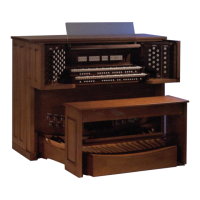
The Rodgers Three Manual Organ is a sophisticated electronic musical instrument designed to emulate the sound and experience of a traditional pipe organ. It features three manuals (keyboards played by the hands) and a pedalboard (keyboard played by the feet), allowing for complex and varied musical performances. The organ utilizes "Dimensional Sound Modeling®" technology to create authentic pipe organ sound and room acoustics, offering extensive control over its tonal and acoustical environment. The "Voice Palette™" system provides access to numerous additional sounds, expanding the instrument's tonal resources beyond the standard stops. These voices can be stored in the organ's memory system, enabling the recreation of various musical styles or individual performances with ease. The instrument is built with hardwoods and veneers, adhering to the standards of the American Guild of Organists.
The organ's operation begins with a simple power-on sequence, initiated by pressing and holding the top of the On/Off rocker switch or the "—" labeled switch until it locks into place. A diagnostic test runs, and the display shows "TRANSPOSER 0" when ready. Powering off involves pressing and holding the bottom of the rocker switch or the "O" labeled switch.
The organ features multiple manuals: the Choir Manual (bottom), Great Manual (middle), and Swell Manual (top), along with a pedalboard. Some models may also include a "Solo division," which is a "Floating division" whose stops can be assigned by the organist.
Stops, which represent individual voices, are activated by "Rocker Tablets" (tabs) or "Drawknobs." Pulling a drawknob or pressing the bottom of a tab activates a stop, while pushing a drawknob or pressing the top of a tab deactivates it. Many stops offer multiple voices through the "Rodgers Voice Palette™" system.
Couplers enhance the organ's versatility. "Intermanual Couplers" allow a division's stops to be played from a different manual or the pedalboard. For example, the "Swell to Great 8'" coupler enables Swell division stops to be played from the Great manual at concert pitch. "Intramanual Couplers" operate within a single division, allowing stops to be played at different pitch levels on the same manual. These include "Sub Couplers" (e.g., "Swell to Swell 16'" for an octave lower) and "Super Couplers" (e.g., "Swell to Swell 4'" for an octave higher). "UNISON OFF" couplers (e.g., "SWELL UNISON OFF") silence notes at unison pitch on their respective manuals, useful for coupling divisions elsewhere without them sounding on their assigned manual.
"MIDI Couplers" (e.g., "MIDI SW A," "MIDI ORCH SW A") are located on thumb pistons beneath the manuals. These allow external sound module sounds or internal orchestral voices (up to 52 on some models) to be played from different organ divisions. Assigning sounds to these pistons involves holding the "SET" piston, pressing the desired MIDI/ORCH piston, then using the "Alpha dial" to select the sound from the "Tones" menu, and finally pressing "STOP" to exit. These settings are remembered if saved to a general or divisional combination piston.
"Combination action pistons" (general and divisional) allow for quick recall of "registrations" (combinations of stops and couplers). "General pistons" affect the entire organ and are found as thumb pistons under the Great and Swell manuals, and as toe pistons near the expression shoes. "Divisional pistons" affect a single division (Great, Swell, Choir, and sometimes Pedal) and are located under their respective manuals or as toe pistons.
To set a piston, the desired stops, couplers, and MIDI settings are selected, then the "SET" piston is held while pressing the target general or divisional piston. Both are then released, storing the new registration.
The organ features an advanced "Combination Memory Levels" system, offering up to 100 independent memory levels, effectively multiplying the available combination pistons. Memory levels can be selected using "M1, M2, M3" pistons or "M+" and "M-" pistons, with the selected level displayed.
The "Console Display" provides information and allows adjustment of various controls and preferences, including "Transposer" settings, MIDI settings, Voice Palette selections, Dimensional Sound Modeling parameters, and Tremulant rate and depth. The "Select knob" navigates menus, and the "Alpha dial" changes settings.
"Expression Shoes" and "Crescendo Shoe" control volume and registration. The left shoe typically controls the Choir division, and the middle shoe controls the Swell and Solo divisions. Pushing a shoe forward increases volume, pulling it back decreases it. The "Crescendo shoe" (rightmost, slightly raised) gradually adds predetermined stops as it's pressed forward, and subtracts them in reverse.
The organ includes "Standard Crescendo" and potentially "Alternate Crescendo" sequences, which can be engaged or disengaged using the "ALT CRESC" reversible piston.
Several features modify how the organ is expressed:
The "Transposer" allows changing the musical key by semitones, adjusted with the "Select knob" when "TRANSPOSER 0" is displayed. Pressing "General Cancel (O)" or "STOP" returns it to 0.
"Tremulants" add warmth and expressiveness by creating changes in pitch, amplitude, and timbre. There are "divisional tremulants" (affecting specific divisions) and "general tremulants" (affecting all divisions), including "Main Tremulant II" and "Flute Tremulant II" on some models.
"Tutti" controls (TUTTI I, TUTTI II) engage full organ registration quickly without canceling the current registration. They are activated by thumb or toe pistons, and pressing again turns them off.
"Melody Couplers" (MEL SW, MEL CH) allow the highest note played on the Great manual to use a registration from another manual (Swell or Choir), enabling accompaniment and solo on one manual. These are thumb pistons under the Great manual.
The "Bass Coupler" adds the Pedal registration to the lowest note played on the Great manual, providing a pedal bass sound without using the pedalboard. It's a thumb piston beneath the Great manual.
The manual emphasizes safety, including instructions to read and keep the instructions, heed warnings, and follow all instructions. It advises against using the apparatus near water, to clean it only with a dry cloth, and not to block ventilation openings. It also warns against installing it near heat sources.
Electrical safety is paramount: do not defeat the safety purpose of polarized or grounding-type plugs, protect the power cord from damage, and unplug the apparatus during lightning storms or long periods of disuse. All servicing should be referred to qualified service personnel.
The manual includes a "Lithium battery warning," stating a danger of explosion if the battery is incorrectly replaced, and advises replacing it only with the same or equivalent type.
For EU countries, a "RECYCLING NOTICE" indicates that the product must be collected separately from household waste. A "CHINESE NOTIFICATION" details hazardous substances within the product and its "environmental protection use period" of 50 years, provided it's used correctly.
The organ's "Combination Memory Levels" can be locked to prevent accidental changes. To lock a memory level, the corresponding memory piston (M1, M2, M3, etc.) is held until the memory bank screen appears, then "Unlocked" is highlighted with the "Select knob" and "Locked" is chosen with the "Alpha dial." For M+ and M- pistons, "SET" is held, M+ is pressed, and "Locked" is selected. Unlocking follows a similar procedure, selecting "Unlocked" instead.
The manual also provides instructions for "Restoring Factory Combination Settings" if original settings have been overwritten. This involves holding a memory piston, navigating to "Restore Factory," confirming with "Yes," pressing "SET," holding "Cancel (O)," and then cycling power. For M+ and M- pistons, "SET" and M+ are held, then "Restore Factory" is selected and confirmed, followed by holding "Cancel (O)" and cycling power. Each memory level must be restored individually.
 General
| Type | Digital Organ |
|---|---|
| Manufacturer | Rodgers |
| Model | A778 |
| MIDI | Yes |
| Pedalboard | 32-note |


 To Next Page