11
piston (i.e. chimes). The stop will sound if it is activated and any keys or pedals that control that
division are pressed.
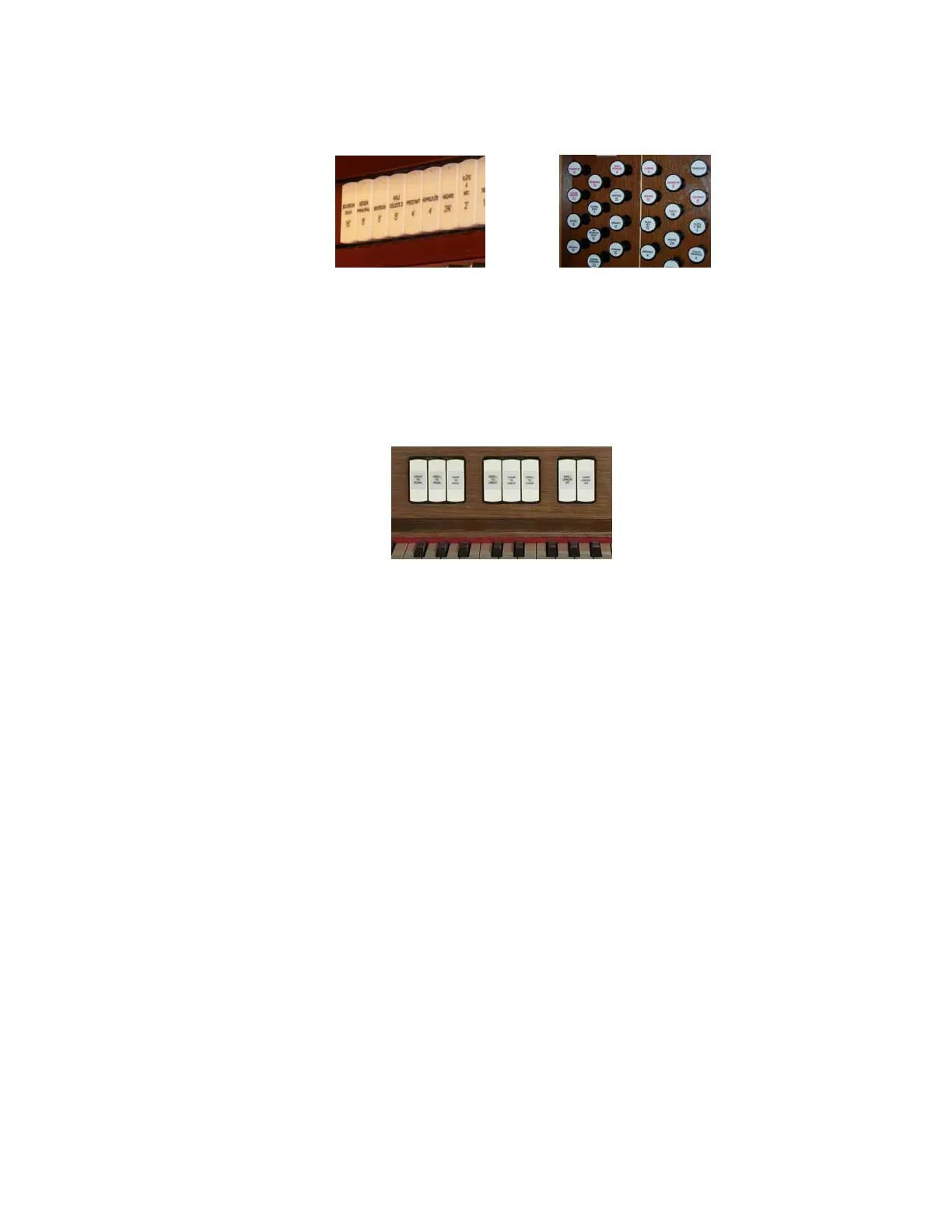
To activate a stop or control, pull the drawknob or press the bottom of the tab, and release.
To deactivate a stop or control, push the drawknob or press the top of the tab, and release.
! Many stops have more than one voice to choose from. This is referred to as the
Rodgers Voice Palette™. See the AG
Couplers
Intermanual Couplers
An Intermanual Coupler is a control that allows a division of the organ to be played from a
different manual or the pedalboard. They most often function from tabs located above the Swell
manual (also called the tab rail). For example, by activating the Swell to Great 8’ coupler, stops
selected in the Swell division will play from the Great manual. (“Swell to Great” literally means,
“connect the Swell division to the Great manual”). Intermanual Couplers allow you to control a
larger portion of the organ from one manual or the pedalboard and are useful in achieving larger
and more varied registrations.
The pitch designation (8’and 4’) specifies the pitch at which the division is to be coupled. 8’
is concert pitch in organ nomenclature; when using an 8’ coupler, the division is coupled at
its normal pitch.
4’ pitch is an octave above 8’ pitch. When a 4’ coupler is used, the division is coupled an
octave higher than normal. This nomenclature is similar to the pitch designation used in
organ stops.
8’ intermanual couplers are commonly used when building large ensemble registrations,
whereas 4’ couplers are usually not employed.
4’ couplers are often used with celeste stops in more gentle registrations; they effectively
increase the number of notes that are sounding and increase the warmth and breadth of the
ensemble.



 To Next Page