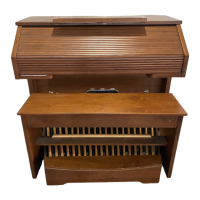
THE
MUSICAL RESOURCES
OF
THE
WINDSOR
840
There
nre
two major
categories
of
organ
tone-
Flue
and
Reed:
FLUE:
This
category
includes
Principals
(Diapasons),
Flutes,
and
Strings.
These
voices
are
produced
by
similarly
constructed
pipes
called
flue
pipes.
These
pipes
make
a
sound
when
air
enters
and
is
channeled
through a thin opening,
directing
the
air
column
upward against
the
lip of
the
pipe.
This
vibrating air
sheet
sets
up
vibrations
in
the
column of air
inside
the
pipe
which
creates
the
musical
tone.
Its principle
is
that of
the
common
whistle.
REED:
In this
pipework,
sound
is
generated
by
a
metal
tongue
(reed)
vibrating against a metal shallot, with flat,
open
portion
of
the
shallot facing
the
tongue.
These
parts
are
contained
in
the
"boot" of
the
pipe.
The
resonator (uppermost
tubular
section)
affects
the
timbre
(color)
and
pitch of
the
particular
pipe.
Such
voices
as
the
TROMPETTE,
OBOE,
KRUMl\1HORN,
and
VOX
HUMANA
are
members
of
the
Reed
Family.
They
are
easily
recognizable
because
their
LEDs
(Light Emitting
Diodes)
are
tinted
red
and
stop
tab
engravings
are
in
red.
THE
PRINCIPAL
(DIAPASON)
FAMILY
The
Principals
are
the
tonal family
unique
to
the
organ.
There
is
no
orchestral counterpart to
the
Principal nor
can
it
be
duplicated
by
any
orchestral instrument.
When
played
in
chorus,
such
as
8'
PRINCIPAL,
4'
OCTAVE,
and
2'
SUPER-
OCTAVE
on
the
Great
manual,
the
resulting
sound
provides
body,
clarity,
and
the
base
to
which
the
other
tone
families
of
the
organ
must relate
and
blend.
The
Mixture
stops
are
made
up
of
several
pitches of high-pitched Principal
pipes.
The
pitches
selected
augment the
natural harmonic
overtone
series.
A mixture's prime function
is
to
add
sparkle
to
the
Foundation
tone
of
the
organ.
The
Roman
numeral
on
the
drawknob
indicates
the
number
of pitches
sounding
when
a
single
note
is
depressed,
e.g.,
CYM-
BALE
II
(two
pitches),
MIXTURE
V(five
pitches).
When
used
sensitively with suitable
Foundation
stops
and/or
Reeds,
a Mixture
provides
the
crown
of the tonal
spectrum.
When
used
in combinations for
hymn
playing, Mixtures provide pitch clarity for
the
ear,
resulting in better
con-
gregational singing.
THE
FLUTE
FAMILY
The
Flute family
has
a
dual
role
in
good
organ
design.
The
Flutes
must support
the
Principals
and,
in addition,
provide another
fund
of
tone
color for
solo
and
accompaniment
voices.
The
most
developed
Flute
Chorus
is
in
the
Swell
Organ
where
Flutes
are
available from 16' through 1
3
/5'
pitches.
In
the
Great
Organ
the
Flutes
give
added
body
when
used
with
the
Principals.
By
combining
unison
and
non-unison
(mutation) Flute
stops,
the
organist
can
create
synthesized
solo
voices.
The
2
2
/3'
NASARD
and
the
1
3
/5'
TIERCE
on
the
Swell
manual
can
be
used
in
combination with
Flutes
of
8'
and/or
4'
pitches to
produce
the
classic
solo
stop
called
SESQUIALTERA.
The
combination
and
proper
balance
of
unison
and
non-unison
pitches
which
comprise
these
combinations
are
a standard practice of
organ
design
dating
back
hundreds
of
years.
The
1
1
/3'
QUINT
on
the
Choir/Positiv manual
is
useful for adding a subtle
sparkle
to
any
combination.
It
is
most
commonly
used
with
the
8'
and
4'
Flutes
to
give
a
very
colorful, quaint
sound
useful
f{)r
contrapuntal literature.
The
combination of
the
Great
8'
BOURDON
and
the
2
2
/3'
NASAT
is
a
cool,
elegant
solo
voice.
Flutes
are
found
in
the
Pedal
Organ
as
well-playing at 32'
and
16'
pitches,
as
well
as
supplying Flute
tone
at 8',4',
and
2~
2



 To Next Page