
 Need help?
Do you have a question about the Rofin Polilight Flare PLUS and is the answer not in the manual?
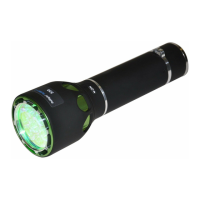
Describes the Polilight Flare+2 as a forensic light-source with various outputs.
Advises on protecting skin from the high-intensity light source.
Recommends wearing safety goggles when using the unit.
Explains safety symbols like eye protection and high intensity light warnings.
Provides contact information for Rofin Australia Pty Ltd.
States the product is CE compliant.
Lists the standard components included with the Polilight Flare+2 kit.
Describes the charger functionality and LED indicators.
Explains the use of the ball mount for attaching to a tripod.
Details the different beam shaping filters available.
Lists the standard included goggles.
Instructions on how to turn the unit on and off.
How to adjust the light intensity of the unit.
Method to lock the battery for air travel.
How to activate the strobing feature.
Instructions for initiating SOS Morse code output.
Explains the continuous operation capability due to cooling vents.
Explains the purpose of short-pass filters in specific heads.
Instructions for fitting and removing diffuser filters.
Details how to charge the unit using mains or car supplies.
Specifics on charging via a car's 12V outlet.
Details on charging using the mains power unit.
Information on battery lifespan and charging cycles.
How the unit's charging circuitry works.
Compares the unit's battery to AA batteries.
How to attach the unit to a tripod.
Procedures for cleaning the unit after use at a crime scene.
Table showing light output bands, wavelengths, and bandwidths.
Introduces the forensic applications of the Flare+2.
Explains fluorescence imaging techniques.
Explains reflection imaging techniques.
Explains absorption imaging techniques.
Details how fluorescence imaging works and provides examples.
Explains specular reflection and its use.
Explains diffused reflection and its use.
Example of using the 60x1 filter for shoe prints.
How differential absorption reduces background interference.
Methods for detecting latent fingerprints at crime scenes.
How to discover shoe prints using the Flare+2.
Using UV and 450 nm heads for general fluorescent searching.
Detecting blood marks using absorption or reflection modes.
Detailed methods for finding latent fingerprints.
Using white light for fingerprints on polished surfaces.
Detecting naturally fluorescent latent fingerprints.
Using powders to enhance latent fingerprints.
Using cyanoacrylate fuming for latent prints.
Example of Adrox treated fingerprints under different lighting.
Table showing settings for crime scene examinations.
Overview of available optional accessories.
Details on optional IR wavelength heads.
Example of IR light use for detecting blood stains.
Lists additional band pass and long pass filters.
Details beam shaping filters like cone altering and slit forming.
Describes cone altering filters for illuminating large areas.
Describes slit forming filters for viewing shoeprints.
Notes on unit warranty and replacement parts.
Instructions for cleaning the unit and its optics.
Details the unit's power input specifications.
Provides the weight of the unit.
Lists the physical dimensions of the unit.
Details the light output specifications.
Specifies the battery shelf life and charge cycles.
Information on the unit's waterproof rating.
Table detailing optical output bands and application examples.
Lists available optional filters and their status.
 General
| Light Source | LED |
|---|---|
| Battery Type | Lithium-Ion |
| Storage Temperature | -20°C to 60°C |
| Power Source | Rechargeable battery or AC adapter |
| Operating Temperature | 0°C to 40°C |
| Humidity | Up to 95% non-condensing |
| Output Power | Up to 10 Watts (depending on wavelength) |

 To Next Page