You can send a signal to a bus in either of two ways:
•
BUS
—You can send a signal to a bus with the flip of an on/off
switch. When you do this, the volume of the signal sent to the bus is
controlled by its channel fader. This is the method to use when
you’re mixing, or recording tracks on a multitrack recorder, and want
the precise amount of level control provided by the channel faders.
•
SND
—You can use a separate volume control that allows you to
independently set the signal’s bus-send level. Use this during
recording when you’re controlling your track levels using the channel
faders, and need to create a separate monitor-speaker or
headphone mix for your performers. When mixing, it allows you to
control the level of a signal being sent to an external effect
processor while your channel faders control its level in the mix.
Each bus can be set up to use either method. Let’s use Busses 1 and
2—the busses that feed the AUX OUT jacks—to see how this is done.
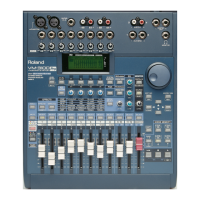
1. Press BUS ASSIGN (PARAM VIEW).
2. Press F3 [OUT]—the “EZR OUT” screen appears. The column at
the left edge of the screen selects the bussing method for each
odd/even pair of busses.
3. Use the UP, DOWN, LEFT or RIGHT page buttons to select the
area to the left of “1/2” at the left edge of the display.
4. You can turn the VALUE dial to set Busses 1 and 2 to use either
bussing method:
❏ —The box symbol signifies the BUS setting (“BUS” is also shown
in the upper right-hand corner of the display). With this setting, you
can send a channel’s signal to the busses using an on/off switch.
The send level will be determined by the channel fader, and you can
pan the signal between the pair of busses using the channel’s
panning control (see Page 55 in the
Owner’s Manual
for more on
panning).
—The dial and small “m” or “s” signify the two SND settings
that allow you to independently control the amount of a channel’s
signal to be sent to the busses. When you select “SND-M,” you’ll
have two volume controls: one for Bus 1 and another for Bus 2.
“SND-S” gives you a single volume control—the channel signal will
be sent equally to both busses.
5. Turn the VALUE dial to the BUS setting.
6. Press LEVEL METER (BIG T.C.) to leave the “EZR OUT” screen.
1999 Roland Corporation U.S. The Basics of the VM-3100/VM-3100Pro Faxback# 21099 Page 17
®ÂØÒňΠSupplemental Notes The Basics of the VM-3100/VM-3100Pro
Only Busses 1 and 2 provide two SND settings since they feed the AUX
OUT jacks used for monitor-speaker and headphone mixes, as well as
for sending signals to external effects—these jobs require an
exceptional degree of control. All other bus pairs offer the BUS and
SND-S settings only.
XVII. Choosing a Bussing Method


 To Next Page
 Loading...