C22
Air
Conditioning
System
Manual
---
---
- Ro/ls-Royce & Bentley
--------------
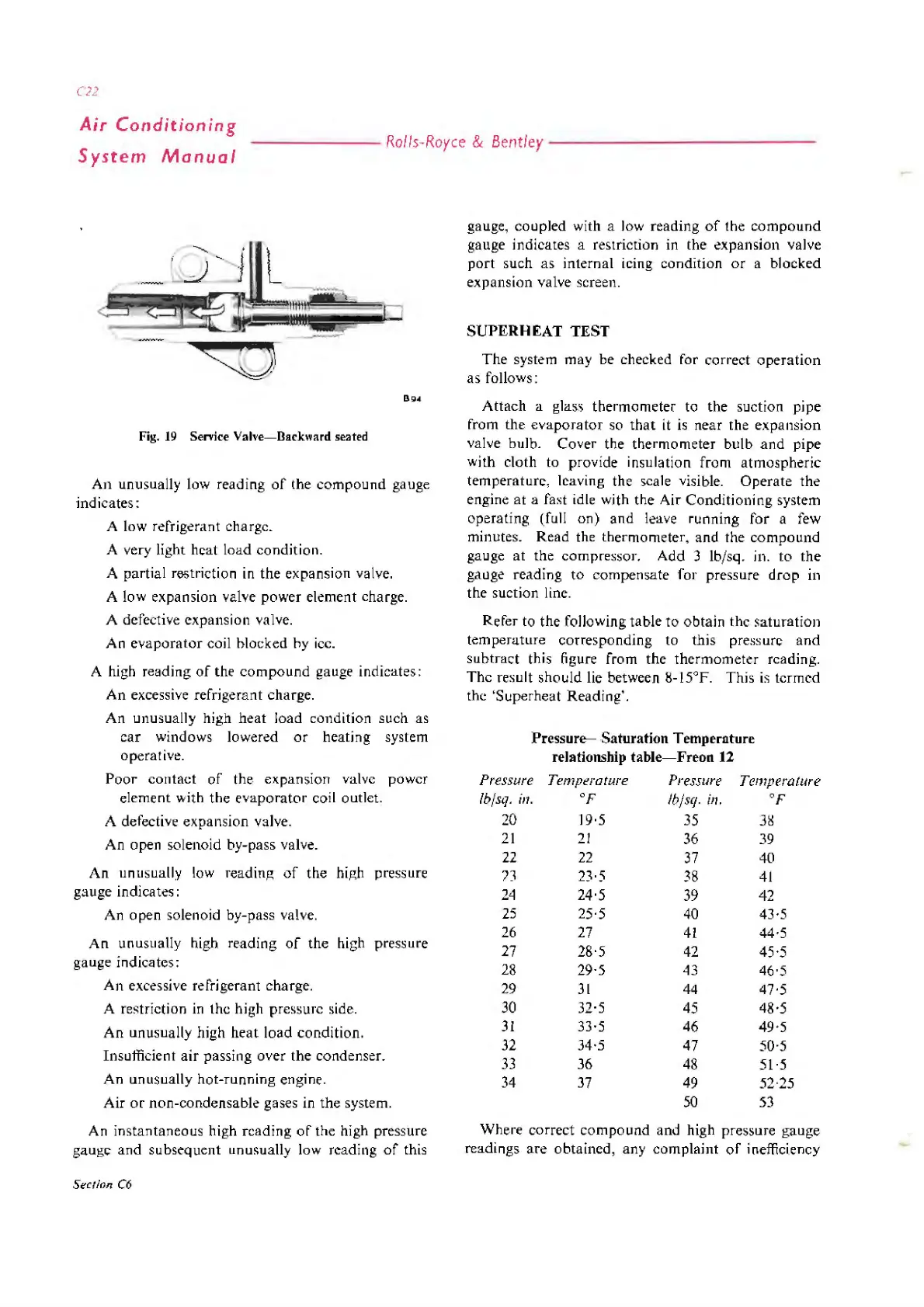
Fig. 19 Serviee
Valve-Back1~ard
seated
An
unusually low reading
of
the
compound
gauge
indicates:
A low refrigerant charge.
A very light heat load condition.
A partial re-striction in the expansion valve.
A low expansion valve
power
element charge.
A defective expansion valve.
An
evaporator
coil blocked hy ice.
A high reading
of
the
compound
gauge indicates:
An
excessive refrigerant charge.
An unusually high
heat
load condition such as
car
windows lowered
or
heating system
operative.
Poor
contact
of
the expansion valve power
element with the
evaporator
coil outlet.
A defective expansion valve.
An open solenoid by-pass valve.
An unusually low reading
of
the high pressure
gauge indicates:
An open solenoid by-pass valve.
An
unusually high reading
of
the high pressure
gauge indicates:
An
excessive refrigerant charge.
A restriction
in
the high pressure side.
An
unusually high
heat
load condition.
Insufficient air passing over the condenser.
An unusually hot-running engine.
Air
or
non-condensable gases in the system.
An instantaneous high reading
of
the high pressure
gauge
and
subsequent unusually low reading
of
this
Secrion
C6
gauge, coupled with a low reading
of
the
compound
gauge indicates a restriction in the expansion valve
port
such as internal icing condition
or
a blocked
expansion valve screen.
SUPERH[AT TEST
The
system may be checked for correct
operation
as follows:
Attach
a glass
thermometer
to the suction pipe
from the
evaporator
so
that
it
is
near the expansion
valve bulb.
Cover
the
thermometer
bulb
and
pipe
with cloth to provide insulation from atmospheric
temperature, leaving the scale visible. Operate the
engine at a fast idle with the Air
Conditioning
system
operating (full
on)
and leave running for a few
minutes. Read the thermometer, and the
compound
gauge at the compressor.
Add
3 lb/sq. in. to the
gauge reading
to
compensate for pressure
drop
in
the suction line.
Refer to the following table
to
obtain
the
saturation
temperature corresponding to this pressure
and
subtract this figure from the
thermometer
reading.
The
result should lie between 8-15°F. This
is
termed
the 'Superheat Reading'.
Pressure- Saturation Temperature
relationship
table-Freon
12
Pressure
Temperature
Pressure Temperature
lb/sq.
in.
OF
lb/sq.
in.
OF
20
19·5
35
38
21
21
36
39
22
22
37
40
73
21-''i
38
41
24
24·5
39 42
25
25·5
40 43·5
26
27
41
44·5
27
28·5 42
45·5
28
29·5 43
46·5
29
31
44
47·5
30 32·5
45 48·5
31
33·5
46
49·5
32 34·5
47
50·5
33
36
48
51
·5
34
37
49
52·25
50 53
Where correct
compound
and high pressure gauge
readings
are
obtained, any
complaint
of
inefficiency




 To Next Page