C23
----
-
--
------
- Rolls-Royce & Bentley
-------
Air
Conditioning
System
Manual
can
only be
attributed
to
Jack
of
air delivery.
Check
for
operation
and
ensure
that
inlet
and
outlet
ducts
are
unobstructed.
A slightly low
compound
gauge
reading
would be
observed
if there were
any
obstruc-
tions
causing a lack
of
air delivery.
DISCHARGING
REFRIGERANT
When
it is necessary
to
break
any
joint
which is
not
protected
by service valves,
the
refrigerant
must
first
be discharged.
Do
not
discharge in
an
area
where
an
open
flame
is exposed.
The refrigerant does
not
burn,
but
decomposes
and
forms a
poisonous
gas.
Remove
the protective
caps
from
the
compressor
service valves.
Just
'crack'
the high pressure valve
in
a clockwise direction, allowing
the
refrigerant in
the
system
to
be
discharged
to
atmosphere.
Care
must
be
taken
not
to
release
the
refrigerant
too
quickly,
as
thi8 will result in oil being
drawn
out
of
the
system.
The
operation
should
take
at
least fifteen
minutes.
Always use
two
wrenches
in
oppos1t1on
when
disconnecting
Aured
connections,
to
prevent
damage
to
flares
or
tubes.
The
tubes
are
easily twisted.
After
the necessary
repair
has been
made
and
before
re-charging, it is necessary
to
evacuate
and
sweep
the
system,
to
remove
all
the
moisture.
The
compressor
oil
level should be checked,
as
detailed
under
'Compressor'.
EVACUATING
The
use
of
a vacuum
pump
is
recommended
for
evacuation
but
when
not
available the
compressor
may
be utilised as follows:
Fit
the
manifold
gauge
unit
to
the
compressor
as
illustrated
.
Forward-seat
the
high pressure service
valve
of
the
compressor
hy
rotating
it
in
a clockwise
direction
to
the
end
of
its travel.
Open
the pressure
valve
of
the manifold gauge set by
rotating
it in
an
anti-clockwise direction fully.
Close
the
vacuum
valve
of
the
manifold
gauge
set
by
rotating
it in a clock wise direction.
Just
'crack'
the
low
pressure service valve by giving
half
a
turn
in
a
clockwise
direction.
Start
the
engine
and
run
on
'slow idle'. Switch
on
the
blowers
in
the
'Hl'
position. Observe the
vacuum
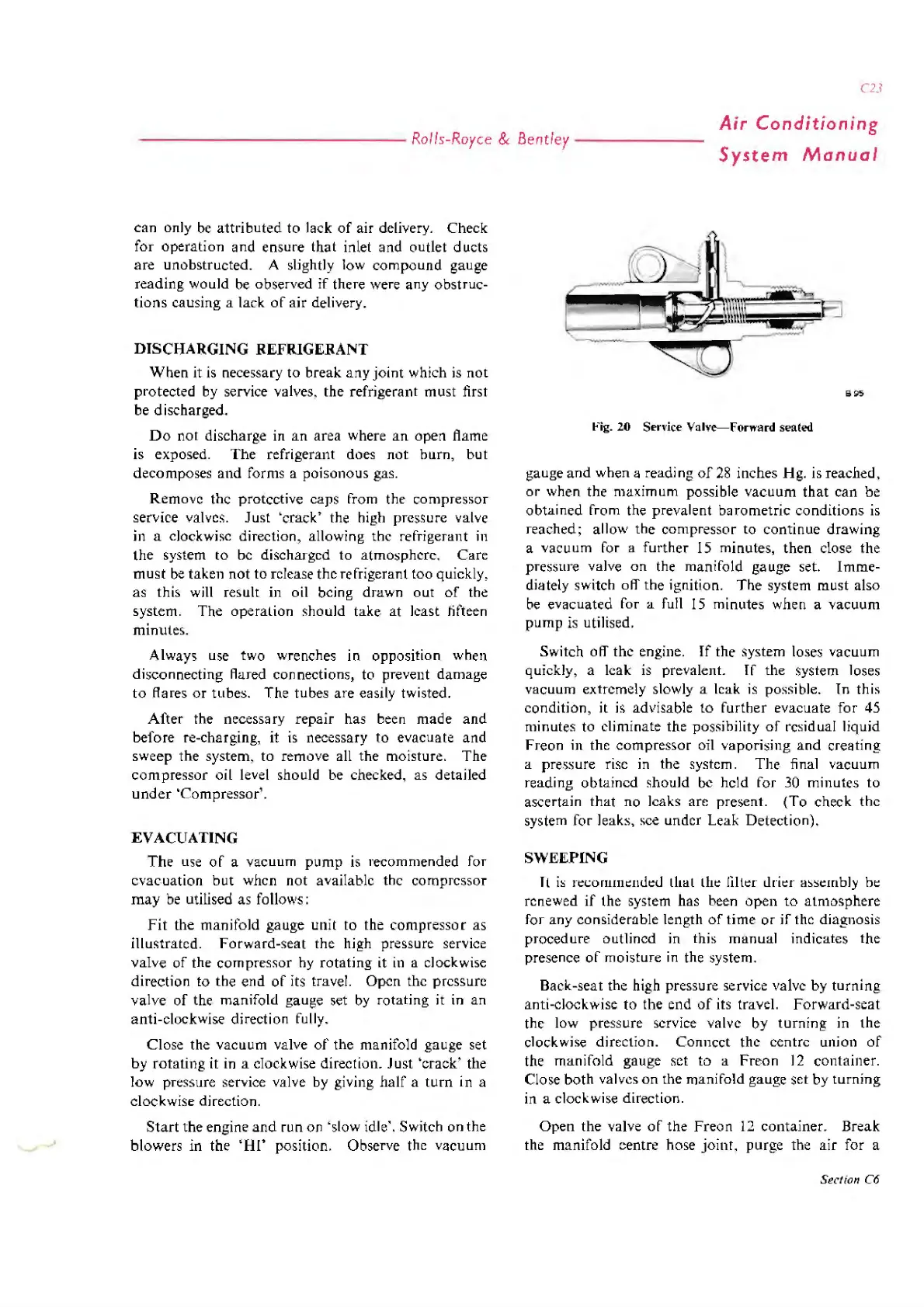
B~5
Fig.
20
Service
Valve-Forward
seated
gauge
and
when
a reading
of
28
inches
Hg. is
reached,
or
when
the
maximum
possible
vacuum
that
can
be
obtained
from the prevalent
barometric
conditions
is
reached;
allow
the
compressor
to
continue
drawing
a
vacuum
for a
further
15
minutes,
then
close the
pressure valve
on
the
manifold
gauge
set.
Imme-
diately switch off the ignition.
The
system
must
also
be
evacuated
for a full
15
minutes when a
vacuum
pump
is utilised.
Switch off
the
engine.
If
the system loses vacuum
quickly, a leak is prevalent.
Tf
the
system loses
vacuum extremely slowly a leak is possible.
In this
condition,
it is advisable
to
further
evacuate
for
45
minutes
to
eliminate the possibility
of
residual liquid
Freon
in the
compressor
oil
vaporising
and
creating
a pressure rise in the system.
The
final vacuum
reading
obtained
should be held for
30
minutes
to
ascertain
that
no leaks are present.
(To
check
the
system
for
leaks, see
under
Leak
Detection).
SWEEPING
It
is
n:l:ommi::11<l1c:<l
lhal
Lht:
J"illt:r
tlrit:r asst:mbly
bt:
renewed
if
the
system has been
open
to
atmosphere
for
any
considerable length
of
time
or
if
the diagnosis
procedure
outlined
in this
manual
indicates
the
presence
of
moisture
in
the system.
Back-seat the high pressure service valve by
turning
anti-clockwise
to
the end
of
its travel.
Forward-seat
the
low pressure service valve by
turning
in
the
clockwise direction.
Connect
the
centre
union
of
the
manifold
gauge set
to
a
Freon
12
container.
Close
both
valves
on
the
manifold
gauge set by
turning
in a clockwise direction.
Open
the
valve
of
the
Freon
12
container.
Break
the
manifold
centre hose
joint,
purge
the
air
for
a
Section C6



 To Next Page