Need help?
Do you have a question about the Rotel RA-840B and is the answer not in the manual?
Discusses design philosophy, headphone listening, and disconnecting speaker leads.
Notes MM/MC switch location and volume control usage before switching or powering.
Explains tape-to-tape copying using TAPE 1 and TAPE 2 buttons.
Welcomes users, highlights Rotel's design and quality.
Provides instructions for power supply and connecting components.
Connects speaker leads to "L" and "R" terminals, ensuring correct polarity.
Details the functions of the power button, headphone jack, and selector buttons.
Instructions for listening from turntable, CD, tuner, and playing/recording tape decks.
Provides guidance on identifying and resolving hum and noise issues.
Explains the unit's protection circuit and actions for no sound output.
Information on voltage settings and compatibility for different regions.
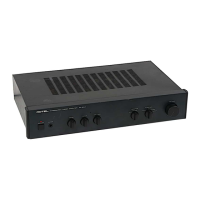
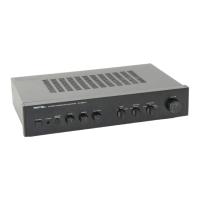
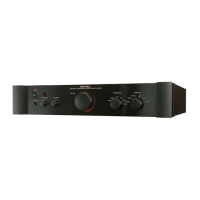
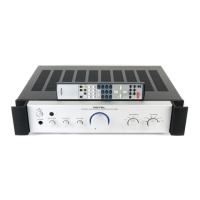
The Rotel RA-840B/RA-840BX is a stereo integrated amplifier designed for high-fidelity audio reproduction. Its design philosophy emphasizes a "STRAIGHT LINE" loudspeaker path to minimize sound degradation from oxidation, ensuring a pure audio signal. This means that for private listening with headphones, it is necessary to disconnect the loudspeaker leads from the amplifier to maintain optimal sound quality.
The amplifier features a range of controls and input options to manage various audio sources. The front panel includes a Power Button that turns the unit on and off, indicated by an LED. A Headphone Jack allows for private listening, with the volume controlled by the main Volume Control. The Mono Button enables monaural reproduction of any input signal, reverting to stereo when released.
For source selection, the amplifier is equipped with Tape Monitor Buttons (TAPE 1 and TAPE 2) for listening to signals from connected tape decks. When these buttons are released, the Function Selector comes into play, allowing users to choose between different program sources: PHONO (for turntables with either MC or MM cartridges), C.D. (for compact disc players), and TUNER (for radio broadcasts). The MM/MC switch, conveniently located on the front panel, allows selection between moving magnet (MM) and moving coil (MC) phono cartridges. It is crucial to set the volume control to zero before switching between MM and MC, or before turning the amplifier on or off, to prevent potential damage or sudden loud noises.
The Volume Control is a dual concentric knob, enabling either separate or combined adjustment of both channels, providing precise control over the listening level. An additional Dubbing Function allows for tape-to-tape copying from TAPE 1 to TAPE 2 by simultaneously depressing both TAPE 1 and TAPE 2 buttons.
On the rear panel, the amplifier provides a comprehensive set of connections. These include input terminals for a Turntable (with separate MC and MM phono inputs), a C.D. Player, a Tuner, and Cassette Decks (TAPE 1 and TAPE 2 with both input and output terminals). There are also Speaker Terminals for connecting right and left speakers, designed for systems with impedance ratings of 4-16 ohms. A grounding wire terminal (GND) is provided for turntable connections to minimize hum.
Before operating the amplifier, it is essential to ensure all connections are properly made and the volume control is set to minimum.
The amplifier incorporates a Protection Circuit to prevent accidental damage to the unit or speakers. If no sound is produced, a blown fuse might be the cause. In such cases, turn off the unit, disconnect the plug, and consult a dealer or qualified electrician.
Proper installation and care are crucial for the longevity and optimal performance of the Rotel RA-840B/RA-840BX.
In high-fidelity installations, hum can arise from the interconnection of components, wiring, grounding issues, or component placement. If hum is experienced, disconnect all components except the speakers from the unit. Then, plug in the turntable and, if hum persists, move it away from the speakers. Defective cable connections or cables run too close to strong AC fields can also induce hum. Noise during broadcast reception is often caused by external objects like fluorescent lamps or household appliances. Relocating the unit away from noise sources or using an improved outdoor antenna can help resolve the issue. If the cause cannot be identified, consult a dealer or qualified electrician.
 General
| Total Harmonic Distortion (THD) | 0.03% |
|---|---|
| Input Sensitivity (line) | 150 mV |
| Signal to Noise Ratio (line) | 90 dB |
| Input Sensitivity (MM) | 2.5 mV |
| Signal to Noise Ratio (MM) | 75 dB |
| Output (line) | 1 V |
| Power Output | 40W per channel into 8Ω |
| Frequency Response | 10Hz - 100kHz |
| Dimensions | 430 x 330 x 100 mm |
| Speaker Load Impedance | 4Ω - 16Ω |


 To Next Page