EN
2.3. PERSONAL SAFETY
a) Do not use the device when tired, ill or under the
inuence of alcohol, narcotics or medication which
can signicantly impair the ability to operate the
device.
b) The device is not designed to be handled by persons
(including children) with limited mental and sensory
functions or persons lacking relevant experience and/
or knowledge unless they are supervised by a person
responsible for their safety or they have received
instruction on how to operate the device.
c) When working with the device, use common sense
and stay alert. Temporary loss of concentration while
using the device may lead to serious injuries.
d) To prevent the device from accidentally switching on,
make sure the switch is on the OFF position before
connecting to a power source.
e) The device is not a toy. Children must be supervised
to ensure that they do not play with the device.
2.4. SAFE DEVICE USE
a) Do not overload the device. Use the appropriate tools
for the given task. A correctly-selected device will
perform the task for which it was designed better and
in a safer manner.
b) Make sure the plug is disconnected from the socket
before attempting any adjustments, accessory
replacements or before putting the device aside.
Such precautions will reduce the risk of accidentally
activating the device.
c) When not in use, store in a safe place, away from
children and people not familiar with the device who
have not read the user manual. The device may pose
a hazard in the hands of inexperienced users.
d) Keep the device in perfect technical condition.
e) Keep the device out of the reach of children.
f) Device repair or maintenance should be carried out by
qualied persons, only using original spare parts. This
will ensure safe use.
g) To ensure the operational integrity of the device, do
not remove factory-tted guards and do not loosen
any screws.
h) Do not move, adjust or rotate the device in the course
of work.
i) Do not leave this appliance unattended while it is in
use.
j) Clean the device regularly to prevent stubborn grime
from accumulating.
k) It is forbidden to interfere with the structure of
the device in order to change its parameters or
construction.
l) Keep the device away from sources of re and heat.
m) Do not use the device without water.
n) When the device is no longer used, switch it o and
pull the plug out of the socket.
o) When operating, the device is hot. Take special care
and grasp the device using handles only. Before
maintenance, service or transport, let the device cool
down.
p) It is recommended to pour away the rst 100 ml of the
distillate obtained from this device.
3. USE GUIDELINES
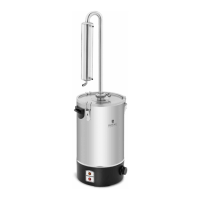
The distiller is designed for the distillation of dierent types
of liquids.
The user is liable for any damage resulting from
unintended use of the device.
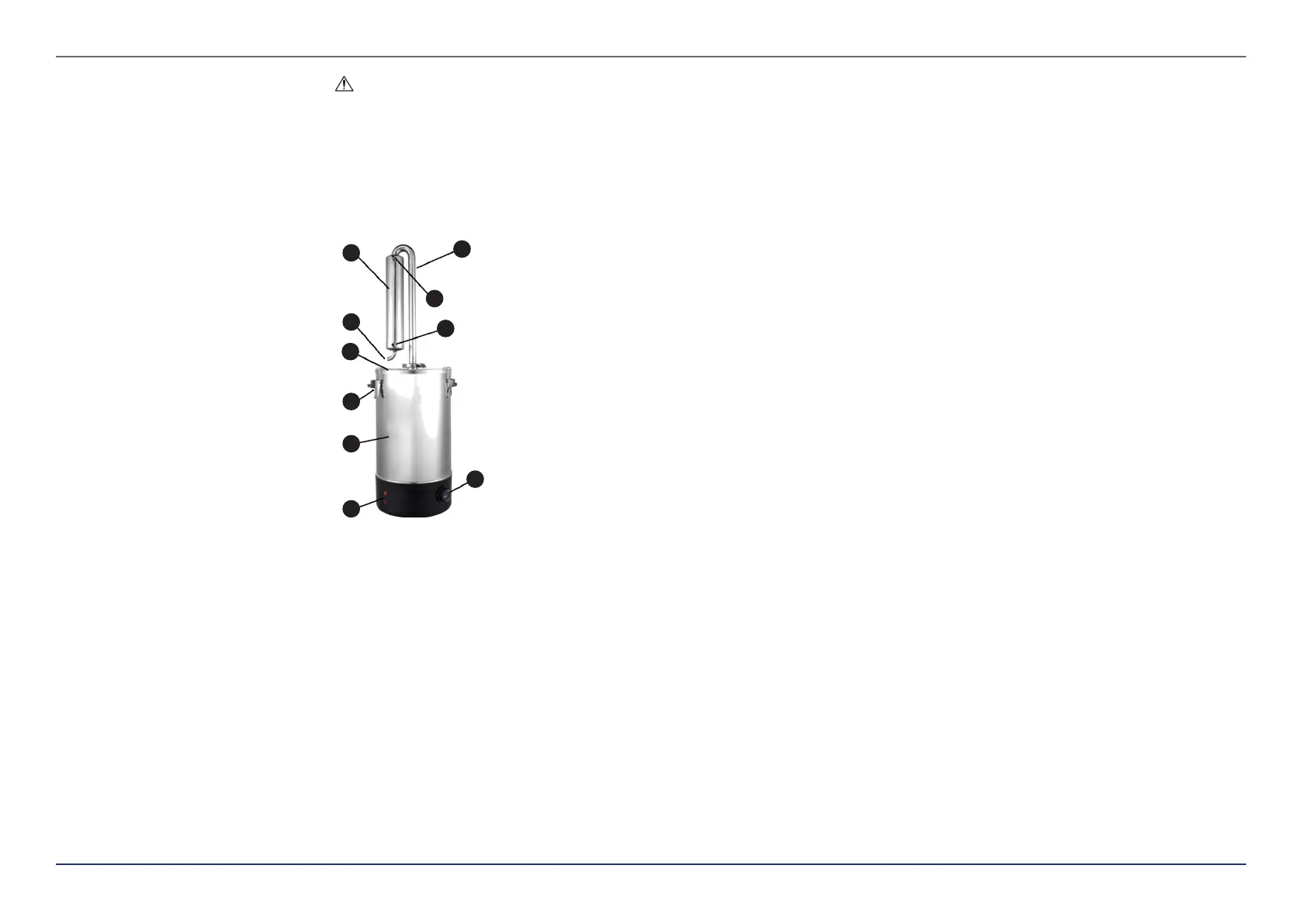
3.1. DEVICE DESCRIPTION
7
8
9
10
6
5
4
3
2
1
ATTENTION! Despite the safe design of the device
and its protective features, and despite the use of
additional elements protecting the operator, there is
still a slight risk of accident or injury when using the
device. Stay alert and use common sense when using
the device.
1. Cooling column
2. Distillate outow tube
3. Lid
4. Handle
5. Tank
6. LEDs
7. Pipe supplying steam to the cooling column
8. Cooling water outlet
9. Cooling water inlet
10. Temperature controller
3.2. PREPARING FOR USE
APPLIANCE LOCATION
The temperature of environment must not be higher than
40°C and the relative humidity should be less than 85%.
Ensure good ventilation in the room in which the device
is being used. There should be at least 10 cm distance
between each side of the device and the wall or other
objects. The device should always be used when positioned
on an even, stable, clean, reproof and dry surface, and
be out of the reach of children and persons with limited
mental and sensory functions. Position the device such that
you always have access to the power plug. The power cord
connected to the appliance must be properly grounded
and correspond to the technical details on the product
label. Disassemble the device and all its components and
clean them before the rst use.
EN
ASSEMBLING THE DEVICE
a) Put cover on the pot.
b) Connect cooling water outlet pipe to the cooling
column.
c) Connect the cooling water inlet pipe to the cooling
column.
d) Water pump must be connected to the other end of
the cooling water inlet pipe (the water pump is to be
provided by the user).
3.3. DEVICE USE
Before operating the device, prepare feed.
DISTILLATION
a) Put the batch in the tank of the device.
b) Assemble the entire device.
c) Connect the device to the power supply. Set the
desired temperature using the temperature controller.
d) The pump with the end of the inlet pipe should be
immersed in cool water, but pumping of cool water
should only be started when the batch temperature
reaches 80°C. The tip of the outlet pipe can be
directed to the same container with the water in which
the pump is immersed along with the water inlet, but
when the cooling water temperature rises to 45 °C,
water should be replaced with a cooler one.
e) The distillate will start pouring from the output pipe
soon after the water starts to boil. It is recommended
to dispose of the rst 100 ml of the distillate.
f) Upon completion of distillation, turn o the heat
source providing the heat to the device, let the device
to cool down, dispose of the feed and wash the
entire device.
3.4. CLEANING AND MAINTENANCE
a) Prior to cleaning or maintenance of the device, let the
device cool down to avoid burns.
b) At the end of each distillation, clean the entire device
with a non-abrasive, mild cleaning agent designed to
clean surfaces in contact with food and then wipe the
device dry with a soft cloth.
c) It is recommended to rinse the inside of the cooling
column (precooling column and main column) with
a mixture of hot water and a mild cleaning agent
designed to clean the surfaces in contact with food,
and then rinse the device several times using only hot
water.
d) Do not use baking soda to clean the device because it
can cause discoloration or damage to the metal.
e) Store the unit in a dry, cool place, free from moisture
and direct exposure to sunlight.
f) In the event of a frost hazard, it is necessary to empty,
clean and dry the device.
DISPOSING OF USED DEVICES
Do not dispose of this device in municipal waste systems.
Hand it over to an electric and electrical device recycling
and collection point. Check the symbol on the product,
instruction manual and packaging. The plastics used to
construct the device can be recycled in accordance with
their markings. By choosing to recycle you are making
a signicant contribution to the protection of our
environment. Contact local authorities for information on
your local recycling facility.
8
Rev. 12.08.2021
9
Rev. 12.08.2021


 To Next Page
 Loading...