7
AIR SOURCE, FITTINGS, AND PRESSURE
AIR SOURCE
Supplied Air
Locate the air source in a clean air environment, always use a lter on the inlet of your air source.
Make sure the air source is somewhere that vehicles, forklifts, and other machinery are not
running near the air inlet, as this will cause carbon monoxide to be drawn into your air supply.
Always use suitable after coolers/dryers with lters and carbon monoxide alarms to ensure clean
breathable air is supplied at all times. A Radex
®
Airline Filter (04-900) and a GX4
®
Gas Monitor
(08-400) are recommended. The air should be regularly sampled to ensure that it meets Grade
D requirements.
AIR QUALITY
This respirator must be supplied with clean breathable air at all times. Breathable air must at
least meet the requirements for Type 1 gaseous air described in the Compressed Gas Association
Commodity Specications G-7.1 (Grade D or higher) and as specied by Federal Law 42 CFR
84, subpart J.84.141(b) and 29 CFR 1910.134 (i) the RPB
®
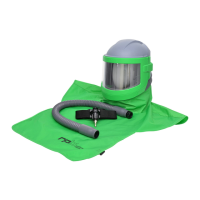
NOVA 3
®
does not purify air or lter
contaminants. A carbon monoxide monitor must be used at all times.
Do not connect the respirator’s air supply hose to nitrogen, toxic gases,
inert gases or other non-breathable air sources. Check the air source
before using the respirator. This apparatus is not designed for use with mobile air supply systems i.e.
cylinders. Connecting the supply hose to a non-breathable air source will result in serious injury or
death.
BREATHING AIR SUPPLY HOSES AND FITTINGS
RPB
®
breathing air supply hoses and ttings must be used between the point of attachment and
the respirator breathing air connection at the wearer’s belt. The hose sections must be within the
correct length and the amount of sections must be within the number specied in the breathing air
pressure table on page 13.
BREATHING AIR PRESSURE
The air pressure must be continually monitored at the point of attachment. Air pressure must be
read from a reliable pressure gauge whilst the respirator has air owing through it.


 To Next Page