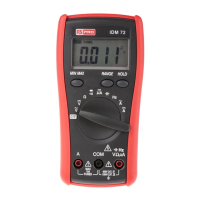
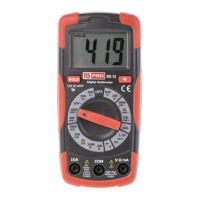
Digital Multimeter/English Digital Multimeter/English
12 13
1. Insert the black test lead banana plug into the negative COM jack and
the red test lead banana plug into the positive diode jack.
2. Turn the rotary switch to the / •))) position.
3. Touch the test probes to the diode under test. Forward voltage will
indicate 400 to 700mV. Reverse voltage will indicate “I”. Shorted
devices will indicate near 0mV. Shorted devices will indicate near
0mV and an open device will indicate “I” in both polarities.
Diode Test
NOTE: If the meter does not work properly, check the fuses and batteries
to make sure that they are still good and that they are properly inserted.
FUSE REPLACEMENT
1. Disconnect the test leads from the meter.
2. Open the fuse/battery door by loosening the screw using a Phillips
head screwdriver.
3. Insert the battery into battery holder, observing the correct polarity.
4. Put the fuse/battery door back in place. Secure with the screw.
WARNING: To avoid electric shock, disconnect the test leads
from any source of voltage before removing the fuse/battery door.
To avoid electric shock, do not operate the meter until the battery
door is in place and fastened securely.
Always use fuses of the proper size and rating:
When the batteries become exhausted or drop below the operating
voltage, “BAT” will appear in the right-hand side of the LCD display.
The batteries should be replaced:
1. Insert the black test lead banana plug into the negative COM jack and
the red test lead banana plug into the positive V jack.
2. Select the 1.5V or 9V BAT position using the function select switch.
3. Connect the red test lead to the positive side of the 1.5V or 9V battery
and the black test lead to the negative side of the 1.5V or 9V battery.
4. Read the voltage in the display.
Battery Test
BATTERY INSTALLATION & REPLACEMENT
WARNING: The following safety information must be observed
to ensure maximum personal safety during the operation of this
Instrument. To avoid electric shock, disconnect the test leads before
removing the battery door.
When replacing the instrument batteries, do not mix batteries of
different types or old and new batteries.
Check the battery polarity carefully when inserting the batteries.
To avoid electric shock, do not operate the meter until the battery
door is in place and fastened securely.
Do not short-circuit used batteries, disassemble them, or throw
them in a fire. Doing so may cause the batteries to explode.
Dispose of the used batteries in accordance with local regulations.


 To Next Page