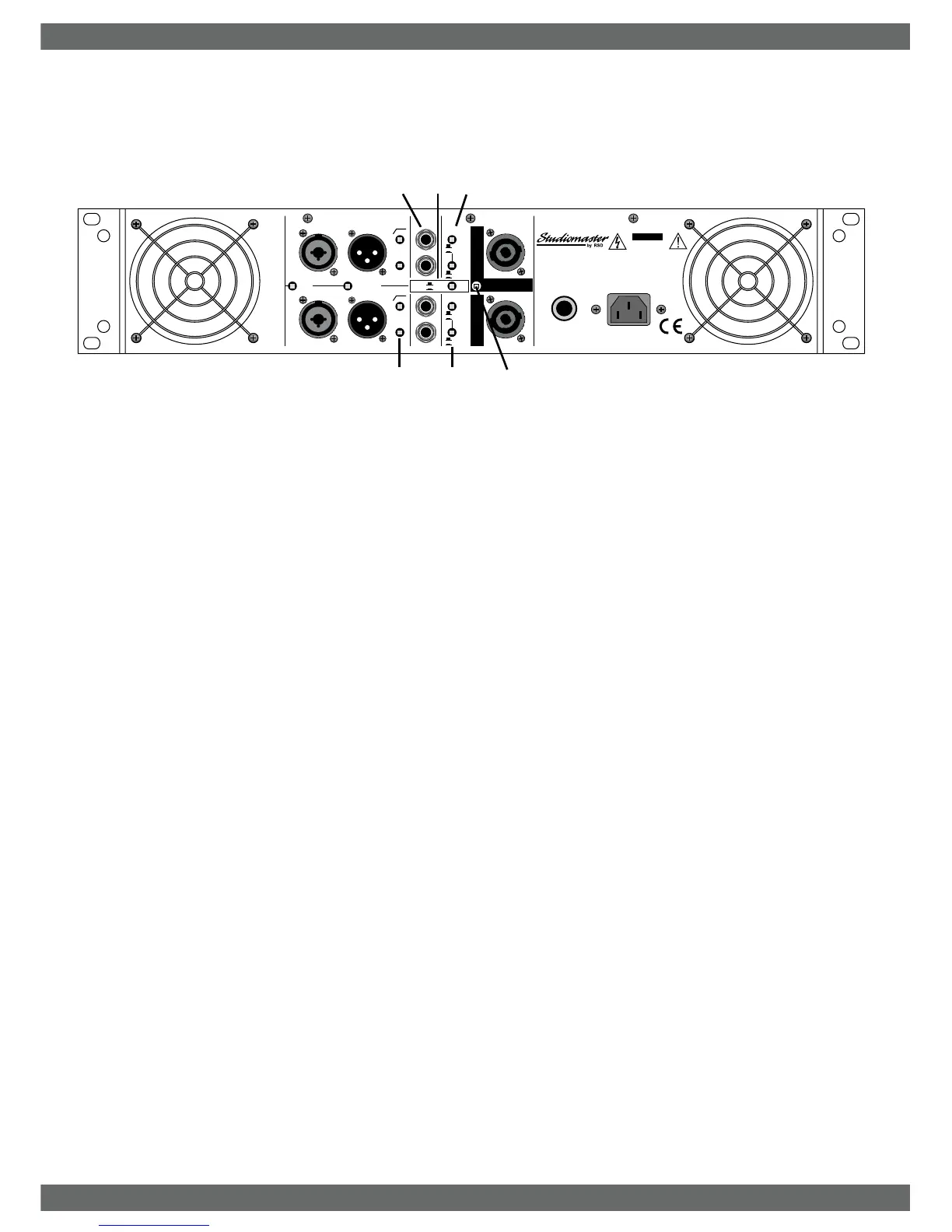
5. LIMITER OFF disables the clip limiter circuit. At maximum power output, the
limiter virtually prevents amplifier clipping, minimising audible distortion. It
should only be turned off in specific applications, as serious speaker damage
can occur if the amplifier is allowed to clip regularly.
6. X-OVER turns on the internal two way crossover circuit. The crossover splits
the audio band into high frequencies, suitable for mid/high speakers and low
frequencies suitable for bass speakers. If the crossover function is not
required this switch should remain off (out position).
7. The frequency switch selects the crossover frequency between 150Hz and
100Hz. For most systems 150Hz is recommended although some, typically
when using 18" subs, will work better with 100Hz. The internal crossover has
a '3rd order' response.
8. HI LO selects which signal from the crossover the amplifier receives. When
HI (out position) is selected only frequencies above 100 or 150Hz feed the
amplifier. When LO (in position) is selected only frequencies below 100 or
150Hz feed the amplifier.
9. XOVER OUTPUT sockets allow the high or low frequencies from the
crossover circuit to feed additional amplifiers. See examples in the Set Ups
section.
10. BRIDGE mode combines the output power of both amplifier channels into one
load. This is useful when driving a single, high powered speaker. Only channel
A output socket connects to the speaker but has to be wired in a different way.
See the section below regarding speaker wiring.
In this mode only Channel A input and level control are used.
Rear panel controls and features
STUDIOMASTER AX Amplifier Series
STUDIOMASTER AX Amplifier Series4
5
9
7
6
230V
RISK OF ELECTRIC SHOCK
DO NOT OPEN
CAUTION
A
I
R
V
E
N
T
S
F
R
O
N
T
A
N
D
R
E
A
R
M
U
S
T
N
O
T
B
E
O
B
S
T
R
U
C
T
E
D
C
A
U
T
I
O
N
CIRCUIT
BREAKER
GND
LIFT
PARALLEL
INPUTS


 To Next Page