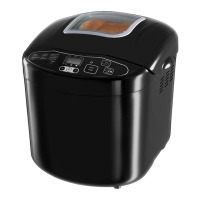
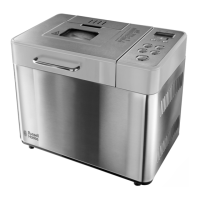
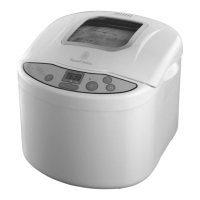
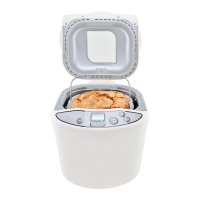
This document describes the Russell Hobbs Bread Maker, model 27260, a kitchen appliance designed for automatic bread making.
Function Description
The Russell Hobbs Bread Maker is a versatile appliance capable of producing various types of bread, dough, cakes, and even jam. It automates the processes of mixing, kneading, rising, and baking ingredients, offering convenience for home users. The device features a control panel with buttons for menu selection, crust color, loaf size, and start/stop functions, as well as a timer for delayed baking.
The bread maker offers 12 distinct programs:
- Basic: For basic white bread or recipes based on white bread dough.
- French: Produces French-type bread with a lighter texture and crispier crust, typically without butter or milk.
- Wholewheat: Designed for heavier flours, requiring preheating for about 30 minutes before kneading. Wholewheat loaves tend to be smaller and denser.
- Cake: For cake and batter recipes, using baking powder or soda as the raising agent.
- Sweet: Used for sweeter bread recipes, often containing fruit.
- Dough: Functions as a mixing/kneading machine for dough preparation.
- Jam: Preheats ingredients and boils them, suitable for fruit-based jams.
- Sandwich: Creates a loaf with a loose texture and thin crust, ideal for sandwiches.
- Gluten-free: Uses alternative substances for dough elasticity, resulting in denser and coarser bread.
- Fastbake I (750g): Cuts baking time to 85 minutes for a 750g loaf. Bread will be smaller, denser, and coarser, with additional ingredients potentially crushed or unevenly distributed. Requires water at 45-50°C.
- Fastbake II (1kg): Similar to Fastbake I but for a 1kg loaf, also with an 85-minute baking time and specific water temperature requirement.
- Speciality: Specifically designed for malt loaf recipes.
The device allows users to select crust color (light, medium, dark) for most bread programs and loaf size (750g, 1kg) for specific programs. The timer function enables delayed baking for up to 13 hours, excluding Jam, Fastbake I, and Fastbake II programs.
Important Technical Specifications
While specific power ratings are not provided, the manual emphasizes the importance of accurate ingredient measurement for optimal results. It recommends using cook's measuring spoons for dry ingredients, leveled off with a knife, and electronic scales for liquid ingredients (measured in grams for accuracy, where 1 gram = 1 milliliter).
The Fastbake programs require water at a temperature of 45-50°C to speed up the process. The appliance operates within a range of temperatures, but extreme room temperatures can affect loaf size.
Usage Features
Before First Use:
- Wash the loaf tin and paddle with hot, soapy water, rinse, and dry.
- Wipe the inside and outside of the bread maker with a damp cloth or sponge.
Preparing the Bread Maker:
- Place the bread maker on a stable, level, heat-resistant surface. Do not plug it in yet.
- Open the lid and remove the loaf tin.
- Fit the paddle onto the shaft in the bottom of the loaf tin.
- Measure all ingredients and have them ready.
Using the Bread Maker:
- Add ingredients to the loaf tin in the order listed in the recipe, ensuring yeast does not directly contact sugar or salt.
- Fit the loaf tin into the bread maker and turn it clockwise until it clicks. Close the lid.
- Plug in the bread maker.
- Select the desired program using the menu button.
- Select loaf size (if applicable) using the size button.
- Select crust color (if applicable) using the crust color button.
- Set the timer for delayed baking (if desired).
- Press the I/O button to start the program. The bread maker will beep, and the display will show the remaining time.
- A "keep warm" feature automatically keeps bread warm for 60 minutes after baking. To remove bread immediately, end the program with the I/O button.
- For some programs (Basic, Wholewheat), the bread maker will beep to remind users to add additional ingredients like nuts or raisins.
- Users can monitor dough through the window after about 30 minutes of kneading (15 minutes for gluten-free programs). A non-metallic soft spatula can be used to incorporate any sticking ingredients.
- Avoid opening the lid during operation unless absolutely necessary.
Using the Timer/Delay Function:
- Available for Basic, French, Wholewheat, Cake, Sweet, Dough, Sandwich, Gluten Free, and Speciality programs.
- Allows setting a finishing time up to 13 hours in advance.
- Not recommended for recipes with easily perishable ingredients (eggs, fresh milk, fruits, onions).
- Ensure yeast/baking powder and liquids are well separated when using the timer.
Removing the Bread:
- Press the start/stop button to end the program.
- Unplug the bread maker.
- Wearing oven gloves, carefully open the lid (beware of steam).
- Raise the loaf tin handle, turn it counter-clockwise, and lift it out.
- Invert the loaf tin and shake to release the bread. If stuck, use a heatproof plastic or wooden spatula (avoid metal/sharp tools).
- If the paddle is stuck in the loaf, use the supplied hook to remove it.
- Place bread on a wire tray to cool for 20-30 minutes before cutting to prevent sogginess.
- Place the loaf tin on a heatproof mat to cool.
Storing Bread:
- Best eaten fresh.
- Can be stored for a couple of days in a polythene bag at room temperature with air squeezed out.
- For freezing, cool bread, place in a polythene bag with air squeezed out, then seal.
- Do not store bread in the fridge as it will go stale faster.
Ingredients:
- Flour: Use "strong" or "bread" flour for gluten content. Brown and wholemeal flours have lower gluten, resulting in smaller, denser loaves. Gluten-free flours require additives like Xanthan gum.
- Yeast: Use "fast action," "instant," "easy bake," or "quick" dried yeast. Check "best before" date. Do not use fresh yeast.
- Liquid: Water (crispier crust) or milk (softer, velvety crust). Liquid should be warm (34-38°C). Do not use milk with the timer function as it may curdle.
- Butter/Oil: Enhances flavor, tenderness, and moisture retention. Avoid low-fat spreads.
- Sugar: Adds flavor, texture, and browning. Honey, syrup, or molasses can be substituted, adjusting liquid content.
- Salt: Controls yeast growth and adds flavor. Keep separate from yeast until the last minute.
- Eggs: Adds richness, nutrition, color, and structure.
Maintenance Features
Care and Maintenance:
- Unplug the bread maker.
- Open the lid and allow it to cool completely before cleaning.
- Wash the loaf tin and paddle in warm soapy water, rinse, and dry thoroughly.
- If the paddle is stuck, fill the loaf tin with warm water to soften residues, then remove. Do not soak the entire tin.
- If the paddle's inside is clogged with flour, soak it in warm water and use a wooden cocktail stick to clear it.
- Wipe all other internal and external surfaces with a damp cloth and a little washing-up liquid if necessary, ensuring all soap residue is removed.
- Ensure all parts are dry before reusing or storing.
- Do not immerse the bread maker in water or any other liquid.
- Do not use harsh or abrasive cleaners or solvents.
- The loaf tin and paddles can be washed in a dishwasher, but this is not recommended as the harsh environment may affect surface finishes. If dishwashing, place the paddle alone in a cutlery basket compartment.
- Clean any spillage off the outside of the loaf tin. Spillage inside the machine can burn onto surfaces and reduce the life of the heating element.
Troubleshooting:
- Stopping a program: Press and hold the start/stop button for 2 seconds.
- Warning Messages:
- "HHH" (5 beeps): Internal temperature too high. Open lid, let cool for 10-20 minutes.
- "LLL" (5 beeps): Internal temperature too low (except bake program). Press I/O, open lid, let cool for 10-20 minutes.
- "EEo": Temperature sensor fault. Contact an authorized dealer.
- Power Loss:
- Less than 10 minutes: Program resumes, time extended by duration of power cut.
- More than 10 minutes: Program fails. Unplug, cool, empty, clean, and restart.
- Bread collapsed: Dough too moist, too much yeast.
- Bread didn't rise: Incorrect ingredient quantities, stale yeast.
- Core too moist: Dough too moist, heavy flour (rye, bran, wholemeal). Reduce heavy flour, replace with strong white flour.
- Coarse texture: Decrease liquid, increase salt.
- Pale crust: Increase sugar, increase crust color setting.
- Risen too much: Too much yeast or sugar. Reduce sweet/sugary ingredients. Reduce liquid to slow yeast action.
- Bland taste: Increase salt.
The product is designed for household use only. It comes with a 2-year guarantee from the first retail purchase, with an option to register for an extra 1-year guarantee online within 28 days. Consumables and replacement/spare parts are covered by a 1-year warranty.

 Need help?
 General

 To Next Page