Maximum capacity of pipe in thousands of BTU per hour of undiluted liquefied petroleum gases (at 11 inches water
column inlet pressure).
Equivalent length of pipe, 60 ft. = 3/4" IPS required.
NATURAL GAS:
The maximum gas supply pressure to
the furnace should be 10.5” W.C. for
natural gas. The minimum gas supply
pressure for purposes of input
adjustment to the furnace should be 5”
W.C.
A properly calibrated manometer or
gauge is required for accurate gas
pressure readings.
1. When adjusting the furnace input, the
high fire input should be checked.
The high fire manifold pressure
should be 3.5’ W.C. Follow these
steps to be sure the furnace is high
fire mode:
a. With a single stage thermostat, the
furnace runs for 12 minutes on low
fire before shifting to high fire. To
be certain that it is on high fire,
jump terminals “W” and “W2” on
the control board in the blower
compartment.
b. With a two stage thermostat, set
the thermostat to its highest setting
to keep the furnace operating in
the high fire mode.
2. To adjust high fire manifold
pressure, remove the adjustment
cover screw on the outlet end of the
gas valve and turn the adjustment
screw clockwise to increase the
pressure and counterclockwise to
reduce the pressure. Replace the
cover screw securely. See Figure
26.
3. The low fire manifold pressure
should be 1.7 W.C. As mentioned
above, the furnace remains in the
low fire mode for 12 minutes upon a
heat call with a single stage
thermostat. With a two stage
thermostat, disconnect the
thermostat lead to the “W2” terminal
on the control board and the furnace
will remain in the low fire mode. To
adjust the pressure, remove the
regulator cover, on top of the valve,
and adjust as noted under Step 2,
above. After the adjustment replace
the screw cover securely.
NOTE: Use a 3/32 allen wrench for
making the pressure adjustment.
TO CHANGE ORIFICE SPUDS:
1. Shut off the manual main gas valve
and remove the gas manifold.
2. Replace the orifice spuds.
3. Reassemble in reverse order.
4. Turn the gas supply back on and
check for proper operation and
manifold pressure.
Check of input is important to prevent
over firing of the furnace beyond its
design-rated input. NEVER SET INPUT
ABOVE THAT SHOWN ON THE
RATING PLATE.
TO CHECK FURNACE INPUT:
1. Make certain that all other gas
appliances are shut off, with the
exception of pilot burners.
2. Start the furnace
3. Time the meter to measure the time
required to burn one cubic foot of
gas.
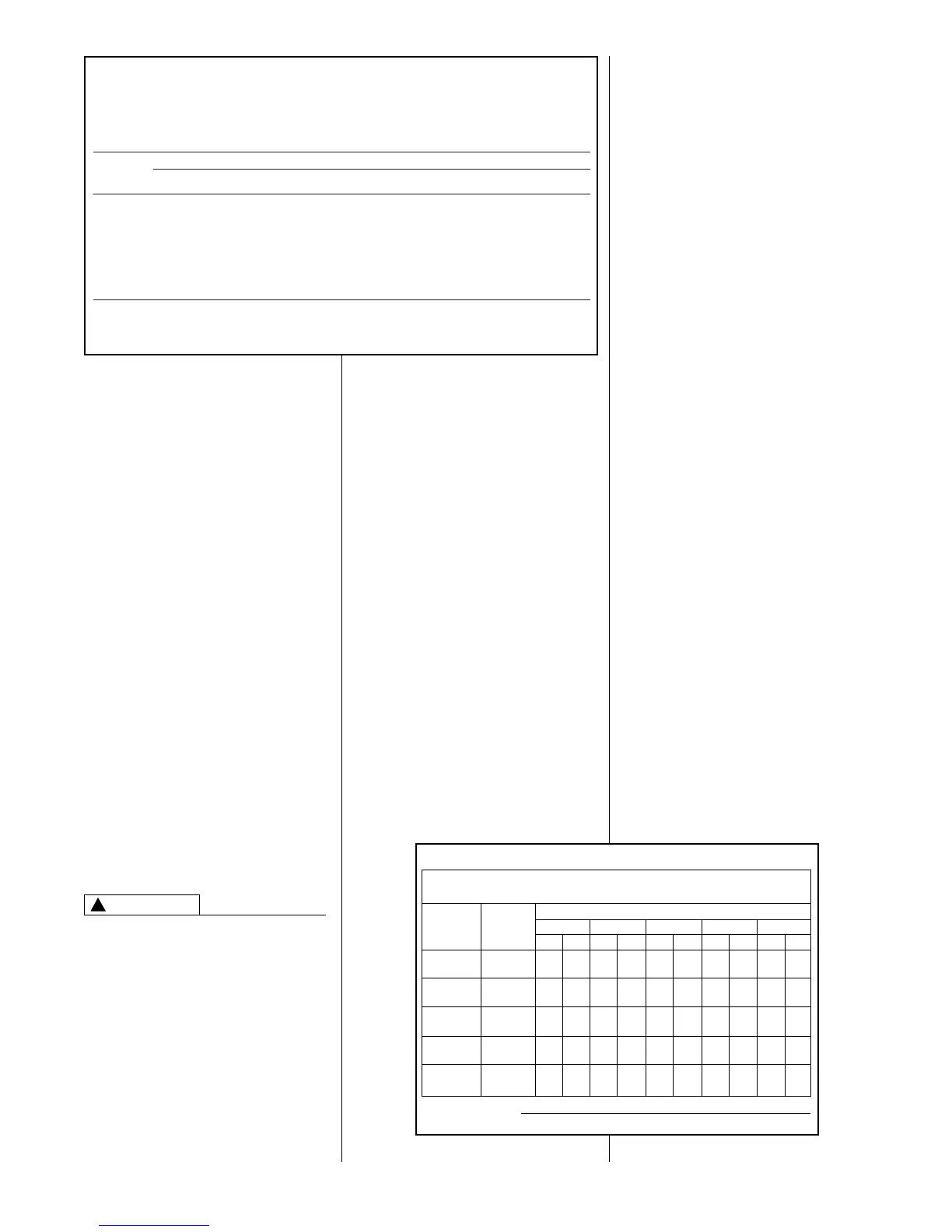
4. Use Table 4 to determine input rate.
13. Verify pressures for high and low
fire operation.
14. Shut off gas at the manual gas
valve and remove the U-Tube
manometer.
15. Replace the manifold pressure tap
plug before turning on gas.
NATURAL GAS:
If the supply gas line pressure is
above the operating range, install
an in-line gas regulator to the
furnace. If supply gas line pressure
is below the operating range, either
remove any restrictions in the gas
supply piping or enlarge the gas
pipe. See Table 7.
LP GAS:
If the supply gas line pressure is above
the operating range, have the LP
supplier reduce the line pressure at the
regulator. If supply gas line pressure is
below operating range, have the LP
supplier adjust the line pressure at the
regulator. See Table 8.
NOTE: Depending on the amount of LP
vapor and the outdoor ambient
temperature, the LP storage tank may
require supplemental heat to maintain
proper pressure levels.
ADJUSTING OR CHECKING
FURNACE INPUT
ELEVATIONS ABOVE 2000 FT
REQUIRE THAT THE FURNACE
INPUT RATING BE ADJUSTED AND
THAT THE SIZE OF THE BURNER
ORIFICES BE RE-CALCULATED
BASED ON ELEVATION AND GAS
HEATING VALUE. THE BURNER
ORIFICES MAY (OR MAY NOT) NEED
TO BE CHANGED. SEE THE SECTION
TITLED “HIGH ALTITUDE
INSTALLATIONS” OF THIS BOOK
FOR INSTRUCTIONS.
!
CAUTION
TABLE 4
METER TIME IN MINUTES AND SECONDS FOR NORMAL
INPUT RATING OF FURNACES EQUIPPED FOR NATURAL OR LP GAS
INPUT
BTU/HR
METER
SIZE
CU. FT.
HEATING VALUE OF GAS BTU PER CU. FT.
900 1000 1040 1100 2500
MIN. SEC. MIN. SEC. MIN. SEC. MIN. SEC. MIN. SEC.
ONE 1 5 1 12 1 15 1 18 3 20
50,000
TEN 10 50 12 00 12 30 13 12 30 00
ONE 0 44 0 48 0 50 0 53 2 0
75,000
TEN 712 8 0 819 84820 0
ONE 0 33 0 36 0 38 0 40 1 30
100,000
TEN 524 6 0 615 63615 0
ONE 0 26 0 29 0 30 0 32 1 12
125,000
TEN 419 448 5 0 51712 0
ONE 0 31 0 24 0 25 0 26 1 0
150,000
TEN 336 4 0 410 42010 0
Heating Value of Gas (BTU/Ft
3
) x 3600 x correction factor
Input BTU/HR =
Time in Seconds (for 1 cu.ft.) of Gas


 To Next Page
 Loading...