Need help?
Do you have a question about the Ryobi P500 and is the answer not in the manual?
Crucial information on preventing kickback, blade, and guard safety.
Best practices for securely supporting workpieces to prevent movement.
Guidelines for safe use of the charger, including extension cords.
Step-by-step guide for securely attaching and safely detaching the saw blade.
Explains kickback causes, dangers, and essential preventative measures.
Information on blade guards, maintaining blades, and safe saw operation.
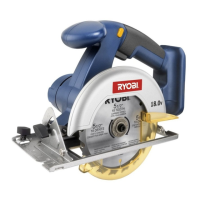
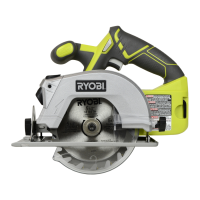
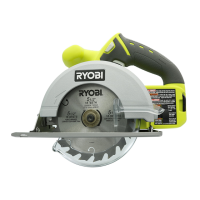
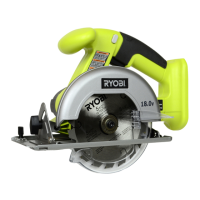
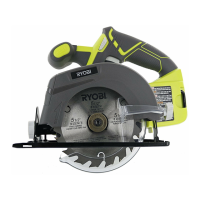
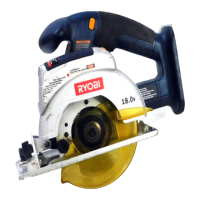
This document is an operator's manual for a Ryobi 5-1/2 inch, 18-volt laser circular saw, model P500. It provides comprehensive instructions for safe operation, assembly, adjustments, and maintenance of the tool.
The Ryobi P500 is a cordless circular saw designed for cutting various wood products such as lumber, plywood, and paneling. It is capable of performing cross cuts, rip cuts, bevel cuts, and pocket cuts. The saw is powered by an 18-volt battery pack (sold separately) and features a laser guide to assist with precise cutting. The laser guide projects a red line onto the workpiece, helping the user follow a marked cut line. The tool is engineered for dependability, ease of operation, and operator safety, aiming to provide years of rugged, trouble-free performance when properly cared for.
The saw incorporates several features to enhance usability and safety. The switch trigger is conveniently located on the underside of the handle, and a lock-off button is included to reduce the possibility of accidental starting. This button must be depressed before the switch trigger can be pulled and resets each time the trigger is released. The spindle lock allows the user to secure the blade for safe blade changes, but it should not be engaged while the saw is running. A blade wrench (5 mm hex key) is provided and has a dedicated storage area on the tool for quick access.
The saw's base includes a bevel adjustment knob, allowing for bevel cuts at angles between 0° and 51.5°. There's also a depth adjustment knob to set the blade depth, ensuring that the blade extends no more than 1/4 inch below the material being cut to minimize kickback and ensure a clean cut. A width of cut scale on the base helps measure cuts up to four inches to the right of the blade and one inch to the left. The lower blade guard is a critical safety feature, designed to cover the blade when not in use and retract automatically during a cut. Users are instructed to always ensure the lower guard is functioning correctly and never to tie it in an open position.
For optimal cutting, users are advised to hold the saw firmly with both hands, avoid placing hands on the workpiece during a cut, and support the workpiece properly to prevent movement and kickback. The saw should always be placed on the supported part of the workpiece, not the "cut off" piece. It's important to allow the blade to reach full speed before engaging the workpiece to prevent kickback. When making cuts, a straight edge guide or rip fence is recommended for accuracy, especially during rip cutting. The laser guide, when activated, projects a red line to assist in following marked cut lines, and its alignment can be adjusted if necessary.
Maintaining the Ryobi P500 involves several key practices to ensure its longevity and safe operation. Users are instructed to keep the saw and its handle dry, clean, and free from oil and grease, using a clean cloth for cleaning. It is crucial to avoid using brake fluids, gasoline, petroleum-based products, or strong solvents on plastic parts, as these chemicals can damage the tool's enclosure.
Blade maintenance is essential; blades should be kept clean, sharp, and properly set. Dull or gummed-up blades can lead to inefficient cutting and increased risk of kickback. Accumulations of gum and wood pitch can be removed using gum and pitch remover, hot water, or kerosene, but gasoline should never be used.
The lower blade guard system requires regular checks to ensure it moves freely and returns to the closed position. Any damage to the guard or its spring should be addressed by an authorized service center. Periodically, the tool should be inspected for misalignment, binding, or breakage of parts, and any damaged components should be repaired or replaced by an authorized service center.
Battery pack maintenance is also detailed. The battery packs are nickel-cadmium and should be charged only with the specified Ryobi charger. New battery packs require several charge/discharge cycles to reach full capacity. It's important to charge a cool battery pack; if the battery pack becomes hot from continuous use, it should be allowed to cool for about 30 minutes before recharging. For storage longer than 30 days, battery packs should be stored below 80°F and in a "discharged" condition. When removing battery packs for recycling, their terminals should be covered with heavy-duty adhesive tape to prevent short circuits.
The laser guide requires two AAA batteries, which can be replaced by removing the laser cover, taking out the old batteries, and installing new ones with correct polarity. After replacement, the laser's alignment should be checked and adjusted if needed. All service and repairs, especially those involving internal components, should be performed by qualified repair personnel using identical replacement parts to avoid hazards and product damage.
 General
| Type | Circular Saw |
|---|---|
| Weight | 6.5 lbs |
| Voltage | 18 V |
| Battery Compatibility | Ryobi ONE+ 18V |
| Power Source | Battery |
| Blade Size | 6.5 inches |

 To Next Page