Need help?
Do you have a question about the Sabiana SK 42 and is the answer not in the manual?
Read this user manual carefully for your own safety and to prevent damage to the fan-coil unit.
All personnel must be trained; responsibilities must be clearly defined.
All electrical work must be done by or supervised by qualified electricians.
All hydraulic work must be done by qualified installers or trained personnel.
Assembly, installation, and maintenance must comply with health/safety laws, codes, and latest technology.
All repairs or maintenance must be performed by qualified specialists.
Any modification affecting safety requires manufacturer approval, including safety devices and valves.
Installation, electrical work, and repairs require qualified, experienced personnel familiar with safety rules, accident prevention, and codes.
Skilled workers must understand their work and identify/avoid potential risks.
All installation, startup, and maintenance must follow health/safety rules and the latest technology.
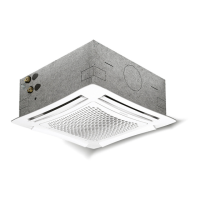
Tilt and push the fan-coil unit through the opening, ensuring the terminal box faces upwards.
The appliance must then be fixed to the threaded rods.
It is essential for the appliance to be exactly level.
Always use original spare parts when replacing components.
Never perform any operation or maintenance without first disconnecting the appliance from the electrical supply.
Warning about dangerous voltage and the need to disconnect power and wait for capacitor discharge.
Never tamper with or modify regulation/safety devices without prior authorization and instructions.
Lists basic specifications for fan coil and heat exchanger, including temperatures, pressure, and voltage.
Tables detailing technical specifications like water connections for different models and pipe configurations.
Install appliance to ensure air intakes are free from obstructions.
Outlines the step-by-step procedure for installing the fan-coil unit.
All departing air ducts must have thermal insulation to avoid condensation and dripping water.
Shows how to connect valves to the fan-coil unit.
Table showing valve types, ways, Kvs, pressure drop, and connection sizes for SK12-36 models.
Table showing valve types, ways, Kvs, pressure drop, and connection sizes for SK42-56 models.
Perform electrical connections according to current national laws and regulations.
Before installing, verify the nominal power supply voltage is 230V - 50 Hz.
For electronic controllers, the 0-10Vdc signal must come from the controller itself, located in the metallic shunt panel.
The unit must always be earthed.
Always disconnect electrical power before opening the unit.
Connections must be made respecting the electrical diagrams in this booklet.
Motor is protected by an integrated thermal contact that stops it on overheating and restarts it automatically.
Level control starts drain pump; high condensate level triggers water valve shut-off.
Consider leakage current when designing power lines and protection for electronic appliances with filters.
Diagram shows the 230Vac 50Hz power supply connection to the unit.
Legend explaining the meaning of symbols and abbreviations used in the wiring diagram.
Shows connections for safety thermostats (manual/automatic reset, cut-off temps).
Follow valve manufacturer instructions for installation; refer to drawings for Cassette connections.
Insulate piping, valves, and coil connections to prevent ceiling condensation in cold water systems.
Wiring diagrams for connecting the valves.
Critical for correct valve operation; connect valves according to suggested wiring diagrams.
Critical safety instruction: Ensure power is off before cleaning or maintenance.
Diagnoses and solutions for the motor not running or running incorrectly.
Diagnoses and solutions for the unit not heating or cooling as before.
Diagnoses and solutions for water leakage from the appliance.
Fan-coil units must be disconnected from mains power before maintenance.
Troubleshooting for fan not starting, including checks for power, connections, and switch positions.
Troubleshooting for insufficient airflow, covering fan speed, duct obstruction, and filter condition.
Troubleshooting for noisy fan, including fan speed, air outlet temperature, and bearing issues.
Troubleshooting for insufficient heating, including fan operation, fluid temperature, water flow, and setpoint.
Troubleshooting for insufficient cooling, including fan operation, fluid temperature, water flow, and setpoint.
Troubleshooting for leaks during cooling mode, including condensate tray, pipe insulation, unit level, and drain.
Troubleshooting for inconsistent room temperature, including control placement, fluid temperature, and water line setup.
 General
| Type | Split System |
|---|---|
| Energy Efficiency Ratio (EER) | 3.2 |
| Refrigerant | R410A |
| Outdoor Unit Weight | 32 kg |
| Mounting | Wall Mounted |


 To Next Page