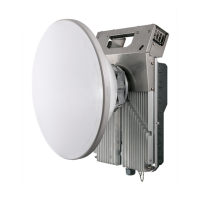
INTEGRA/-S/-G/-GS User Manual WEB GUI
SAF Tehnika JSC
“s” suffix indicates “ETSI or “ETSI class 4L” (for 56 MHz).
“_VP” suffix indicates "Variable Tx power”.
“_W” suffix indicates “Weak FEC” modulation.
modem configuration set
factory
Use to reset modem settings to factory defaults –
bandwidth and modulation will be reset to a minimum.
modem loopback [{none | digital
<time>}]
Use to check, disable, or enable modem loopback for n
seconds.
Use to check the list of available modem configurations.
Over The Air → Modem → Aggregation/protection configuration
Integra/Integra-S/Integra-G/Integra-GS 2+0 aggregation (link bonding) provides ACM-aware
binding of user-available capacities of two parallel links each using an individual frequency
pair. Traffic is split per-frame over two links on the modem level.
2+0 aggregation is not based on MAC-MAC connections. A single MAC address (e.g.
router) can be used.
Integra/Integra-S/Integra-G/Integra-GS 2+0 aggregation features full link
synchronization/power/cable redundancy by reconfiguring to 1+0 operation mode in case of
failure.
Full 2+0 to 1+0 redundancy will operate only when an external switch is used. Please see
below interconnection schemes c and d.
Integra/Integra-S/Integra-G/Integra-GS 1+1 protection provides Hot Standby redundancy of
user-available capacities of two parallel links each using the same frequency pair. Traffic is
using only one link at a time. Transmitters of the second link will be automatically muted.
Full 1+1 redundancy (including cables, power, HW protection) will be available only when an
external switch is used. Please see below interconnection schemes c and d.
Header compression cannot be used with 2+0 aggregation configured.
Two pairs of Integra/Integra-G or Integra-S/Integra-GS FODUs are required. In the case of
2+0 aggregation with Integra-S/Integra-GS OMT, a dual-polarized antenna, or a coupler can be
used. In the case of 1+1 HSB with Integra-S/Integra-GS, only a coupler can be used (as only a
single frequency pair in the same polarization is being utilized).
Necessary equipment for Integra/Integra-S/Integra-G/Integra-GS 2+0 or 1+1
1. 4 Integra/Integra-S/Integra-G/Integra-GS FODUs – 2 low side, 2 high side;
2. 2 or 4 SFP modules and appropriate FO cables (multi-mode or single-mode) for
Integra/Integra-S/Integra-G/Integra-GS interconnection (depending on
interconnection scheme a, b, c or d; see below);
3. Electrical or optical Ethernet cables (together with corresponding SFP modules) for
user traffic (depending on chosen interconnection scheme);
4. In the case of Integra-S/Integra-GS – additionally, 4 antennas, or 2 antennas and
OMT/couplers. Please refer to the chapter Integra-S/Integra-GS 6-13GHz* 2+0 &
OMT interconnection for instructions on Integra/Integra-S/Integra-G/Integra-GS
installation to an antenna or an OMT.
General configuration guide
1. Do not interconnect Integra/Integra-S/Integra-G/Integra-GS with each other and do
not plug Integra/Integra-S/Integra-G/Integra-GS into switches before you have
finished the configuration of each node.
2. Choose one link (low/high side radio) which will operate as the “Master”. The
second link will operate as the “Slave”;
3. Configure radio/modem parameters for each link. Channel bandwidths must be the


 To Next Page
 Loading...