Need help?
Do you have a question about the Saft Ni-Cd and is the answer not in the manual?
Steps for operating the watering cart, including battery connection, filling, and pump activation.
Instructions for selecting and attaching spacer tubes, inserting the probe, and dispensing water correctly.
The Saft Ni-Cd battery topping-up equipment is a specialized system designed to facilitate the precise and safe replenishment of water in large Ni-Cd battery installations, particularly where electrolyte levels are difficult to observe. This equipment is crucial for maintaining optimal battery performance and longevity by ensuring proper electrolyte levels.
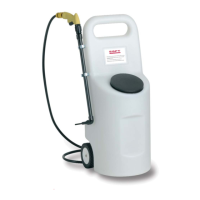
The complete topping-up system consists of two primary components: a filling pistol and a watering cart. The filling pistol is engineered for accurate water delivery, featuring a flow rate of 8 liters per minute. Its key functionality lies in its automatic shut-off mechanism, which activates once the correct electrolyte level is reached, provided the appropriate spacer tube is used. This prevents both overfilling and underfilling, which are critical for battery health. The watering cart serves as the water reservoir and pump unit, connected to the filling pistol via a flexible hose. It ensures a dependable water source and consistent pressure for efficient topping-up. The system is designed to simplify the maintenance process for Ni-Cd batteries, making it more efficient and less prone to human error.
Operating the topping-up equipment involves several steps to ensure safe and effective use. Before commencing any work, it is imperative to remove all metal items such as rings and watches to prevent accidental short circuits or other hazards. Users must wear appropriate protective gear, including rubber gloves, long sleeves, closed goggles, or a face shield, as electrolyte is corrosive. Open flames or sparks should never be near the battery, and smoking is strictly prohibited during operation. To prevent static electricity discharge, users should touch an earth-connected "ground" part before handling the battery. Only insulated tools should be used.
The watering cart requires initial setup. The battery for the cart is shipped disconnected and must be connected according to the provided instructions before use. The tank should be filled exclusively with distilled or de-ionized water, adhering to IEC 60993 standards; tap water must never be used. Once filled, the cap should be replaced. The output hose of the watering cart is then connected to the bottom of the filling pistol's handle using the preassembled quick connector. The power switch on the back of the cart is turned to the ON position, which will energize the pump for a few seconds before it stops.
For the filling pistol, selecting the correct spacer tube is paramount. The manual provides a list of spacer tubes corresponding to different cell types, each marked with an identity letter. The chosen spacer tube is attached to the front end of the probe, ensuring it is pushed completely against the probe top with no visible space. The cell's vent cap is opened, and the probe is inserted until the spacer tube rests on the open vent hole. The handle is then pressed and held until the pistol automatically stops dispensing water, after which the handle is released. The probe is removed, and the process is repeated for other cells. Some water may drip from the probe after release, which should be allowed to drain into the cell or another suitable location. Once all topping-up is complete, the power switch on the watering cart is turned to the OFF position.
Proper maintenance of the topping-up equipment ensures its continued reliability and effectiveness. The watering cart's battery needs to be charged as needed, with a full charge taking approximately 13 hours. It is important to keep the battery at a good level of charge. A crucial note for operation is that the watering cart cannot be operated while its charger is connected to the battery. A fully charged cart battery provides approximately 2 hours of continuous run time, with longer durations possible during intermittent use.
The equipment should always be dedicated to Ni-Cd batteries to prevent cross-contamination or damage. The use of correct spacer tubes is emphasized to prevent overfilling or underfilling, which can negatively impact battery performance and lifespan. In the event of skin or eye contact with electrolyte, immediate washing with plenty of water is required. If eyes are affected, flushing with water and immediate medical attention are necessary. Adhering to these maintenance and safety guidelines will ensure the longevity of both the topping-up equipment and the Ni-Cd batteries it serves.
 General
| Brand | Saft |
|---|---|
| Nominal Voltage | 1.2V per cell |
| Energy Density | 40-60 Wh/kg |
| Chemistry | Nickel-Cadmium (Ni-Cd) |
| Memory Effect | Yes |

 To Next Page