33
Changing gear oil
Be sure the outboard motor is securely fastened to the transom or a stable
stand. You could be severely injured if the outboard motor falls on you.
Never get under the lower unit while it is tilted, even when the tilt su-
pport lever or knob is locked. Severe injury could occur if the outbo-
ard motor accidentally falls.
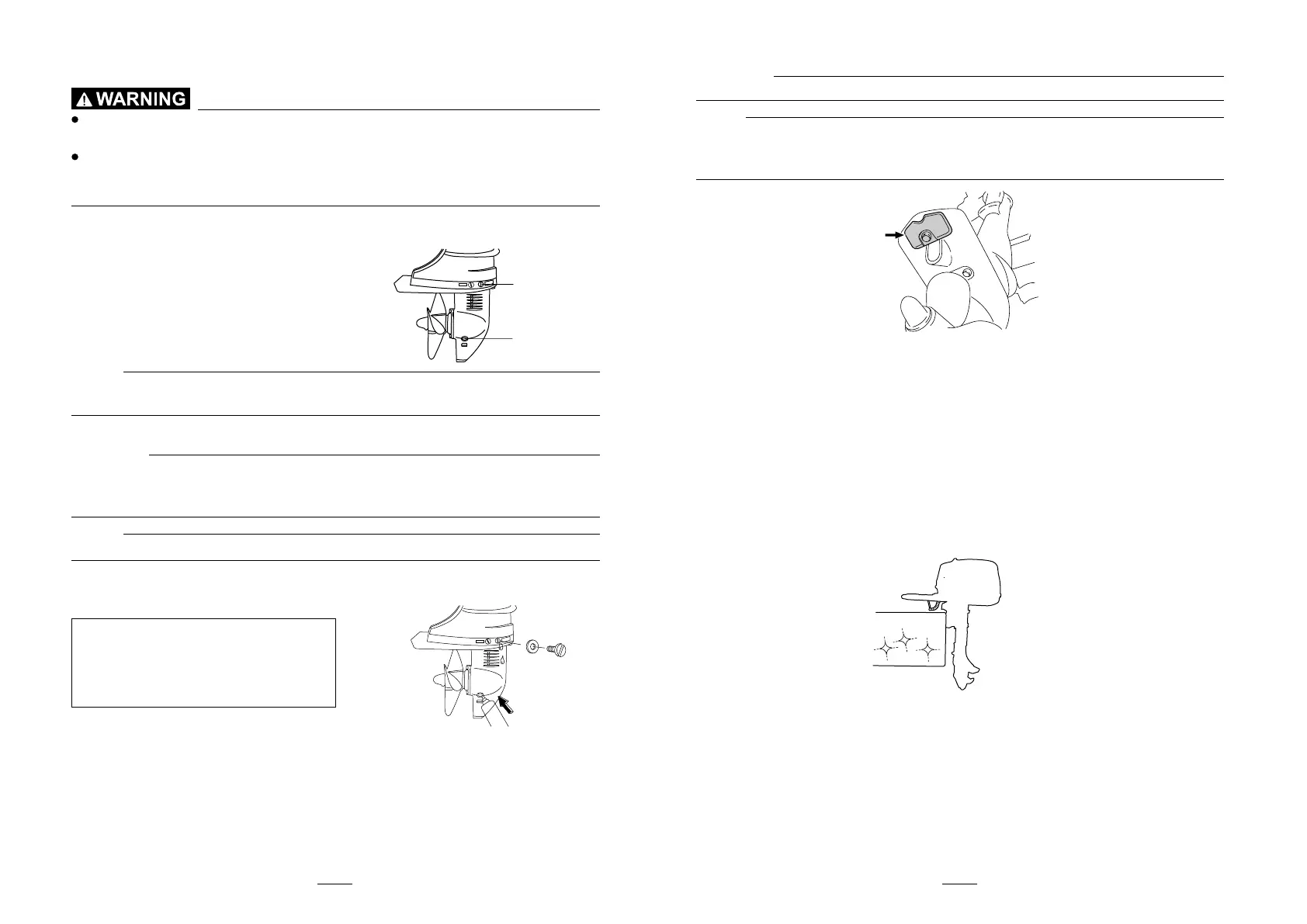
1. Tilt the outboard motor so that the gear oil drain screw is at the lowest point possible.
2. Place a suitable container under the gear case.
3. Remove the gear oil drain screw.
1. Gear oil drain screw
2. Oil level plug
NOTE:
If the magnetic gear oil drain screw equipped: remove all metal particles
from the screw before installing it.
4. Remove the oil level plug to allow the oil to drain completely.
CAUTION:
Inspect the used oil after it has been drained. If the oil is millky, water is
getting into the gear case which can cause gear damage. Consult a dealer
for repair of the lower unit seals.
NOTE:
For disposal of used oil consult your dealer.
5. With the outboard motor in a vertical position, and using a flexible or pres-
surized filling device, inject the gear oil into the gear oil drain screw hole.
Recommended gear oil:
Hypoid gear oil SAE#90
Gear oil quantity:
120 cm3 (4.064 US oz)(4.24 Imp.oz)
6. When the oil begins to flow out of the oil level plug hole, insert and tighten
the oil level plug.
7. Insert and tighten the gear oil drain screw.
Inspecting and replacing anode(s)
Outboard motors are protected from corrosion by sacreficial anodes. Inspect
the external anodes periodically. Remove scales from the surfaces of the
anodes. Consult a dealer for replacement of external anodes.
2
1
32
CAUTION:
Do not paint anodes, as this would render them ineffective.
NOTE:
Inspect ground leads attached to external anodes on equipped models. Con-
sult a dealer for inspection and replacement of internal anodes attached to t-
he power unit.
Checking top cowling
Check the fitting of the top cowling by pushing it with both hands. If it is loose
have it repaired by your dealer.
Coating the boat bottom
A clean hull improves boat performance. The boat bottom should be kept as
clean of marine growth as possible. If necessary, the boat bottom can be co-
ated with an antifouling paint approved for your area to inhibit marine growth.
Do not use anti-fouling which includes copper or graphite. These paints can
cause more repid engine corrosion.



 To Previous Page