5-6 In case of emergency
JUMP STARTING
CAUTION:
Use a battery rated at 12 volts
for a booster.
1. Remove vent caps on the
battery (if so equipped).
Cover the battery with an old
cloth as shown.
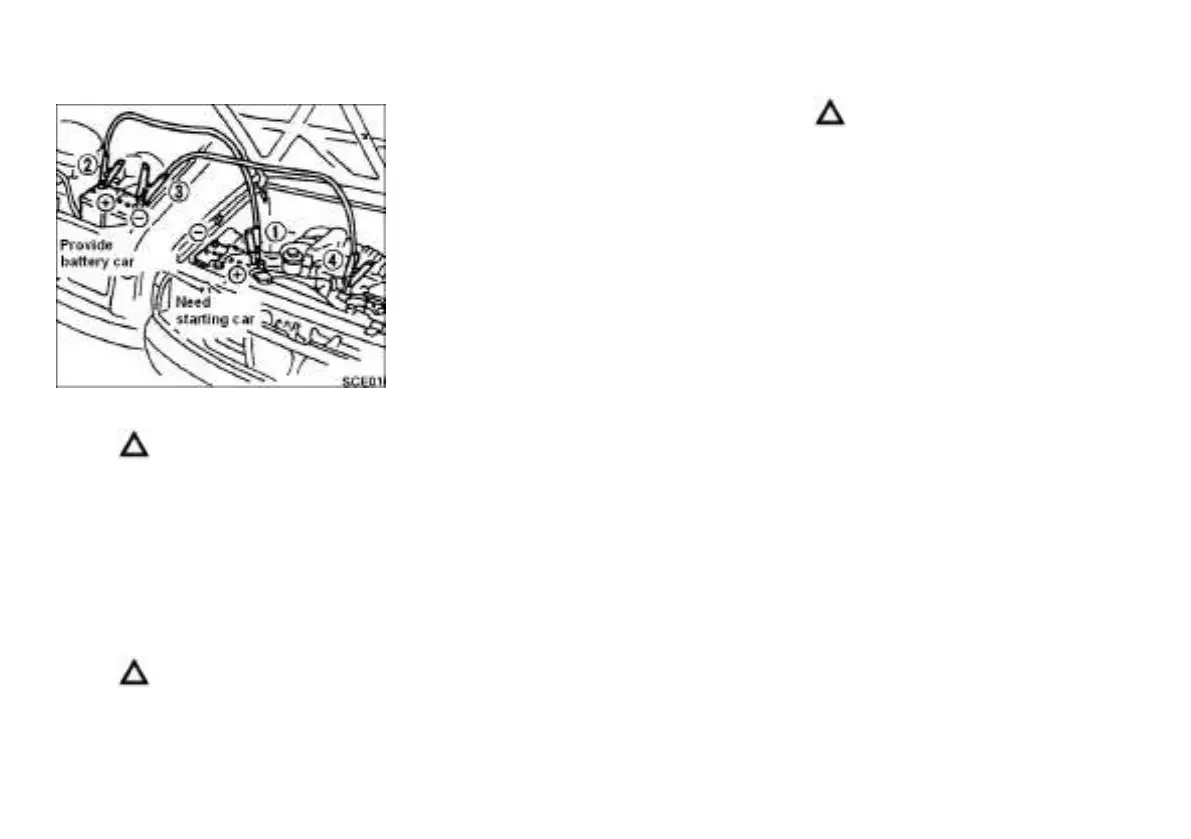
2. Connect jumper cables in the
sequence as illustrated.
CAUTION:
An incorrect connection could
result in damage to the
charging system.
3. Start the engine of the other
vehicle and let it run for a few
minutes. Keep the engine
speed at about 2,000 rpm,
and start your engine in the
normal manner.
4. After starting your engine,
carefully disconnect the
negative cable and then the
positive cable.
5. Replace the vent caps (if so
equipped).
If your vehicle is equipped
with dual batteries, it is not
necessary to connect a booster
battery to both batteries; one
battery is enough. Jump starting
procedure is the same as that for
single battery models. Follow the
instructions and precautions in
the preceding page.
PUSH STARTING
CAUTION:
Automatic transmission
models cannot be started by
pushing. This may cause
transmission damage.
Never try to start the
vehicle by towing it; when the
engine starts, the forward
surge could cause the vehicle
to collide with the tow vehicle.
Gasoline engine
1. Turn the ignition key to “ON”.
2. Hold the clutch pedal fully
depressed and shift into
second or third. Place the
transfer in “2H” and
free-running hubs in the
“FREE” position (models with
manual-lock free-running
hub).
3. Hold the accelerator pedal
about halfway.
4. Start pushing, and when the
vehicle reaches a speed of
about 16 km/h, slowly
releases the clutch pedal to
start the engine.


 To Next Page