
 Need help?
Do you have a question about the Samsung AM072FXVAFH/AA and is the answer not in the manual?
Essential guidelines for performing service tasks correctly, including part selection and connection integrity.
Procedures to prevent damage from static electricity and protect against potential hazards during handling.
Critical safety measures to prevent electric shock, fire, and other hazards during operation and maintenance.
Safety and environmental guidelines for handling refrigerants, covering release risks and container management.
Procedures and safety measures to follow when welding air conditioner pipes, including refrigerant removal.
Guidelines for adding refrigerant, emphasizing precise calculation and avoiding hazardous methods like heating containers.
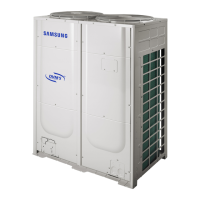
This document serves as a service manual for the Samsung System Air Conditioner Outdoor Unit, covering models AM072/096/120/144FXVAFH, AM072/096/120/144FXVAFR, AM072/096/120/144FXVAJH, and AM072/096/120/144FXVAJR. It provides comprehensive information for servicing and maintaining these units.
The manual begins with a crucial section on precautions, emphasizing safety during service operations. It advises using correct parts for electrical component changes, ensuring proper harness connections to prevent irregular noise and problems, and laying the product on a work cloth during disassembly or assembly to avoid scratching. Technicians are instructed to thoroughly remove dust and foreign substances from housing, connections, and inspection parts to prevent fire hazards. Proper tightening of the service valve and charging valve cap using a monkey spanner is also highlighted. Furthermore, it stresses the importance of checking that all parts are securely assembled after repairs.
Specific precautions for static electricity and PL (Product Liability) are outlined, urging careful handling of PCB power terminals when the unit is on, recommending insulation gloves for PCB repair, and advising installation at least 2m away from electronic appliances to prevent interference. The manual strictly prohibits customers from repairing the product themselves to avoid electric shock or fire.
Safety precautions include not touching the power plug or subsidiary power switch with wet hands, immediately replacing damaged power lines or plugs, and avoiding bending wires or placing heavy objects on them. The use of multiple electric outlets is forbidden, and grounding connections are required where there is a risk of electrical short. Technicians must unplug the power or turn off the subsidiary power switch before changing or repairing electrical parts. For remote controls, batteries should be removed during long-term storage to prevent fluid leakage.
Regarding refrigerant handling, the manual warns about environmental pollution from gas release and safety concerns such as frostbite from liquid gas, suffocation from lack of oxygen, and the production of noxious gases if released gas is heated. It also advises against subjecting refrigerant containers to physical shock or overheating.
For welding air conditioner pipes, all dangerous or flammable objects must be removed. Refrigerant must be removed from the product or pipe before welding to prevent improper welding, noxious gas production, and potential explosions due to increased refrigerant pressure. Nitrogen gas should be used to remove oxide produced inside the pipe during welding.
When supplementing refrigerant, precise calculation using a scale and S-net is crucial, followed by a test operation. Excessive refrigerant can cause liquid refrigerant inflow into the compressor. Heating the refrigerant container for forced injection is prohibited as it may cause the container to burst. Operating the product after removing the safety pressure switch and sensor is also forbidden due to the risk of excessive pressure increase. Finally, the manual emphasizes ensuring no pipe leakage after installation and stopping the compressor before removing connecting pipes to prevent air and other substances from entering the pipe, which could lead to excessive high pressure and explosion.
The product features section details the Dual Smart Inverter System, which includes both DSC (Digital Smart Compressor) and DSI (Digital Smart Inverter) technologies. The DSC system utilizes DVI variable and constant speed AC motors with 2nd generation vapor injection. The DSI system features Dual Smart Inverters (SSC + SSC) with BLDC Inverter Motors capable of 20-160Hz driving and 3rd generation vapor injection, maximizing performance for low-temperature heating. The Dual SSC System Technology allows for soft capacity adjustments through continuous operation of the Dual Inverter when load changes occur.
An innovative Inverter circuit refrigerant cooling technology is applied, using a high-efficiency refrigerant cooling circuit to ensure stable Inverter PCB cooling performance. Unlike air cooling, which can be inefficient under high loads, the refrigerant cooling system uses forced circulation, leveraging the superior thermal conductivity of refrigerant (10 times higher than air) to manage heat effectively.
The manual also highlights changes in comparison to basic models. The cabinet color has been updated to Earth Brown from Touch Gray, and the wire harness installation part and LOGO have been changed. The control box and PCB structure have evolved from a monolayer to a double-layer design, integrating inverter technology for inverter control circuit composition and maximizing control box volume. It now features a built-in controller, integrated power supply, and control unit, simplifying piping service.
Key PCB components have been updated: the Main PCB is now separated for load/control, with option resistance deleted for standardization, and requires option download upon replacement. A new Hub PCB is introduced for load/control separation and enhanced fixing of load/sensor wires. The FAN PCB uses a 3-phase power controller to prevent phase unbalance and includes IPM temperature protection. The Inverter PCB (Compressor Control PCB) is designed for applied inverter compressors, utilizing refrigerant cooling, and now incorporates a power relay mount. The EMI PCB is a 3-phase power EMI PCB with a fuse mount. The Communication Terminal block is now mounted directly to the PCB.
Pipe cooling has been introduced as a new feature for the inverter PCB, replacing the unapplied basic model. The tube structure also reflects new inverter cycle technology applications and new piping designs for both HP (Heat Pump) and HR (Heat Recovery) models.
The manual provides detailed diagrams and parts lists for various PCBs, including Main, Main-HUB, Inverter, Fan, EMI, and SUB-COMM. It also includes wiring diagrams for different models and comprehensive cycle diagrams illustrating cooling and heating operations for various configurations (H/R and H/P). Explanations of cycle component functions are also provided.
Key options are covered, including outdoor unit option switch settings and instructions on how to set the key function of the outdoor unit and check the view mode using a tact switch.
The test operation section outlines auto trial operation, including its synopsis, functions, troubleshooting for "Undetermined" errors, and error codes. It also describes the process for automatically checking the amount of refrigerant.
Finally, a reference sheet provides nomenclature for various components, ensuring clarity and consistency in terminology throughout the service process. This comprehensive manual is an essential resource for technicians to safely and effectively service Samsung System Air Conditioner Outdoor Units.
 General
| Model | AM072FXVAFH/AA |
|---|---|
| Cooling Capacity | 72, 000 BTU/h |
| Refrigerant | R410A |
| Voltage | 208-230 V |
| Phase | 1 |
| Compressor Type | Rotary |
| Power Source | Electric |
| Power Supply | 208-230V/60Hz/1Phase |
| Operating Temperature (Heating) | 5°F to 75°F |



 To Next Page