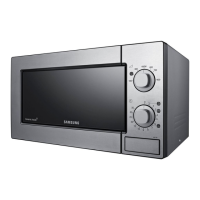
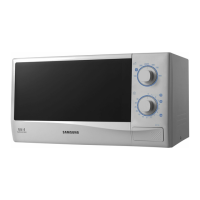
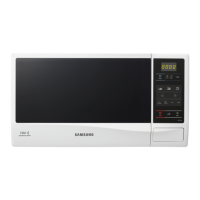
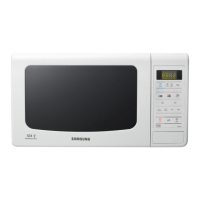
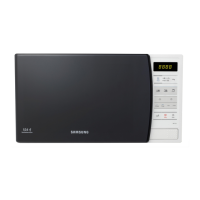
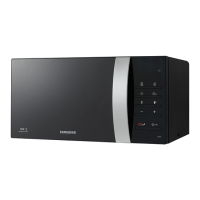
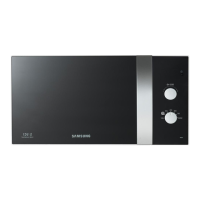
This document serves as the owner's instructions and cooking guide for the Samsung Microwave Oven models ME711K, ME712K, and ME713K. It emphasizes safety, proper usage, and maintenance to ensure optimal performance and longevity of the appliance.
Function Description
The Samsung Microwave Oven is designed primarily for heating food and beverages using microwave energy. It offers various power levels and a timer function to control cooking duration. The appliance is intended for domestic household use, providing a convenient and efficient way to prepare meals.
Microwave Function:
The core function of the oven is microwave cooking. Microwaves penetrate food, causing water molecules to vibrate and generate heat, cooking the food from within. This method is fast and efficient for many types of food. The oven has a maximum power output of 800W (IEC-705 rating), which is a standardized international rating for microwave ovens.
Power Levels:
The oven provides several power levels, allowing users to adjust the intensity of microwave energy for different cooking needs:
- HIGH (800 W): For fast cooking and reheating.
- REHEAT (700 W): Suitable for reheating various dishes.
- MEDIUM HIGH (600 W): A versatile setting for general cooking.
- MEDIUM (450 W): Ideal for more delicate cooking or simmering.
- MEDIUM LOW (300 W): For gentle cooking or melting.
- DEFROST (180 W): Specifically designed for defrosting frozen foods.
- LOW (100 W): For very gentle heating or keeping food warm.
Higher power levels require shorter cooking times, while lower power levels require longer times.
Defrost Feature:
The manual defrosting feature allows users to thaw frozen meat, poultry, and fish. To use this, the MICROWAVE knob is turned to the "Defrost" symbol, and the TIMER knob is used to select the appropriate defrosting time. It is crucial to use microwave-safe recipients for defrosting.
Instant Reheat Feature:
This feature provides quick reheating options for specific food categories: "Drinks," "Soup/Sauce (chilled)," and "Fresh Vegetables." To use it, the MICROWAVE knob is set to Max Power, and the TIMER knob is turned to select the desired Instant Reheat category. This simplifies the reheating process by pre-setting optimal times for common items.
Usage Features
The microwave oven is designed for straightforward operation, with a control panel featuring two main knobs: the MICROWAVE knob for power level selection and the TIMER knob for setting cooking duration and instant reheat options.
Control Panel:
The control panel consists of:
- DEFROST: A setting on the MICROWAVE knob for manual defrosting.
- MICROWAVE KNOB: Used to select the desired power level (100W, 300W, 450W, 600W, 700W, 800W, or Defrost).
- TIMER KNOB: Used to set the cooking time, up to 35 minutes, and to select Instant Reheat categories.
- INSTANT REHEAT: Specific settings on the TIMER knob for Drinks, Soup/Sauce, and Fresh Vegetables.
Cooking/Reheating Procedure:
- Place food in the center of the turntable and close the door.
- Turn the MICROWAVE knob to select the desired power level (e.g., 800W for maximum power).
- Turn the TIMER knob to set the cooking time.
- The oven light will turn on, and the turntable will begin rotating, indicating that cooking has started.
- Cooking can be stopped temporarily by opening the door or completely by turning the TIMER knob to "0."
Adjusting Cooking Time:
The remaining cooking time can be adjusted at any point by rotating the TIMER knob.
Stopping Cooking:
- Temporarily: Open the oven door. Cooking will pause. Close the door to resume.
- Completely: Turn the TIMER knob to "0."
Accessories:
The oven comes with essential accessories for proper operation:
- Roller Ring: Placed in the center of the oven, it supports the turntable.
- Turntable: Placed on the roller ring, fitting into the coupler. It serves as the main cooking surface and rotates to ensure even cooking. It can be easily removed for cleaning.
- Important Note: The microwave oven should NOT be operated without the roller ring and turntable in place.
Cookware Guide:
Selecting appropriate cookware is crucial for microwave cooking. The guide provides recommendations:
- Microwave-Safe Utensils: Only use utensils explicitly marked as microwave-safe.
- Avoid Metal: Do NOT use metallic containers, dinnerware with gold or silver trimmings, skewers, or forks, as these can cause electric arcing or sparking and damage the oven.
- Aluminum Foil: Can be used in small quantities to shield areas from overcooking, but avoid placing it too close to oven walls or using too much, as this can cause arcing.
- Browning Plate: Suitable for browning foods, but do not preheat for more than eight minutes.
- China and Earthenware: Porcelain, pottery, glazed earthenware, and bone china are generally suitable unless they have metal trim.
- Disposable Polyester Cardboard Dishes: Some frozen foods come in these, which are suitable for microwave use.
- Fast-Food Packaging:
- Polystyrene Cups/Containers: Can be used to warm food, but overheating may cause melting.
- Paper Bags or Newspaper: May catch fire and should be avoided.
- Recycled Paper or Metal Trims: May cause arcing and should not be used.
- Glassware: Oven-to-tableware and fine glassware are generally suitable. Glass jars can be used for warming, but lids must be removed.
- Paper: Plates, cups, napkins, and kitchen paper are suitable for short cooking times and absorbing moisture. Recycled paper may cause arcing.
- Plastic: Heat-resistant thermoplastic containers are suitable. Some plastics may warp or discolor at high temperatures; avoid melamine plastic. Cling film can retain moisture but should not touch food. Freezer bags, if boilable or oven-proof, can be used but should not be airtight and may need to be pricked with a fork.
- Wax or Grease-Proof Paper: Can be used to retain moisture and prevent spattering.
Maintenance Features
Regular cleaning and proper maintenance are essential for the safe and efficient operation of the microwave oven.
Cleaning the Microwave Oven:
The following parts should be cleaned regularly to prevent grease and food particles from accumulating:
- Inside and Outside Surfaces: Wipe with a soft cloth and warm, soapy water, then rinse and dry.
- Door and Door Seals: Clean with a soapy cloth, rinse, and dry. Ensure no particles accumulate that could prevent the door from closing correctly.
- Turntable and Roller Rings: Wash these dishwasher-safe parts whenever necessary.
Cleaning Tips:
- To loosen hardened food particles and remove smells, place a cup of diluted lemon juice in the oven and heat for ten minutes at maximum power.
- Clean the oven cavity immediately after each use with a mild detergent solution, allowing it to cool first to avoid injury.
- For models with a swing heater, the heater can be turned downward by 45° for easier cleaning of the upper part of the cavity.
- DO NOT spill water in the vents.
- NEVER use abrasive products or chemical solvents for cleaning.
- DO NOT use high-pressure water cleaners or steam jet cleaners.
- DO NOT use harsh abrasive cleaners or sharp metal scrapers on the oven door glass, as this can scratch the surface and lead to shattering.
General Maintenance and Safety:
- Door Seals: Always ensure the door seals are clean and the door closes properly. Failure to maintain clean conditions can lead to deterioration of surfaces and hazardous situations.
- Power Cord and Plug:
- Regularly clean dust and water from power plug terminals with a dry cloth.
- Do not pull, excessively bend, or place heavy objects on the power cord.
- If the supply cord is damaged, it must be replaced by the manufacturer, its service agent, or similarly qualified persons to avoid hazards.
- Plug the power plug firmly into a proper AC earthed socket. Do not use multiple plug adapters, extension cords, or electric transformers.
- If the oven generates strange noises, a burning smell, or smoke, unplug it immediately and contact a service center.
- Ventilation: Ensure adequate ventilation by leaving at least 10 cm (4 inches) of space behind and on the sides, and 20 cm (8 inches) of space above the oven.
- Placement: Place the oven on a flat, level surface 85 cm above the floor, strong enough to bear its weight. The microwave oven is intended for counter or countertop use only and should not be placed in a cabinet.
- Light Bulb: The light bulb should not be replaced by the user for safety reasons. Contact an authorized Samsung customer care center for replacement.
- Repairs: Only qualified microwave service technicians trained by the manufacturer should perform repairs. Never remove the outer casing. If the oven is faulty or damaged (e.g., broken hinge, deteriorated seals, distorted casing), it must not be used and should be serviced by a qualified technician.
- Storage: If storing the oven temporarily, choose a dry, dust-free place to prevent dust and damp from affecting internal working parts.
Important Safety Instructions:
- Children: Children aged 8 years and above, and persons with reduced physical, sensory, or mental capabilities, or lack of experience, can use the appliance if supervised and instructed on safe use, understanding the hazards. Children should not play with the appliance. Cleaning and user maintenance should not be done by children unless they are aged 8 and above and supervised.
- Heating Liquids: Microwave heating of beverages can result in delayed eruptive boiling. Always allow a standing time of at least 20 seconds after heating and stir during and after heating to equalize temperature and prevent scalding.
- Sealed Containers: Liquids and other foods must not be heated in sealed containers as they are liable to explode.
- Eggs: Eggs in their shell and whole hard-boiled eggs should not be heated in microwave ovens as they may explode.
- Food Containers: When heating food in plastic or paper containers, keep an eye on the oven due to the possibility of ignition.
- Overheating: Do not operate the oven when empty. It will automatically shut down for 30 minutes for safety. Placing a glass of water inside can absorb microwave energy if accidentally started.
- Ventilation Slots: Do not cover ventilation slots with cloth or paper, as this can cause overheating and fire.
- Oven Mitts: Always use oven mitts when removing dishes to avoid burns.
- Stirring Liquids: Stir liquids halfway through heating or after heating ends, and allow at least 20 seconds standing time to prevent eruptive boiling.
- Interference: Slight interference with televisions or radios may occur during oven operation. Install the oven away from these devices.
- Electrical Shock: Ensure the appliance is switched off before replacing the lamp to avoid electric shock.
- Hot Surfaces: Accessible parts and heating elements become hot during use. Care should be taken to avoid touching them, and young children should be kept away.
- Installation: Install the oven according to specified clearances. Do not install near heaters, inflammable materials, or in humid, oily, dusty, or uneven locations.
- Earthing: The appliance must be properly earthed. The mains lead includes an earth wire for connection to the earth terminal of the mains plug.
This comprehensive guide ensures users can safely and effectively operate and maintain their Samsung Microwave Oven.


 To Next Page

 General
 Weight and Dimensions