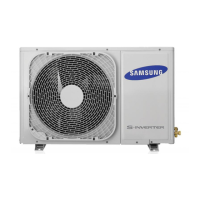
What to do if my Samsung RD060PHXEA Heat Pump shows an over current error?
- AAdam LewisAug 21, 2025
To address an over current issue in your Samsung Heat Pump, reduce the load on the system and inspect all electrical connections.
What to do if my Samsung RD060PHXEA Heat Pump shows an over current error?
To address an over current issue in your Samsung Heat Pump, reduce the load on the system and inspect all electrical connections.
How to fix current sensor error on Samsung RD060PHXEA?
To resolve a current sensor error on your Samsung Heat Pump, replace the current sensor.
What to do if my Samsung RD060PHXEA Heat Pump displays discharge temp sensor error?
To fix the discharge temperature sensor error (short/open) on your Samsung Heat Pump, replace the discharge temperature sensor.
What to do if my Samsung RD060PHXEA Heat Pump displays cond temp sensor error?
To fix the condenser temperature sensor error (short/open) on your Samsung Heat Pump, replace the condenser temperature sensor.
What to do if my Samsung Heat Pump displays outdoor temp sensor error?
To fix the outdoor temperature sensor error (short/open) on your Samsung Heat Pump, replace the outdoor temperature sensor.
What to do if my Samsung RD060PHXEA Heat Pump shows over temperature of OLP thermistor?
To address the issue of an over temperature of the OLP thermistor in your Samsung Heat Pump, allow the system to cool down before checking the thermistor.
Why Samsung RD060PHXEA is in prohibited cooling mode?
If your Samsung Heat Pump is in a prohibited cooling mode due to outdoor temperatures being under 10°C or inlet water temperature being out of range (5°C ~ 55°C), switch to heating mode or wait for the outdoor temperature to increase.
What to do if my Samsung RD060PHXEA Heat Pump shows an over-load prevention control error?
To resolve an over-load prevention control issue with your Samsung Heat Pump, allow the system to cool down before restarting it.
Why is my Samsung Heat Pump in prohibited heating mode?
If your Samsung Heat Pump is in a prohibited heating mode due to outdoor temperatures being over 35°C or inlet water temperature being out of range (5°C ~ 55°C), switch to cooling mode or wait for the outdoor temperature to decrease.
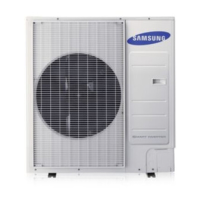
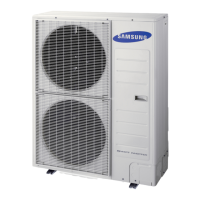
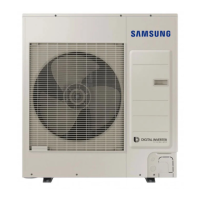
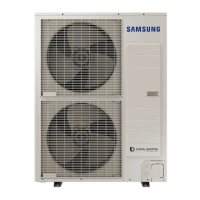
Illustrates the physical appearance of different outdoor unit models.
Lists essential accessories provided with the unit for installation and use.
Details compatibility between outdoor units and various indoor unit types.
Outlines compatibility of additional components with different unit types and capacities.
Guidelines for choosing an optimal and safe placement for the outdoor unit.
Specifies clearances needed around the outdoor unit for ventilation and airflow.
Procedures for moving, handling, and physically installing the outdoor unit.
Lists necessary tools and details unit compatibility for installation.
Details allowable pipe lengths, height differences, and provides installation examples.
Guidance on choosing correct pipes, cutting, flaring, and selecting Y-joints.
Instructions for insulating pipes, brazing, and connecting Y-joints and unit pipes.
Steps for leak testing, vacuum drying the system, and performing refrigerant charging.
Diagrams illustrating power cable connections for standard and EEV kit systems.
Details on power supply, cable sizes, circuit breakers, and earth cable requirements.
Guidelines for running cables, connecting terminals, and installing earth wires.
Explains the outdoor unit's Printed Circuit Board Assembly (PBA) display and key operations.
Details the specific functions accessed by pressing the K4 button on the PBA.
Defines the range for setting up connected indoor units and their addresses.
Configuration options for communication tracking, capacity compensation, and night silence.
Explains the purpose of pump down and critical safety precautions during the process.
Detailed steps for collecting refrigerant into a vessel before pump down, including handling large amounts.
Checks to perform on power supply, cables, and unit connections before starting.
Steps for running the system, checking airflow, noise, and drainage.
Instructions for filling out and storing the installation check card.
Lists error numbers displayed on the outdoor unit PCB with their corresponding meanings.


Loading...