EasyManua.ls Logo

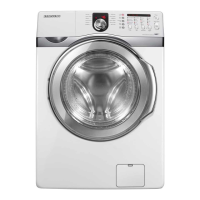
Samsung WF409ANW/XAA - User Manual

Samsung WF409ANW/XAA
7 pages
Print Icon
To Next Page IconTo Next Page
Loading...
# tsWF409 RevF 03/21/2011 1
Fast Track Troubleshooting
Model: WF409ANW/XAA
Publication # tsWF409 Revision Date 03/21/2011
Quick Test Mode
Note: This test erases all faults and memory:
To enter press Spin, Signal, & Power
simultaneously with the power off.
1. All LED’s light up and the washer beeps as it
enters the Quick Test Mode.
2. The unit displays the software version for a
second then clears the EEprom.
3. After the displaying the software version, LCD
will display Model information. If EEEE is displayed
the PCB ass’y is defective.
4. When the version is displayed, turn the Jog-Dial
1 click CCW to show 0058. Press the following keys
to test the various components
Press Temp Key to cycle through the Water Valves
circuit test in this order: Cold Main, Bleach, Cold Main
& Bleach for Fabric Softener, Hot, then off.
Press Spin Key to test Door Lock/Unlock circuit.
Press Signal Key to test Drain Pump
Service Mode:
This mode allows more detailed operation tests and trouble-
shooting, to enter press Signal & Extra Rinse
simultaneously with the power on.
While in Service Mode the following tests can be performed:
Quick Spin Test = Delay Start & My Cycle: This acceler-
ates the drum motor from 0 to maximum RPM over a few
minutes. Note: Stay with the washer during this test, out of
balance detection is bypassed and the door may not lock.
Press the Start/Pause button during the test to hold its spinning
speed for 10 minutes before going back to Quick Spin Test
Mode.
Cycle Count = Press the Signal button to see how many times
the unit was used
Soft Ware # = Press the Soil button to see the software version
information
Fast Time Down = Press the Temp button to advance to the
next cycle
Fault Code Test = Press the Extra Rinse button to view the
stored fault codes then turn Jog Dial to view error codes
(Push Start/Pause while the code is displayed to view the num-
ber of cycles since the error occurred)
Peripheral (Main PCB) input Tests
1. My Cycle. Then turn the Jog-Dial so that the Extra Rinse
LED is turned on. Next, press the Start/Pause Key. The Water
Temperature will be displayed in Fahrenheit.
2. My Cycle. Then turn the Jog-Dial so that the Extra Spin LED
is turned on. Next, press the Start/Pause Key. The door status
will be displayed (OP if open, CL if closed).
3. My Cycle. Then turn the Jog-Dial so that the Delay Start LED
is turned on. Next, press the Start/Pause Key. The door lock
Switch status will be displayed (UL if unlocked, Lo if locked).
4. Water Frequency/Water Sensor Testing
Select a cycle & start the washer, enter Service Mode &
press My Cycle. Turn the Dial so that the My Cycle LED is
turned on. Next, press the Start/Pause Key. The Water Fre-
quency will be displayed. The frequency will change as the unit
fills.
IMPORTANT SAFETY NOTICE “For Technicians Only” This service data sheet is
intended for use by persons having electrical, electronic, and mechanical experience
and knowledge at a level generally considered acceptable in the appliance repair trade.
Any attempt to repair a major appliance may result in personal injury and property
damage. The manufacturer or seller cannot be responsible, nor assume any liability for
injury or damage of any kind arising from the use of this data sheet.
Please Note: There are multi-
ple Versions of this model,
verify your parts order
EEPROM Clear Check
Power off, Press Delay Start, Signal and Power Key at
the same time. Good = Good Fail = FAiL
All memory will be cleared, including Fault Codes
This should be done when a new Main PCB is installed
SUPPORT INFORMATION
Training Plus One http://my.plus1solutions.net/clientPortals/samsung/
Help GSPN http://service.samsungportal.com/
Samsung Product Support TV http://support-us.samsung.com/spstv/howto.jsp
Customer information videos and chat programs. Programs for Fridges, Laundry, Ranges & D/W

Question and Answer IconNeed help?

Do you have a question about the Samsung WF409ANW/XAA and is the answer not in the manual?

Overview

This document provides service information for the Samsung WF409ANW/XAA washer, including its function, technical specifications, usage features, and maintenance procedures.

Function Description

The Samsung WF409ANW/XAA is a washing machine designed to clean clothes using various wash cycles and features. It incorporates advanced technology for efficient and effective washing, including a detergent drawer with multiple compartments for different washing stages (Main Wash, Bleach, Pre Wash, Softener). The machine also features a heater for temperature control, a water level sensor, and a motor for drum rotation.

Important Technical Specifications

  • Model: WF409ANW/XAA
  • Power Supply: 120VAC
  • Motor: The motor has multiple power settings (U, V, W) and is controlled by the main PCB.
  • Water Temperature Thermistor: Measures water temperature.
  • Water Level Sensor: Detects water level in the tub.
  • Hall Sensor: Monitors motor rotation.
  • Heater: Provides heat for water temperature control.
  • Detergent Drawer: Features compartments for Main Wash, Bleach, Pre Wash, and Softener.
  • Communication: Utilizes a communication line between the sub and main PBAs.
  • EEPROM: Stores operational data.

Usage Features

Quick Test Mode:

This mode allows technicians to quickly test various functions of the washer.

  1. Press and hold the Spin, Signal, and Power buttons simultaneously for three seconds to enter Quick Test Mode.
  2. All LEDs will light up, and the washer beeps as it enters the mode.
  3. The display shows the software version for two seconds, then "EEPROM" appears.
  4. After displaying the software version, "LCD" will display "Model Information." If "EEEE" is displayed, the PCB is defective.
  5. When "LCD" is displayed, turn the Jog-Dial to click "CCW" to show "0058." Press the following keys to test various components:
    • Temp Key: Cycles through the Water Valves (Main Cold, Bleach Cold, Main & Bleach for Fabric Softener, Hot, then off).
    • Spin Key: Tests the Door Lock/Unlock circuit.
    • Signal Key: Tests the Drain Pump.

EEPROM Clear Check:

  1. Power off, then press the Delay Start, Signal, and Power keys at the same time.
  2. "Good" indicates a successful clear, "Fail" indicates a failure.
  3. All memory will be cleared, including Fault Codes.
  4. This should be done when a new Main PCB is installed.

Service Mode:

This mode allows for more detailed operations and troubleshooting. To enter, press Signal & Extra Rinse simultaneously with the power on.

While in Service Mode, the following tests can be performed:

  • Quick Spin Test: Press Delay Start & My Cycle. This activates the drum motor from a maximum RPM over a few minutes. Note: Stay with the washer during this test, out of balance detection is bypassed and the door may not lock. Press the Start/Pause button during the spin to hold the spinning speed for 10 minutes before going back to Quick Spin Test Mode.
  • Cycle Count: Press the Signal button to see how many times the unit was used.
  • Soft Ware: Press the Soil button to see the software version.
  • Fast Time Down: Press the Temp button to advance to the next cycle.
  • Fault Code Test: Press the Extra Rinse button to view the stored fault codes. (This Jog Dial view error codes (Push Start/Pause) while the code is displayed to view the number of cycles since the error occurred).
  • Peripheral (Drain Pump) Input Test:
    1. My Cycle: Turn the Jog-Dial to show that the Extra Rinse LED is turned on. Next, press the Start/Pause key. The water temperature will be displayed in Fahrenheit.
    2. Pre Wash: Turn the Jog-Dial so that the Extra Spin LED is turned on. Next, press the Start/Pause key. The door status will be displayed (OP = open, CL = closed).
    3. My Cycle: Turn the Jog-Dial so that the Extra Hot LED is turned on. Next, press the Start/Pause key. The door lock switch status will be displayed (UL if unlocked, Lo if locked).
  • Water Frequency/Water Sensor Testing:
    1. Select a cycle & Start the washer (enter Service Mode & press My Cycle). Turn the Dial so that the My Cycle LED is turned on. Next, press the Start/Pause key. The Water Frequency will be displayed. The frequency will change as the unit fills.

Maintenance Features

Error Type and Mode Details:

The document provides a comprehensive list of error codes (LED and LCD) along with their descriptions and troubleshooting steps.

  • LE8 (Water Level Sensor Problem): Check for any leakage on the base, hose, valve, and tub connections. If the problem persists, replace the main PCB. If the washer is undergoing natural draining, this error occurs because the drain bellows are clogged with foreign material. Remove the foreign material.
  • 3E, E3, bE25 (Motor Drive Error or Hall Sensor error): Check the motor drive connector. If it's loose or damaged, check the motor or motor damage. The motor might be overloaded from too many clothes, or the relay or PCB might be defective.
  • nF3 (Water Supply Error): Check the water valve wiring harness. Check whether the water supply valve is clogged with foreign material and whether water is supplied properly. Check for reversed fill hoses. Check water temperature; if sensed higher than 50 °C in the Wool or Lingerie cycle, it will create an error. Check the relays; if they operate correctly, replace the Main PCB.
  • nF1 (Fill Hoses Reversed): Correct hot/cold hose connections.
  • SF1, SF2, SF3 (System Error): Replace PCB.
  • nD1 (Drain Error): Check for foreign material entering the pump or hoses. Check to make sure the wiring harness is connected properly. Check the water pump terminal. Check for freezing.
  • 2E, 91, 92 (Power Error): Make sure to check the operating voltage. (An error occurs when under or over voltage is supplied.) Check whether a plug receptacle is used. When the connecting wires are too small (extension cord used), a momentary low voltage may drop up to 10 V. Main PBA fault (sometimes).
  • PF (Momentary Power Failure):
  • AE (Communication Error): Check the wire connections and terminal contacts between the sub and main PBAs. Check for disconnected wires. Check whether the sub PCB is short-circuited because of moisture. If the main PCB's communication circuit is faulty, replace it.
  • 11 (EEPROM Fault): Go to "EEPROM Clear Mode." If the display shows "FAIL," replace the Main Control Board.
  • E2, 15 (Switch Error (Main Relay Error)): Check whether either the Power switch or a tact switch (any button) is stuck down. Check whether the service PBA holding screws are fastened too tight, pinching the contacts. If the main PBA switching IC on/off error has occurred, replace the main PBA. The "E2" error occurs if the main relay connections are incorrect. Check the connections. If there is no error in the connections, replace the main PBA.
  • dS22 (Door is open):
  • dL18 (Door Error - during operation): Check the door switch and latch alignment. Check the latch for damage. Check the wiring harness to the latch. Check the door switch. Replace if faulty. Check the main PBA door sensing circuit. Replace if faulty. Finally, verify the operation of the Main PCB.
  • LO2 (Unlock Fail):
  • FL4 (Lock Fail):
  • Hr36 (Heater Error): This can be a short or a wire disconnected to the heater circuit. This can also be a problem with the tub contacting the heater or if the washer tub is frozen or there is no water. The error is triggered by temperatures above 145C. If the heater has no error, this occurs because of a PBA relay malfunction. Check the wiring harness to the heater. An Hr error occurs if the steam heater is faulty; replace it.
  • 9E1 (EMC Filter issue or a noise spike from an external device):
  • OE, E (Overflow error): Water is supplied continually because the water level detection does not work. Verify the drain is working properly, the water level detection does not work and water is supplied continually. Verify the water valves shut off fully. Finally check the water level sensor.
  • 29 (Temperature Sensor error): The washing heater temperature sensor in the tub has an error. Check the connections for the washing heater temperature sensor connector.
  • dC10 (Unbalance Error): Check the type of laundry. Check whether it may cause an unbalanced situation. Educate the consumer in this case, to press pause, reposition the load or remove a few items. Press start to continue and complete the wash cycle.
  • 7E (Silver Care Kit PCB Failure): Check Silver Care PCB, Main PCB & Wire-harness.
  • 8E (Mems or Harness Failure): Check MEMS PCB, Main PCB & Wire-harness.
  • SUdS, Sd (Foaming Detected): This occurs when too much foaming is detected. It is also displayed while foaming is removed. When the removal is finished, the normal cycle proceeds. (This is one of the normal operations. It is an error for preventing non-sensing faults.)

General Maintenance:

  • Checking Washer Level: Check whether the washing machine is level to the floor with respect to the original position of the washing machine prior to service. Doing this now will reduce the need for a redo call and customer dissatisfaction.
  • Vibrations: Vibrations can shorten the lifetime of the product.
  • Foot Pad for Walking Washer: There is one in each package, so order 4. When installing a washer and dryer on the first or second floor, do not exceed this leg adjustment height for stability.
  • Detergent Drawer Maintenance: It is normal for a small amount of water to remain in the Detergent Drawer after it completes washing. Bleach is usually flushed out of the tub at the beginning of the washing. Also, its compartment is washed again during the following rinse cycle, removing any remnants.
  • Laundry Touch Up Paints: Available in various colors (Blue Onyx, Imperial Silver, Near White, Stratus Gray, Tango Red) with corresponding part numbers (DH81-11980A, DH81-11981A, DH81-11982A, DH81-11983A, DH81-11984A).
  • Stacking Kit: (Model No: SK-3A1/XAA, SK-4A/XAA, SK-5A/XAA) Samsung washers and dryers can be stacked to maximize usable space. An optional stacking kit is available for purchase from your Samsung retailer.
  • Detergent Usage: When using non-HE detergents, or using too much detergent for the water hardness and soil level of the clothing, over sudsing will occur. When this happens, there will be leaks out of the detergent drawer and door. Please advise consumer of proper detergent usage.
  • Location Considerations: Do not install your washer in areas where water may freeze, since your washer will always maintain some water in its water valve, pump, and hose areas. This can cause damage the belts, the pump, hoses and other components. Operating temperature should be above 60°F/16°C.
  • Sanitize and Pure Cycle Wash Cycles: The unit sometimes will pause during Sanitize, or Pure Cycle, wash modes and appear not to be functional. The Sanitize and Pure Cycle wash cycles have target temperatures to assure washer performance. If the water temperature doesn't meet the target temperature during the wash cycle, the washer will automatically add extra time to allow the heater to bring the water to the programmed, or target temperature. In this stage, the displayed time will pause and hold until the heating operation has been completed. It is at this point that the customer may feel that operation has stopped. (The maximum added programmed time is 30 minutes).

Support Information:

  • Training: Plus One (http://my.plus1solutions.net/ClientPortals/samsung/)
  • Help: GSPN (https://service.samsungportal.com/)
  • Samsung Product Support TV: http://support-us.samsung.com/spstv/howto.jsp
  • Customer information videos and chat programs: Programs for Fridges, Laundry, Ranges & D/W.

Samsung WF409ANW/XAA Specifications

General IconGeneral
BrandSamsung
ModelWF409ANW/XAA
CategoryWasher
LanguageEnglish

Related product manuals