Need help?
Do you have a question about the Sanwa EM7000 and is the answer not in the manual?
Provides detailed instructions for safe operation to prevent accidents and instrument damage.
Clarifies the meaning of safety symbols used in the manual and on the product for user understanding.
Specifies the maximum input values to prevent overload and protect the instrument from damage.
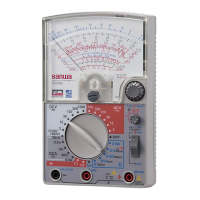
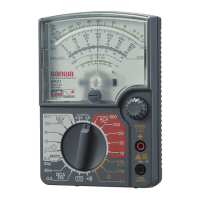
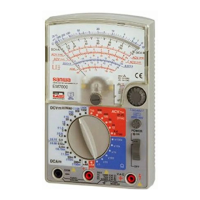
Describes the intended uses and measurement capabilities of the FET multimeter for various electronic circuits.
Highlights key characteristics like high sensitivity, zero center meter, and frequency response of the FET multimeter.
Explains the operation of the function selector, range switch, power switch, and various zero adjusters.
Provides instructions on how to utilize the built-in stand for positioning the meter during use.
Indicates the signs and conditions that suggest the internal batteries need replacement for proper operation.
Outlines essential checks of the instrument and test leads before performing measurements.
Provides guidance on choosing the correct range for accurate and safe measurements based on expected values.
Details the necessary steps to set up the meter, including zero adjustments, before taking measurements.
Explains the procedures for measuring DC, AC, and ±DC voltages using the multimeter.
Describes how to measure low-frequency audio signals in decibels (dB) using the instrument.
Covers the methods for measuring DC and AC currents across various ranges, including safety precautions.
Details the process for measuring resistance and checking the continuity of parts and circuits.
Explains how to measure high DC voltages using an optional HV probe for specialized applications.
Provides instructions on safely concluding measurement procedures and powering down the instrument.
Covers routine visual checks and inspections of the instrument's appearance and test leads for upkeep.
Information on recalibrating the instrument to maintain its accuracy and ensure safe operation.
Provides a step-by-step guide for safely replacing internal batteries and fuses.
Instructions for proper cleaning methods and environmental conditions for storing the instrument.
Outlines the terms and conditions of the product warranty, coverage, and exclusions.
Details the process and required customer information for requesting product repairs.
Provides contact information for customer support, technical assistance, and general inquiries.
Lists the overall technical specifications, operating conditions, and dimensions of the instrument.
Details the available optional accessories that can be purchased to enhance the instrument's functionality.
Specifies the measurement ranges, accuracies, and operating conditions for each function of the multimeter.
 General
| Category | Test Equipment |
|---|---|
| Model | EM7000 |
| Type | Digital Multimeter |
| Display | LCD |
| Measurement Functions | DC/AC Voltage, DC/AC Current, Resistance, Capacitance, Frequency, Temperature |
| Frequency Range | 10Hz - 10MHz |
| Temperature Range | -40°C to 1000°C |
| Battery | 9V |

 To Next Page