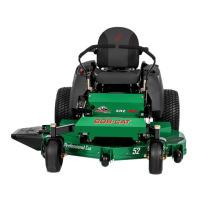
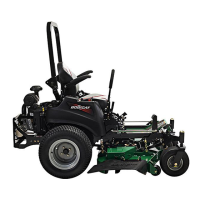
This document is a comprehensive operator's and parts manual for the Bob-Cat FastCat Pro series of commercial zero-turn mowers. It covers various models, including the 942297F (18HP Kawasaki, 36" side discharge), 942298F (20HP Kawasaki, 48" side discharge), 942299F (22HP Kawasaki, 52" side discharge), 942404F (23HP Briggs & Stratton, 61" side discharge), and 942405F (24HP Kawasaki, 61" side discharge). The manual provides essential information for safe operation, maintenance, and ordering replacement parts.
Function Description
The Bob-Cat FastCat Pro is a commercial-grade zero-turn riding lawnmower designed for efficient and precise grass cutting in various terrains. Its primary function is to provide high-performance mowing with enhanced maneuverability due to its zero-turn capability. The machine is equipped with different engine options (Kawasaki or Briggs & Stratton) and various deck sizes (36", 48", 52", and 61" side discharge) to suit different operational needs. The zero-turn steering system allows for tight turns and efficient cutting around obstacles, making it suitable for professional landscaping.
Important Technical Specifications
The manual lists several key technical specifications, primarily related to the engine and deck sizes:
- Engine Options: Kawasaki (18HP, 20HP, 22HP, 24HP) and Briggs & Stratton (23HP).
- Deck Sizes: 36", 48", 52", and 61" side discharge.
- Tire Pressure: Recommended 14 lbs/in² (1.0 kg/cm²) for optimal performance and tire wear. Tires are overinflated for shipping.
- Blade Torque: Blade bolts should be torqued to 70 ft-lbs (95 Nm).
- Wheel Hub Nut Torque: 150 ft-lbs (203 Nm).
- Engine Crankshaft Bolt Torque: 50 ft-lbs (68 Nm).
- Transaxle Pulley Nut Torque: 28.3-41.6 ft-lbs (38-56 Nm).
- Transaxle Drain Plug Torque: 15-20 ft-lbs (20-27 Nm).
- Transaxle Filter Torque: 130-150 in-lbs (14.6-16.9 Nm).
- Blade Balance: Must be maintained at 5/8 oz-in (19.4 g-cm) or less to prevent excessive vibration and wear.
- Battery: The manual highlights the caustic and explosive nature of battery acid and fumes, emphasizing safety precautions during handling and jump-starting.
- Fuel: Gasoline and diesel fuels are flammable and explosive. The fuel tank selector valve has "Off," "Right Tank," and "Left Tank" positions.
Usage Features
The FastCat Pro offers several features designed for user convenience and operational efficiency:
- Controls:
- Keyswitch (K): Three positions (OFF, RUN, START) for engine control.
- Throttle (T): Controls engine speed, with maximum forward speed achieved when levers hit the front of the forward-reverse slot.
- Choke (C): Used for cold starts.
- Power Take-Off (PTO) Switch (P): Engages and disengages the blades or other attachments.
- Hour Meter (M): Records accumulated time for maintenance scheduling.
- 12 Volt Power Outlet (X): Provides a 12-volt personal accessory power source.
- Fuel Selector Valve (U): Allows selection between left and right fuel tanks or to shut off fuel.
- Lift Lever (F): Raises and lowers the cutterdeck for transport, curb climbing, or blade changing.
- Traction Levers (L): Control forward/reverse movement, steering, and dynamic braking. They feature a neutral lock slot (S).
- Parking Brake (R): Engages/disengages the parking brake, essential for starting the engine and preventing movement when the operator leaves the seat.
- Operator Presence Interlock System: Ensures the operator is in the seat, PTO is off, and traction levers are in neutral lock for the engine to start. It also kills the engine if the operator leaves the seat, the parking brake is off, or a traction lever is moved out of neutral lock while the PTO is engaged.
- Pushing the Machine: Bypass valves can be opened to allow manual pushing when the engine is off.
- Cutting Tips: Recommendations for mowing large areas, extremely tall grass, trimming, and varying mowing patterns for even distribution of clippings and turf health.
- Deck Leveling: Procedure for ensuring the deck cuts level, involving adjusting carriage bolts and tightening nuts.
- Height of Cut Adjustment: Achieved by moving a pin to different holes.
- Deck Rollers: Adjustable for various cut heights to prevent scalping.
- Parking Brake Adjustment: Detailed procedures for 36", 48", 52", and 61" models to ensure proper brake function.
- Hydrostatic Transaxle Adjustments: Procedure for adjusting the neutral position of the hydrostat transaxle using a turnbuckle-style control rod.
- Arm Rest Height Adjustments: Allows operators to customize armrest height for comfort.
- Seat Adjustment: The seat plate can be adjusted forward or backward using specific holes.
Maintenance Features
The manual provides a comprehensive maintenance chart and detailed instructions for various service tasks:
- Maintenance Chart: Outlines intervals for checks and services (First 5 hours, Before Each Use, Every 25, 50, 100, 200 hours, and Yearly) for the engine, transaxle, and general machine components.
- Daily Checks: Includes reviewing safety rules, checking decals, shields, guards, hardware, engine for dirt/debris, air intake screen, air cleaner, oil level, lubrication points, hydrostatic fluid level, cooling fins, and safety interlock system.
- Engine Oil: Instructions for checking, adding, and changing engine oil and filter, with specific guidance for the first 5 hours of operation.
- Spark Plugs: Guidance on checking condition, identifying issues, and replacing plugs.
- Fuel Filter: Inspection and replacement instructions.
- Air Cleaner: Cleaning and replacement of the air cleaner element.
- Cleaning Machine: Recommendations for cleaning the machine after use to prevent overheating, extend life, and reduce fire hazards.
- Washing Machine: Cautions against using pressure washers or directing water at bearings/seals, and advice to allow the machine to cool before washing.
- Engine Cooling: Daily and 100-hour checks for cleaning the air intake screen and cooling fins.
- Transaxles:
- Fluid Change: Recommended every 200 hours, with instructions for removing/installing filters and filling with SAE 20W-50 engine oil.
- Purging: Procedure to remove air from the hydrostatic drive system, necessary after fluid changes or if symptoms like noisy operation or lack of power occur.
- Blade Removal and Installation: Detailed safety instructions for removing, sharpening, balancing, and installing blades, including torque specifications.
- Belt Replacement: Procedures for cutterdeck and hydro transaxle drive belts, including tensioning instructions for the 61" cutterdeck.
- Lubrication: Points to lubricate every 50 hours (deck lift lever, deck lift pivots, pull arms) and every 500 hours/yearly (caster wheel pivots). Notes that blade spindles use sealed bearings and do not require relubrication.
- Safety Decals: Illustrations and locations of various safety decals (Warning, Danger, Thrown Objects, Rotating Blades, Fuel, Battery, Parking Brake, HOC, etc.) are provided throughout the manual, emphasizing their importance for safe operation.

 Need help?
 General


 To Next Page