Operation
All SP Rock Valve Models
Startup 250:Users:Danny:Desktop:Operation manuals:line
pumps:All SP Rock Valve models:Frame files:operation.fm
Operation Manual -
83
After the correct amount of slurry has been placed in
the hopper, back up the first ready mix truck to your
hopper.
NOTE!
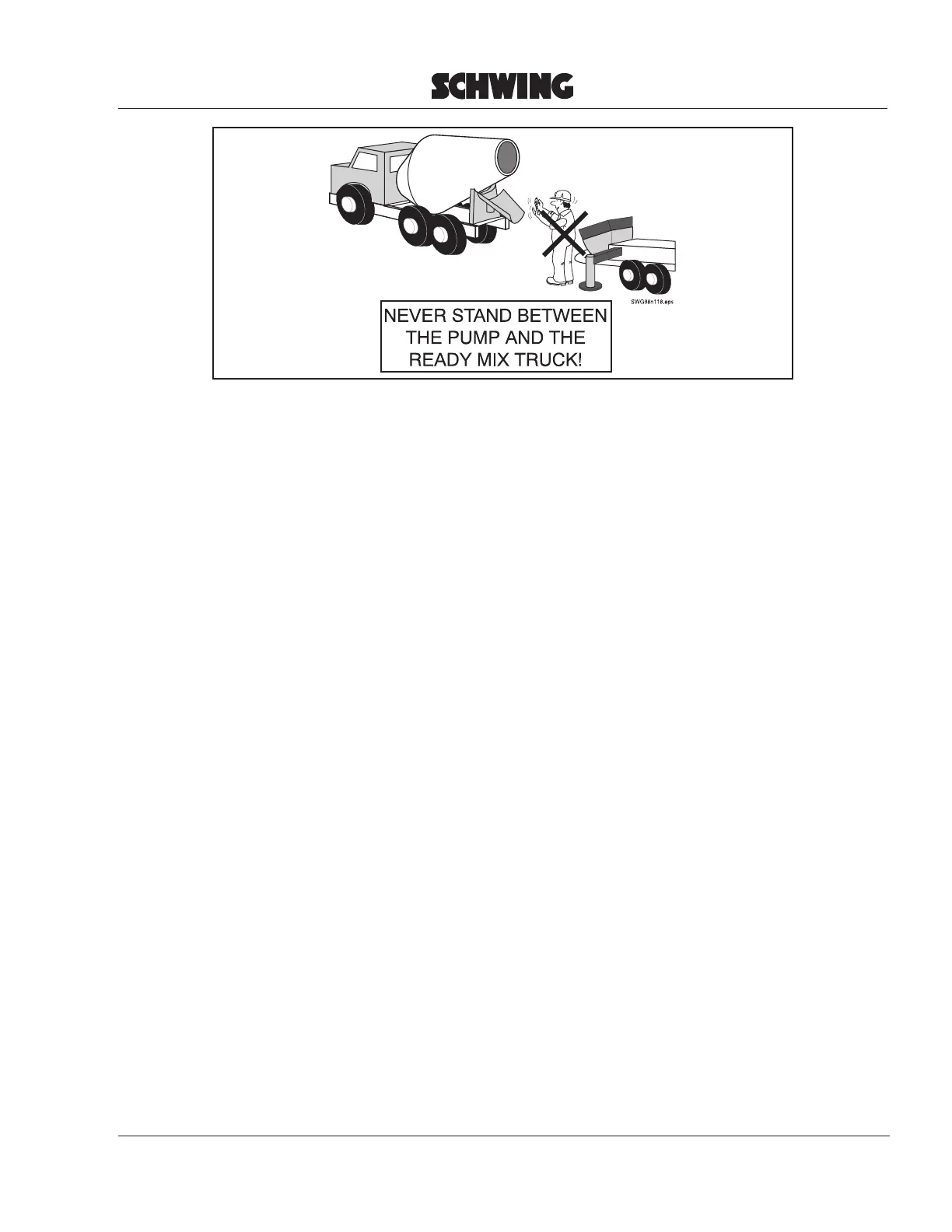
DO NOT stand between the ready mix truck
and the pump. If the driver’s foot would slip
off of the clutch while he was backing, you
could be crushed between the two machines.
Look at the concrete before putting it into your hopper.
If the mixing fins of the truck are badly worn, the mix
will not be homogenous (that is, the rock, sand, cement
and water will not be properly mixed). Do not allow a
chute full of grey colored rocks to be put into your
hopper...it is almost a certainty that you will plug the
line before you get concrete out of the pipe. If this is
the case, have the driver dump the first chute off to the
side, and then display the next chuteful. In most cases,
the mix will look a lot better after the first chuteful is
dumped. If not, dump the next chute to the side also.
You will learn by experience what mixes can and can’t
be pumped and how the two look. Once the mix looks
good, turn on the pump in the ‘forward’ mode, and
have the driver fill the hopper.
Pump slowly and watch the concrete pump circuit
pressure gauge until the slurry starts to escape from the
pipe and/or hose. If the pressure approaches the relief
valve setting of 300 bar, immediately switch the pump
to ‘reverse’ mode, and notify the ready mix driver to
stop dumping. Give the unit one or 2 strokes in reverse,
then go back to ‘forward’. If the concrete continues to
slide without high pressure, then you’re OK. If
pressure again rises towards the relief setting, repeat
the reverse cycle. In many cases you can prevent a
blockage by “rocking” it back and forth. In fewer
cases, the plug will not cooperate and you will need to
find the source of the blockage and remove it manually.
NOTE!
You must not open a blocked pipeline
without first sucking the concrete back into
the hopper! the act of putting the pump into
reverse for several strokes will release the
pressure on the blockage. Cover the hopper
before reversing pump and understand the
safety rules for opening a blocked pipe as
shown in the Safety Manual section of this
Operation Manual.
With an accumulator, speed control is available as soon
as the engine is started. You do not have to wait for a
steady hydraulic pressure in the concrete pump circuit
before you can use the stroke limiter to change the
strokes per minute of the pump.
Once concrete has emerged from the point of
discharge, stop pumping. If you are pumping into a
pipeline, wait for the start signal before you begin to
pour.
To control the speed of the unit
There are two ways to control the speed on this unit: by
the stroke limiter by the engine throttle.
The stroke limiter is a hydraulic device that can be
adjusted at the operator’s panel. Its function is to raise
and lower the output of the hydraulic pumps that
operate only the concrete pump. This has the advantage
of allowing the engine to remain at higher RPM, where
horsepower is at the maximum. With an accumulator,
there is pressure in the system as soon as the engine is
started, and therefore you can use the stroke limiter
immediately to control the speed. Basically, it will
work whenever there is 50 bar or more showing on the
concrete pump circuit pressure gauge. It has an
adjustment range of 100%. That is, it can go from zero
strokes per minute to maximum strokes per minute.
Beware...because it can go to zero strokes per minute,



 To Next Page