6
Equipment:
1. Select weights that have a tolerance that is one third or better than the accuracy you require for your
application. This way the error of the weight will not dramatically impact the quality of your
measurements.
2. The equipment must be of sufficient readability to calibrate or measure the weight or sample
under test.
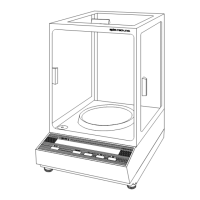
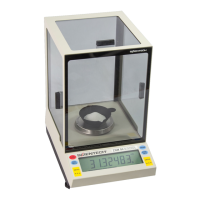
3. The balance should be placed on a stable platform free from the effects of vibration. The most
common type of setup involves placing the instrument onto a balance table that is constructed
of marble or granite.
4. Never use a balance or scale as soon as it is turned on (plugged in). The internal electronic
components need to stabilize and “warm up” for at least 24 hours once the equipment has been
energized. Troemner recommends that you leave this instrument plugged in twenty four hours a
day, seven days a week.
5. Never use a balance that has been idle for several hours without first "exercising it" and calibrating
it. A balance is exercised by repeatedly placing and removing weights from the balance pan.
We recommend that this be done at least ten times each with a weight that is 100% of the max
capacity of the balance. After exercising, the balance should be calibrated. If these two techniques
are consistently employed, a noticeable improvement will result in both linearity and stability of
the measurement.
7. When weights are not in use, store them in the case in which they were supplied. If the weights were
not supplied with a case, either purchase a case or use a clean container to protect the surfaces. This
will keep airborne particles from getting on your weights between uses. Weights should be in
thermal equilibrium with the balance so store weights near your balance. Another option is to leave
calibration masses commonly used inside the weighing chamber when not in use. This assures your
weights are in thermal equilibrium with the balance producing a better measurement.
Environment:
1. The more stable your environment, the better your measurement results. Changes in temperature, pres-
sure, and humidity affect balance performance and weight stability. Ideal room conditions are 20º C
with a relative humidity between 45% and 60%. Fluctuations in temperature should not exceed 1º C
per hour. Humidity fluctuations should not exceed 10% per hour.
2. Balances should not be placed in close proximity to anything that shakes, vibrates, or stirs violently.
Avoid placing your equipment near centrifuges, vortexers, or shakers.
3. Do not place your balance and/or scale near anything that generates heat. Heat will cause the balance
chamber to warm and due to the effects of the thermal expansion introduce large errors into your
measurement. Do not place the balance near a window. Sunlight can penetrate the window, warm the
balance chamber at different rates during the day, and affect the quality of your work.
4. Avoid placing the balance near sources of drafts, extreme air currents, or near air-conditioning vents.
These positions can cause your readings to be unstable and can dramatically cool the balance cham-
ber when the air-conditioning system begins to run.
5. The measurement environment should be clean and free of excessive contaminants. Contaminants
such as dirt and grease can adversely affect the weight of an object.
Operator:
1. Never touch a weight with your bare hands. Oils and contaminants from your hand will be transferred
to the weight and introduce a significant error. It is recommended that all weights be manipulated with
gloved hands or forceps. The two types of gloves that are commonly used and accepted are either la-
tex (powderless) or cotton. Avoid any metal to metal contact when handling or storing weights. This
will cause scratches that may introduce error. All weight forceps and weight lifters should be either
nonmetallic (plastic or wood) or if metal, covered with a soft protective coating or material to avoid
scratches.



 To Next Page