TB-9017 Page 4 of 6
© 2015 DESCO INDUSTRIES, INC.
Employee Owned
SCS - 926 JR Industrial Drive, Sanford, NC 27332 • (919) 718-0000 • Website: StaticControl.com
Resistance Measurement of Static Control Flooring
This section provides a summary of installed or applied
oor material measurements specied and described by
ESD-S7.1.
Note: The following paragraphs are offered as a co
densed summary of the test methods and procedures
outlined in the EOS/ESD standard. For complete details,
refer to the standard.
PERIODIC PERFORMANCE TESTING OF INSTALLED
OR APPLIED FLOORING MATERIALS
(Measurement of resistance from the surface of an
installed oor to GROUNDABLE POINT at ambient
temperature and humidity).
Note: GROUNDABLE POINT is a point on the oor
material that is intended to accommodate an electrical
connection from the oor material to an appropriate
electrical ground. The ground point may be an electrical
ground, building ground, or other suitable ground. If you
have questions concerning the correct ground, refer to
EOS/ESD Standard 6.0 and/or contact a qualied
electrician.
The Resistance-to-Ground test veries the surface is
working correctly and will drain a static charge in a
reasonable time. This test involves measurement of
the total resistance from the static control surface
through the conductor or ground cord to the ESD
GROUND (ESDG), verifying the static control system is
functioning correctly. Note: ESD 7.1 is designed to
measure oor materials with resistances of 2.5 x 10
4
to
1.0 x 10
11
ohms.
The following procedures should be followed when
testing installed static control oor mats or ooring
surfaces.
Test Procedure for Resistance to Ground
A. Complete BATTERY TEST and CONTINUITY TEST.
B. Before testing new oor mats or newly installed
oors, clean mats/oors per manufacturer’s
recommendations. For testing of oor nishes or
monitoring of existing oor materials, test in an as-is
condition.
C. Perform tests at ambient humidity.
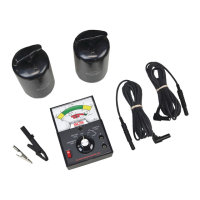
D. Place the SCS 701 Analog Surface Resistance
Megohmmeter Kit and test weight at the desired test
location.
E. Connect one lead of the meter to ground with
supplied clip and the other lead to the test weight.
F. Set meter to 100V. Place test weight on the surface
of the material being tested.
G. Push test button and record the resistance after the
measurement has stabilized or after 15 seconds.
Release test button.
H. Repeat the procedure placing the test weight on the
surface at different locations.
I. Perform a minimum of ve tests per contiguous oor
surface material or a minimum of ve tests per 5,000
square feet (464.5 m2) of oor material, whichever is
greater. A minimum of three of the ve tests should
be conducted in those areas that are subject to wear
or have chemical or water spillage or are visibly dirty.
Test Procedure for Resistance Point to Point
A. Complete BATTERY TEST and CONTINUITY TEST.
If required clean electrodes as described in Test
Weight Cleaning section below.
B. Before testing new oor mats or newly installed
oors, clean mats/oors per manufacturer’s recom-
mendations. For testing of oor nishes or monitor-
ing of existing oor materials, test in an as-is condi-
tion.
C. Perform tests at ambient humidity.
D. Place the Tester and test weight at the desired test
location.
E. Connect test leads of the meter to the test weights.
F. Set meter to 100V. Place test weights three feet
apart on the surface of the material being tested.
G. Push test button and record the resistance after the
measurement has stabilized or after 15 seconds.
Release test button.
H. Repeat the procedure placing the test weights three
feet apart on the surface at different locations.
I. Perform a minimum of ve tests per contiguous oor
surface material or a minimum of ve tests per 5,000
square feet (464.5 m2) of oor material, whichever is
greater. A minimum of three of the ve tests should
be conducted in those areas that are subject to wear
or have chemical or water spillage or are visibly dirty.
Maintenance
Caution: Batteries are intended for use in applications
subject to replacement only by a trained service
technician. Use only non-rechargeable batteries.
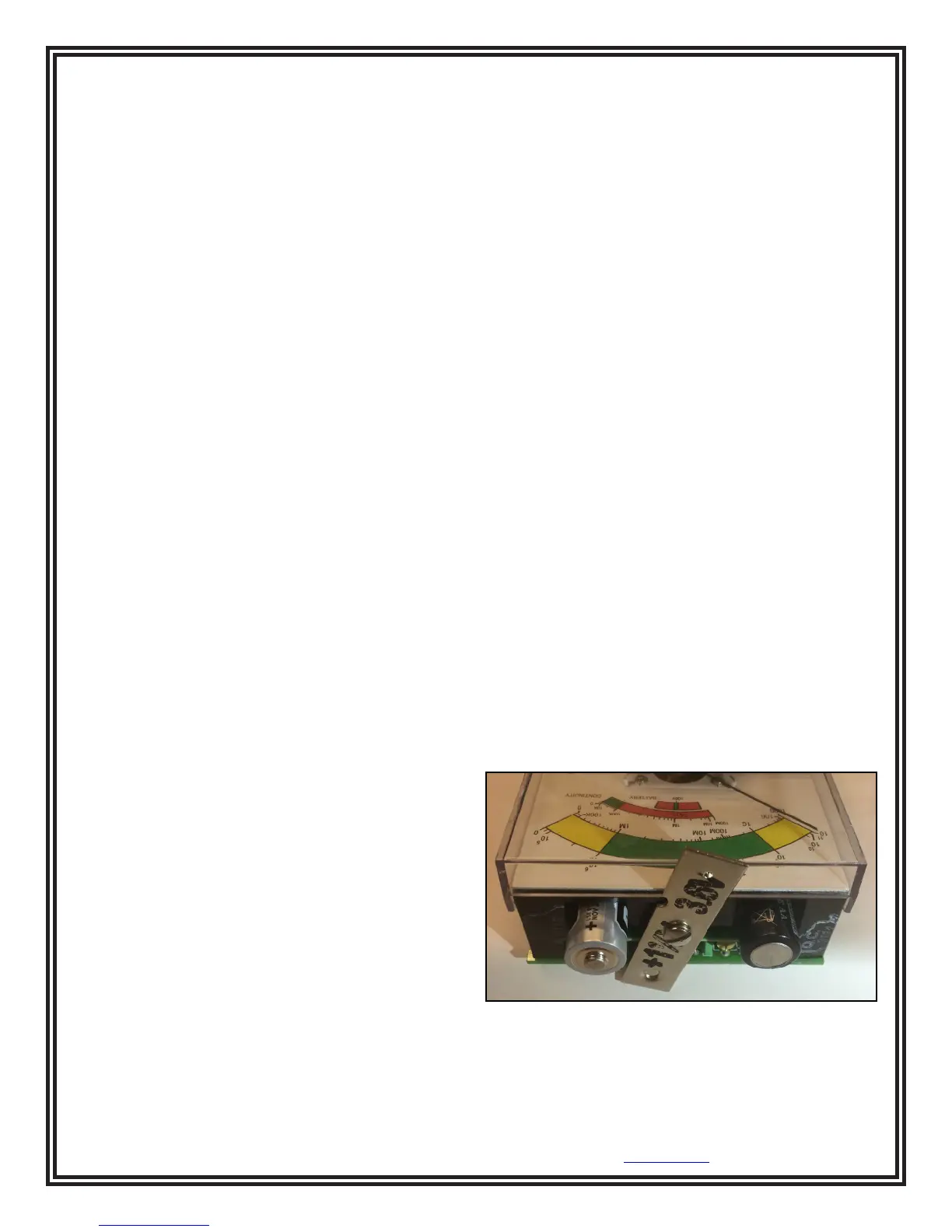
Battery Replacement
Figure 9. Battery Replacement.


 To Next Page