5
OPERATING YOUR SEA EAGLE
Battery Selection
A wide range of acceptable batteries are available. The battery must be 12 volt (unless otherwise stated by
the manufacturer) and between about 20 and 120 Amp Hours (Ah). Amp hours is a very important number,
if the battery you are looking at doesn’t clearly state the amp hours, it is probably not suitable. A 12v deep
cycle marine lead-acid battery, lithium ion battery, personal watercraft battery or electric vehicle
(wheelchair) battery is acceptable. A Group 24 lead-acid battery or smaller is recommended for the SE-9
because of its weight. Group 24 batteries weigh approximately 50 lbs and hold 75 Ah charge. Heavier
batteries can be dicult to safely manage in an small inatable boat.
Battery Features and Safety
• Positive (+) red wire connects to positive (+) battery terminal. Black wire to negative terminal (-).
• To determine a battery’s charge life, divide the amp hour rating by the motor amperage. For example,
a battery rated at 60 Ah connected to a 30 amp motor will last approximately two hours at full speed.
Note: this number will vary depending on conditions.
• Running the battery all the way down will shorten its life. Not more than 85% discharge is
recommended. Multiply the above by 0.85 to get best run time.
• Charge battery after each use. Lead acid batteries like to be kept charged.
• Exposure to excessive heat will shorten battery life.
• Cold Cranking Amps (CCA) and starting power are not a consideration.
• 12v automobile, lawn tractor and motorcycle batteries can be used but are not designed for deep
discharge and will wear out more quickly.
• A battery box like the Minn Kota Power Center is recommended, especially around aluminum paddle
shafts which could cause an electrical short. It has a built-in circuit breaker. It will keep bare skin and
clothes protected if any acid leaks from the battery.
• A circuit breaker or fuse is required by the Coast Guard. Check the trolling motor manual for the size
circuit interrupter needed. Some of these conveniently bolt to the battery terminal. They are intended to
protect against reverse polarity and shorts.
• In the event the motor wires are placed on the wrong terminals, reversing the polarity, the wires heat up
and can melt the insulation and cut through the boat.
• A 12v battery charger will be needed. Chargers are widely available and prices range widely. Inexpensive
chargers are usually sucient.
• Choose gel cell over wet cell. Gel will be less leak likely to leak acid if the case seal is broken.
• Lithium or AGM batteries can be a good choice even if they are more expensive. They are generally
lighter, discharge evenly for longer run times, and charge evenly for a longer life.
• For some, two small batteries are better than one large, heavy one. A small backup battery can be helpful
too.
More technical and safety information is available from battery and motor manufacturer’s, boating
organizations and publications.
Capacity Ratings and Dimensions
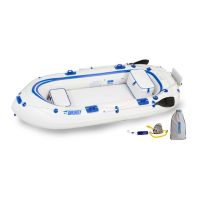
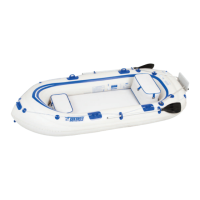
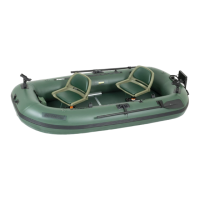
Persons: 4
Total Weight Capacity: 1200 lbs.
Maximum Engine Rating: 3hp, 20” shaft, 45 lbs. max. weight
Chambers: 4
Length: 11’
Width: 4’ 8”
Boat Weight: 35 lbs.




 To Next Page