EasyManua.ls Logo

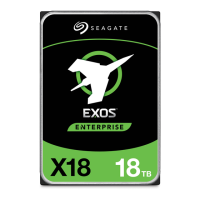
Seagate EXOS 512E Series - User Manual

Seagate EXOS 512E Series
62 pages
Print Icon
To Next Page IconTo Next Page
Loading...
512E* models
Standard
ST18000NM004J
ST16000NM004J
ST14000NM004J
ST12000NM004J
512E* models
Self-Encrypting
ST18000NM005J
ST16000NM005J
ST14000NM005J
ST12000NM005J
512E* models
SED-FIPS 140-3
ST18000NM007J
ST16000NM007J
ST14000NM007J
ST12000NM007J
* Default configuration is 512E for 512E / 4KN drives.
See
Section 4.1.2 to Fast Format to 4KN in seconds
100865853, Rev. D
March 2021
X18 SAS Product Manual

Table of Contents

Question and Answer IconNeed help?

Do you have a question about the Seagate EXOS 512E Series and is the answer not in the manual?

Summary

1.0 Scope

2.0 HDD and SSD Regulatory Compliance and Safety

2.0.1 Regulatory Models

Lists regulatory model numbers for all features and configurations.

2.1 Reference Documents

Lists related documentation for SAS and TCG standards.

3.0 General Description

3.1 Standard Features

3.2 Performance

3.3 Reliability

3.4 Media Description

3.5 Formatted Capacities

3.6 Programmable Drive Capacity

3.7 Factory-Installed Options

4.0 Performance Characteristics

4.1 Internal Drive Characteristics

Details physical attributes like capacity, heads, and tracks.

4.1.1 Format Command Execution Time

Provides time estimates for format operations.

4.1.2 Fast Format

4.1.3 General Performance Characteristics

4.2 Start;Stop Time

4.3 Prefetch;Multi-Segmented Cache Control

4.4 Cache Operation

4.4.1 Caching Write Data

Details the process of writing data to the drive's cache.

4.4.2 Prefetch Operation

Explains the function and enabling of the prefetch feature.

5.0 Reliability Specifications

5.1 Error Rates

Lists various error rate specifications like Unrecovered Data and Interface errors.

5.1.1 Recoverable Errors

5.1.2 Unrecoverable Errors

5.1.3 Seek Errors

5.1.4 Interface Errors

5.2 Reliability and Service

5.2.2 Hot Plugging the Drive

Explains the procedure and considerations for hot plugging.

5.2.3 S.M.A.R.T.

5.2.4 Thermal Monitor

5.2.5 Drive Self Test (DST)

5.2.5.1 DST Failure Definition

Defines conditions that constitute a DST failure.

5.2.5.2 Implementation

Provides information for implementing the DST function.

5.2.5.2.1 State of the Drive Prior to Testing

5.2.5.2.2 Invoking DST

5.2.5.2.3 Short and Extended Tests

5.2.5.2.4 Log Page Entries

5.2.5.2.5 Abort

5.2.6 Product Warranty

6.0 Physical;Electrical Specifications

6.1 PowerChoice Power Management

Explains programmable power management modes for efficiency.

6.1.1 PowerChoice Reporting Methods

6.2 Power Balance

6.3 AC Power Requirements

6.4 DC Power Requirements

6.4.1 Conducted Noise Immunity

6.4.2 Power Sequencing

6.4.3 Current Profiles

6.5 Power Dissipation

6.6 Environmental Limits

6.6.1 Temperature

Details operating and non-operating temperature ranges and gradients.

6.6.2 Humidity

Specifies operating and non-operating humidity levels.

6.6.3 Effective Altitude (Sea Level)

Details operating and non-operating altitude specifications.

6.6.4 Shock and Vibration

6.6.5 Acoustics

6.6.6 Air Cleanliness

6.6.7 Corrosive Environment

6.7 Mechanical Specifications

7.0 About Self-Encrypting Drives

7.1 Data Encryption

Explains the AES-256 bit encryption engine and its operation.

7.2 Controlled Access

Describes security providers (Admin SP, Locking SP) for access control.

7.2.1 Admin SP

7.2.2 Locking SP

7.2.3 Default Password

7.3 Random Number Generator (RNG)

7.4 Drive Locking

7.5 Data Bands

7.6 Cryptographic Erase

7.7 Authenticated Firmware Download

7.8 Power Requirements

7.9 Supported Commands

7.10 Sanitize - Cryptographic Erase

7.11 RevertSP

8.0 Defect and Error Management

8.1 Drive Internal Defects;Errors

Explains identification and management of internal media defects.

8.2 Drive Error Recovery Procedures

Details the error recovery mechanisms and levels.

8.3 SAS System Errors

8.4 Deferred Auto-Reallocation

8.5 Idle Read After Write

8.6 Protection Information (PI)

9.0 Installation

9.1 Drive Orientation

Discusses permissible drive mounting orientations.

9.2 Cooling

9.3 Drive Mounting

9.4 Grounding

10.0 Interface Requirements

10.1 SAS Features

Lists the SAS-specific features supported by the drives.

10.1.1 Task Management Functions

10.1.2 Task Management Responses

10.2 Dual Port Support

10.3 SCSI Commands Supported

10.3.1 Inquiry Data

10.3.2 Mode Sense Data

10.4 Miscellaneous Operating Features and Conditions

10.4.1 SAS Physical Interface

10.4.2 Physical Characteristics

10.4.3 Connector Requirements

10.4.4 Electrical Description

10.4.5 Pin Descriptions

10.4.6 SAS Transmitters and Receivers

10.4.7 Power

10.5 Signal Characteristics

10.5.1 Ready LED Out

Explains the drive's Ready LED Out signal conditions.

10.5.2 Differential Signals

Discusses compliance with SAS differential signal requirements.

10.6 SAS-3 Specification Compliance

10.7 Additional Information

Seagate EXOS 512E Series Specifications

General IconGeneral
ModelEXOS 512E Series
CategoryEnterprise HDD
InterfaceSATA 6Gb/s
RPM7200 RPM
Cache256MB
MTBF2.5 million hours
Workload Rate Limit550 TB/year
Sector Size512e
Bytes per Sector512
Warranty5 years
Form Factor3.5-inch

Related product manuals