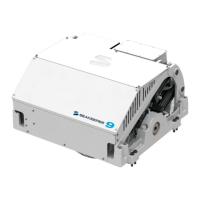
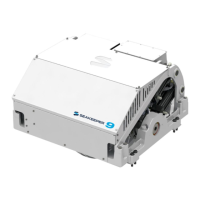
Section 6: SEAKEEPER SPECIFICATIONS
Electrical
The installer is responsible for supplying 208-230 VAC, 50/60 Hz, single phase power on a 20A
service to the Motor Drive Box and 24 VDC @ 10A service to the Seakeeper Control System.
Separate circuit breakers should be used for each Motor Drive Box in multiple Seakeeper
installations. Similarly, separate circuit breakers should be used for each Seakeeper Control
System in multiple Seakeeper installations.
Operator Controls
A Display with integrated Keypad is used to start, operate, monitor, and shutdown the
Seakeeper.
Performance
Reduction of boat roll is a function of the boat’s displacement, transverse metacentric height
(GM
T
) and hull damping as well as the operating conditions (speed and heading with respect to
waves) and sea state. The Seakeeper controller regulates the active hydraulic brake to ensure
the Seakeeper’s anti-roll torque is maximized irrespective of hull characteristics or operating
conditions.
Alarm and Monitoring
Sensors, alarms and shutdowns are provided to allow unattended operation. Sensors measure
Seakeeper and drive temperatures, vacuum pressure, gimbal angle, brake pressure, and ship
motion. The Seakeeper controller sends sensor values and alarm information to the display and
also locks the brake and shuts down the motor drive in the event of an alarm condition.
Seakeeper operating history during faults or alarms is recorded in the controller’s memory for
subsequent recall if service is needed. Seakeeper may access the Seakeeper’s software to
gather run hours, bearing loading, and hull slamming information.
Safety
The brake automatically locks the Seakeeper so it cannot generate excessive anti-rolling torque
loads in the event of a system fault or alarm, loss of electrical power or loss of brake pressure.
The brake can be locked from the Display or by shutting off AC and DC power at the supply
breakers.


 To Previous Page