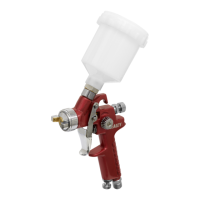
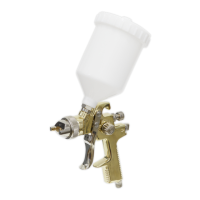
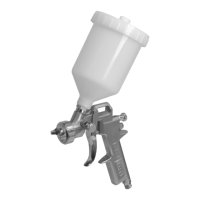
The Sealey HVLP Gravity Feed Touch Up Spray Gun, Model No: HVLP732, is a specialized tool designed for precise paint application in small areas, particularly for panel touch-ups where fine control over paint and air is essential. Its construction features an anodized spray gun body, which not only resists corrosion but also facilitates easier cleaning after use. The gun is equipped with a brass air cap and a stainless steel needle and nozzle, making it suitable for use with waterborne paints.
For optimal performance and safety, users are advised to familiarize themselves with the gun's application, limitations, and potential hazards. Before any maintenance or accessory changes, it is crucial to disconnect the spray gun from the air supply. The gun should be maintained in good condition, with any damaged parts replaced using authorized components to ensure safety and preserve the warranty. Regular cleaning is vital for the gun's best and safest performance.
The compressed air system supplying the gun must be capable of meeting the specified air consumption for the model. Users are required to wear approved safety respiratory protection and eye goggles. When spraying isocyanate-based finishes, additional precautions include wearing an approved respirator or clean air breathing apparatus, latex gloves, and an impervious hooded coverall to protect exposed skin. Loose clothing, ties, watches, rings, and other jewelry should be removed, and long hair tied back to prevent entanglement.
The spray gun should be operated in a suitable work area that is clean, tidy, free from unrelated materials, and adequately ventilated and lit. When not in use, the air supply must be turned off to prevent unintentional operation. It is important to note that the spray gun is treated with an anticorrosive agent at the factory and must be thoroughly flushed with thinner before its first use.
Users are explicitly warned against pointing the spray gun at themselves, other persons, or animals, or directing air from the air hose at them. The gun should not be carried by the hose, nor should the hose be yanked from the air supply. The working pressure of 43psi (3bar) must not be exceeded. The spray gun is designed for specific purposes and should not be used for any other application. Untrained persons should not operate the spray gun. It should not be used in damp or wet locations or areas with condensation. Operating the spray gun with missing or damaged parts can lead to failure and personal injury. After use, the spray gun should be disconnected from the air supply, thoroughly cleaned, and stored safely.
The recommended hook-up for the air supply involves ensuring the spray gun air valve or trigger is in the off position before connecting. An air pressure of 43psi and an appropriate air flow are required. It is critical to ensure the air supply is clean and does not exceed 43psi, as excessive pressure or unclean air can shorten product life and pose safety risks. The air tank should be drained daily to prevent water in the air line from ruining the paint finish and damaging the spray gun. The air inlet filter should be cleaned weekly. For unusually long air hoses (over 8 meters), line pressure should be increased, with a minimum hose diameter of 1/4" I.D. and fittings of the same inside dimensions. Hoses should be kept away from heat, oil, and sharp edges, and checked for wear, with all connections secure. To prevent vibration-induced failure, a leader hose should be used between the spray gun and a quick-change coupling.
For best results, the gun should be held perpendicular to the surface being sprayed and moved parallel to it. The stroke should begin before squeezing the trigger and end before releasing it, allowing for accurate control of the gun and material. The recommended spraying distance is 6 to 10 inches (150 to 250mm), depending on the material and atomizing pressure. The deposited material should always be even and wet, with each stroke overlapping the preceding one for a uniform finish. To maximize efficiency and reduce over-spray, the lowest possible atomizing air pressure should be used.
The spray gun offers control over the fan spray and fluid. The amount of paint flow is adjusted using the needle (paint) adjustment knob. The atomizing air flow is controlled by a dedicated control knob, and the volume of air input is managed by another adjustment knob. As the spray width increases, more material must pass through the gun to maintain coverage. The air nozzle can be turned to achieve a horizontal or vertical fan spray, which is then locked with a retaining ring. The spray pattern is variable from round to flat. In normal operation, the wings on the nozzle are horizontal, providing a vertical fan-shaped pattern for maximum, uniform, and even coverage when moving the gun back and forth, parallel to the work surface.
For optimum performance, it is critical to ensure the spray gun is correctly cleaned after each use. Before any cleaning or maintenance, disconnect the gun from the air supply. To clean the gun, flush it thoroughly with clean solvent. Use a bristle brush and solvent to wash off accumulated paint. The air nozzle should be cleaned with a brush and then blown clean with air, handling all nozzles carefully and avoiding any alterations. The outside of the gun should be wiped with a dampened solvent rag. If probing the nozzle holes is necessary, use a tool softer than brass to avoid damage to the spray pattern. Adjust the fluid needle valve so that air flow occurs before fluid flow when the gun is triggered.
When re-assembling, screw parts hand tight to avoid cross-threading. If a part does not turn easily, check for the correct part, unscrew, realign, and retry, avoiding excessive force. When changing the nozzle size, ensure the complete nozzle set (air cap, fluid nozzle, and paint needle) is fitted, inserting the fluid nozzle before the paint needle.
Faulty spray is often caused by improper cleaning or dried material around the fluid nozzle tip or in the air nozzle. If cleaning is required, remove these parts and soak them in solvent to soften dried material, which can then be removed with a brush or cloth. These precision-machined parts are susceptible to damage, which can lead to a faulty spray and necessitate replacement of the air or fluid nozzle.
Common problems include paint spray 'flutters' due to dried material restricting air passage in a side port or around the fluid nozzle tip, or a loose air nozzle. Solutions involve dissolving material with solvent, blowing the gun clean, removing and wiping the fluid tip, and tightening the air nozzle. If the material is too thin or atomization air pressure too high, the solution is to regulate material viscosity or reduce air pressure. If there is not enough paint in the bottle, or if the nozzle set/seating is dirty, damaged, or loosely installed, the bottle should be refilled, the fluid nozzle cleaned, and the nozzle refitted and secured tightly, or the nozzle set replaced if necessary. Material bubbles or "boils" in the paint cup indicate atomized air flowing through the paint channel to the bottle, an insufficiently tight paint nozzle, or an incompletely screwed-on air nozzle. The solution is to tighten, clean, or replace parts accordingly.



 To Next Page
 General