Need help?
Do you have a question about the Sealey SSG502 and is the answer not in the manual?
Covers safe operational requirements, PPE, work area, and general handling of the spray gun.
Details actions to avoid, such as pointing at people or using the gun improperly.
Describes the spray gun's ideal use, adjustable controls, and available setups.
Lists model number, air pressure, air consumption, and pot capacity.
Specifies required air pressure, flow rate, cleanliness, and hose diameter for optimal performance.
Provides guidance on connecting air hoses and couplings to the spray gun, including diagrams.
Guides on holding the gun, stroke initiation, and spray distance for even coverage.
Explains adjusting fan width, fluid flow, and nozzle orientation for desired patterns.
Details steps for cleaning the gun body, immersing the front end in solvent, and flushing.
Instructions for cleaning nozzles, handling parts carefully, and adjusting the fluid needle.
Guidance on re-assembly, lubrication, part replacement, and handling delicate components.
A table detailing common issues like material bubbles and split sprays with their possible causes and resolutions.
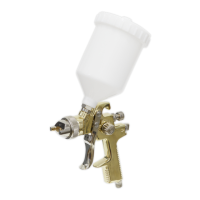
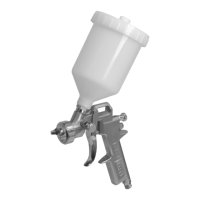
This document provides instructions for the Sealey SSG502 Gravity Feed Spray Gun, designed for applying base coats. It features adjustable paint flow and fan width controls and is supplied with a composite gravity feed pot. The gun is suitable for use with waterborne paints, and alternative set-ups are available separately.
Before operating the spray gun, users must familiarise themselves with its application, limitations, and potential hazards. It is crucial to disconnect the spray gun from the air supply before changing accessories, servicing, or performing any maintenance. The paint cup remains pressurised after disconnection from the air line; therefore, users should depressurise it by gently opening the cup rather than pulling the trigger. The spray gun must be maintained in good condition, and only recommended parts should be used for replacement or repair. Unauthorised parts can be dangerous and will invalidate the warranty.
The working area should be adequate, clean, tidy, free from unrelated materials, and well-ventilated and lit. The spray gun must be kept clean for optimal and safe performance. The air system must be suitable for the spray gun's air consumption. Users must wear approved respiratory protection, safety eye goggles, and appropriate protective overalls. Children and unauthorised persons should be kept away from the working area. When not in use, the air supply must be turned off to prevent unintentional operation.
Users must never point the spray gun at themselves, other persons, or animals. The gun should not be carried by the air hose, nor should the hose be yanked from the air supply. The spray gun is designed for specific purposes and should not be used for any other function. Untrained persons must not operate the spray gun. The gun should not be used in damp or wet locations or areas with condensation. Operation with missing or damaged parts is prohibited as it may cause failure or personal injury. Air from the air hose should not be directed at oneself or others.
For best results, the gun should be held perpendicular to the surface being sprayed and moved parallel to it. The stroke should begin before squeezing the trigger and end after releasing it, allowing accurate control of the gun and material. The recommended spray distance is approximately 150mm (6") to 250mm (10"), depending on the material and atomising pressure. The material deposited should always be even and wet, with each stroke overlapping the preceding one for a uniform finish. To reduce overspray and maximise efficiency, the lowest possible atomising air pressure should be used.
The atomising air flow is controlled by a regulator attached to the incoming air supply, which should be capable of supplying between 5 and 11cfm. An adjustment knob (fig.4.4) is used to increase or decrease the amount of paint flowing from the gravity feed pot. The width of the spray can be adjusted using knob (fig.4.5). As the spray width increases, more material must pass through the gun to maintain coverage. The air nozzle (fig.4.1) can be turned to achieve a horizontal or vertical fan spray, which is then locked with the retaining ring (fig.4.2). The spray pattern is variable from round to flat. In normal operation, the wings on the nozzle are horizontal, providing a vertical fan-shaped pattern for maximum uniform and even coverage when moving the gun back and forth, parallel to the work surface (fig.5).
Before connecting to the air supply, ensure the spray gun air valve (or trigger) is in the "off" position. An air pressure of 50psi and an air flow according to specifications are required. It is critical to ensure the air supply is clean and does not exceed 50psi during operation, as high pressure and unclean air can shorten the product's life due to excessive wear and may cause damage and/or personal injury. The air tank should be drained daily to prevent water in the air line from ruining the paint finish and damaging the spray gun. The air inlet filter should be cleaned weekly.
For unusually long air hoses (over 8 metres), the line pressure should be increased. The minimum hose diameter should be 1/4" I.D., and fittings must have the same inside dimensions. Hoses should be kept away from heat, oil, and sharp edges, and checked for wear to ensure all connections are secure.
A quick change coupling should not be fitted directly to the spray gun. Instead, a leader hose should be fitted to the spray gun, and then a quick change coupling can be used to connect the leader hose to the air line recoil hose (fig. 1 & 2).
For optimum performance, it is very important to ensure the gun is correctly cleaned after each use. Always disconnect the gun from the air supply before attempting any cleaning or maintenance.
Only the front end of the gun should be immersed in solvent, just covering the fluid connection. A bristle brush and solvent should be used to wash off accumulated paint. The entire gun should not be immersed in solvent, as this can dissolve lubricants on rubber seals and clog narrow passages. The gun should be flushed through with clean thinners, and the outside wiped with a dampened solvent rag.
To clean the nozzles, soak them in solvent to dissolve any dried material, then blow them clean with air. All nozzles must be handled carefully, and no alterations should be made to the gun. If probing the holes in the nozzles is necessary, use a tool softer than brass; metal instruments should not be used. Adjust the fluid needle valve so that air flow occurs before fluid flow when the gun is triggered.
When re-assembling, screw parts hand tight to avoid cross-threading. If a part cannot be easily turned by hand, check for the correct part, or unscrew, realign, and try again. Excessive force must not be used during re-assembly. The gun should be lubricated daily with a light machine oil. If the nozzle size is changed, ensure the complete nozzle set is exchanged. Insert the paint nozzle before putting the paint needle in. To change the needle packing, use the provided socket spanner. Handle the teflon seal and self-tensioning spring with care.
A faulty spray is usually caused by improper cleaning or dried material around the fluid nozzle tip or in the air nozzle. These parts should be soaked in a solvent to soften and remove dried material with a brush or cloth. Metal instruments must never be used to clean the air or fluid nozzles, as they are carefully machined, and any damage will cause a faulty spray. If either the air nozzle or fluid nozzle is damaged, the part must be replaced to achieve a perfect spray.
Problem: Fan pattern is forced in one direction.
Problem: Pattern is as shown (heavy on one side, light on the other).
Problem: Split spray or heavy on each end, weak in the middle.
Problem: Gun spits.
Problem: Material bubbles in paint cup.
 General
| Brand | Sealey |
|---|---|
| Model | SSG502 |
| Category | Paint Sprayer |
| Language | English |

 To Next Page