Thank you for purchasing a Sealey W
elder. Manufactured to a high standard this product will, if used according to these instructions and properly maintained,
give you years of trouble free performance.
1.2 GENERAL SAFETY
p
p
WARNING: unplug the welder from the mains power supply before performing maintenance or service.
3 Keep the welder and cables in good working order and condition. (Take immediate action to repair or replace damaged parts).
3 Use recommended parts and accessories only. (Non recommended parts may be dangerous and will invalidate the warranty).
3 Check the gas cup and contact tip and spray regularly with anti-spatter spray available from your Sealey dealer.
Note: Read instructions 3.4.6. carefully.
3 Use an air hose to regularly blow out any dirt from the liner, and keep the welder clean for best and safest performance.
3 Locate the welder in an adequate working area for its function, and ensure the area is well ventilated. Keep working area clean and tidy
and free from unrelated materials. Also ensure the working area has adequate lighting.
p
p
WARNING: use a welding head shield to protect your eyes against ultraviolet rays given off by the electric arc, also wear safety welding gauntlets.
3 Stand correctly keeping a good footing and balance, and ensure the floor is not slippery and wear non slip shoes.
3 Remove ill fitting clothing, remove ties, watches, rings, and other loose jewellery, and contain long hair.
7 DO NOT store gas cylinders in areas where temperature exceeds 50°C, and
DO NOT puncture or damage the gas cylinder.
7 DO NOT use the welder in damp or wet locations.
p
p
DANGER! DO NOT weld near inflammable materials, solids, liquids, or gases.
7 DO NOT operate welder while under the influence of drugs, alcohol or intoxicating medication, or if fatigued.
7 DO NOT operate the welder if it or its cables are damaged.
7 DO NOT allow untrained persons to operate the welder
, and keep children and unauthorised persons away from the working area.
7 DO NOT pull the welder by the cable, or the torch, and DO NOT bend the torch.
3 Turn voltage switch to "0" (off) when not in use and unplug from the mains power supply. Store welder in a safe, clean, dry, childproof area.
SUPERMIG150/5.V2 - (1) - 24 1002
IMPOR
TANT: PLEASE READ THESE INSTRUCTIONS CAREFULLY. NOTE THE SAFE OPERATIONAL REQUIREMENTS, WARNINGS & CAUTIONS.
USE THE PRODUCT CORRECTLY AND WITH CARE FOR THE PURPOSE FOR WHICH IT IS INTENDED. FAILURE TO DO SO MAY CAUSE
DAMAGE OR PERSONAL INJUR
Y, AND WILL INVALIDATE THE WARRANTY. PLEASE KEEP INSTRUCTIONS SAFE FOR FUTURE USE.
1.1. ELECTRICAL SAFETY
p WARNING! It is the responsibility of the owner and the operator to read, understand and comply with the following:
You must check all electrical products, before use, to ensure that they are safe. You must inspect power cables, plugs, sockets and any other
connectors for wear or damage. You must ensure that the risk of electric shock is minimised by the installation of appropriate safety devices.
A Residual Current Circuit Breaker (RCCB) should be incorporated in the main distribution board. We also recommend that a Residual Current
Device (RCD) is used. It is particularly important to use an RCD with portable products that are plugged into a supply which is not protected
by an RCCB. If in any doubt consult a qualified electrician. You may obtain a Residual Current Device by contacting your Sealey dealer.
You must also read and understand the following instructions concerning electrical safety.
1.1.1. The Electricity at Work Act 1989 requires all portable electrical appliances, if used on business premises, to be tested by a qualified
electrician, using a Portable Appliance Tester (PAT), at least once a year.
1.1.2. The Health & Safety at Work Act 1974 makes owners of electrical appliances responsible for the safe condition of those appliances
and the safety of the appliance operators. If in any doubt about electrical safety, contact a qualified electrician.
1.1.3. Ensure that the insulation on all cables and on the appliance is safe before connecting it to the power supply. See 1.1.1. and 1.1.2.
and use a Portable Appliance Tester.
1.1.4. Ensure that cables are always protected against short circuit and overload.
1.1.5. Regularly inspect power supply cables and plugs for wear or damage and check all
connections to ensure that none is loose.
1.1.6. Important: Ensure that the voltage marked on the appliance matches the power supply
to be used and that the plug is fitted with the correct fuse - see fuse rating at right.
1.1.7. DO NOT pull or carry the appliance by the power cable.
1.1.8. DO NOT pull the plug from the socket by the cable.
1.1.9. DO NOT use worn or damaged cables, plugs or connectors. Immediately have any faulty
item repaired or replaced by a qualified electrician. When a BS 1363/A UK 3 pin plug is
damaged, cut the cable just above the plug and dispose of the plug safely.
Fit a new plug according to the following instructions (UK only).
a) Connect the GREEN/YELLOW earth wire to the earth terminal E.
b) Connect the BROWN live wire to the live terminal L.
c) Connect the BLUE neutral wire to the neutral terminal N.
d) After wiring, check that there are no bare wires, that all wires have been correctly connected, that the cable outer insulation
extends beyond the cable restraint and that the restraint is tight.
Double insulated products, which are always marked with this symbol , are fitted with live (brown) and neutral (blue) wires only.
T
o rewire, connect the wires as indicated above -
DO
NOT
connect either wire to the earth terminal.
1.1.10. Products which require more than 13 amps are supplied without a plug. In this case you must contact a qualified electrician to ensure that a
suitably rated supply is available. We recommend that you discuss the installation of an industrial round pin plug and socket with your electrician.
1.1.1
1. If an extension reel is used it should be fully unwound before connection. A reel with an RCD fitted is preferred since any appliance
plugged into it will be protected. The cable core section is important and should be at least 1.5mm
2
, but to be absolutely sure that the
capacity of the reel is suitable for this product and for others which may be used in the other output sockets, we recommend the use of
2.5mm
2
section cable.
1. SAFETY INSTRUCTIONS
FUSE RATING 13 AMP
Blue
Neutral
Wire
Yellow & Green
Earth Wire
Cable
Restraint
Brown
Live
Wire
INSTRUCTIONS FOR
:
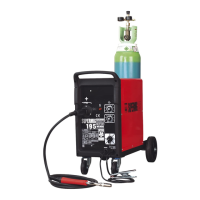
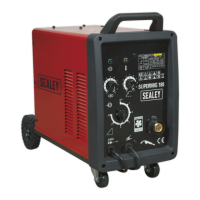
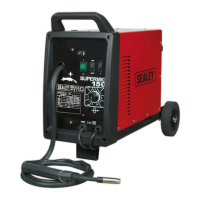
MIG WELDER
MODEL NO
:
SUPERMIG 150/5.V2

 Need help?
 General

 To Next Page