High-voltage battery
●
Never charge the vehicle in potentially
explosive atmospheres. The components of
the charging cable can cause sparks and,
therefore, may ignite flammable or explo-
sive vapours.
●
Never use damaged charging connectors
or cables. Before each use, check that the
connector and charging cable are not
damaged.
●
Never use the charging cable with an ex-
tension lead, rolled cable, power strip or
adapter, e.g. adapter for other countries or
timer.
●
Always protect the connectors to prevent
water, moisture and other liquids from di-
rectly getting inside.
●
For safety reasons, no other work should
be performed on the vehicle while it is
charging.
●
Always end the charging process before
unplugging the mains connector. Other-
wise the charging cable and the electrical
installation may also be damaged.
●
Never charge several vehicles simultane-
ously from electrical sockets of the same
safety circuit. Use a different safety circuit
to charge additional vehicles. Always
check the maximum current or power of the
safety circuit that is used. If necessary,
seek advice from qualified electrical instal-
lation professionals.
●
Only use the charging cables supplied
with the vehicle or the charging station ca-
ble. If the cable needs to be replaced, it is
recommended to exclusively use SEAT
charging cables.
●
Never make changes or repairs to electri-
cal components, particularly the high volt-
age system.
●
Always unplug the charging cable before
starting the vehicle. Place the protective
caps and close the cover of the battery
charging socket.
Note
●
The high-voltage battery can only be
charged at charging stations that meet the
following requirements and regulations:
–
IEC 61851 and IEC 62196 (type 2 con-
nector).
●
Very low or very high temperatures can
noticeably reduce the high voltage bat-
tery’s charging power.
●
To avoid possible compatibility problems
with charging infrastructures, SEAT recom-
mends the use of cables and home charg-
ing stations recommended by the Volkswa-
gen Group.
●
For charging with alternating current,
SEAT recommends charging the high-volt-
age battery at maximum charging power
from a fixed charging station or Wallbox.
This achieves greater efficiency when
compared to charging from an electrical
socket.
●
Check the technical information about
your vehicle’s charging capacity. You can
get more information from any SEAT dealer.
AC charging (charging station or
electrical socket)
3 Valid for: hybrid vehicles
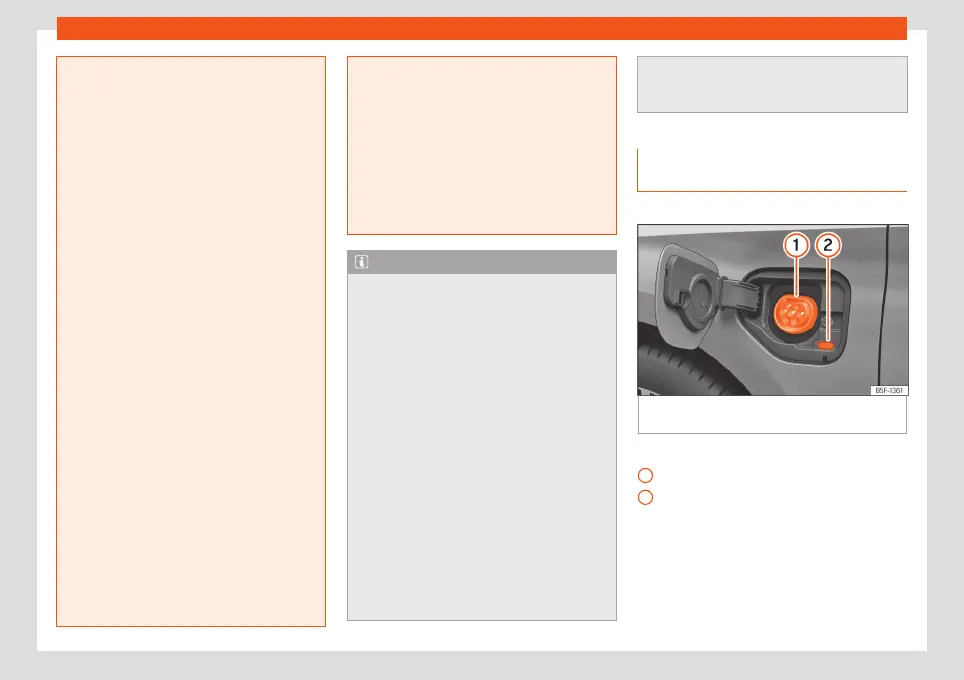
Fig. 210
Behind the battery charging cover on
the front left-hand side: Charging socket
›››
Fig. 210
charging socket
Charging process display
The battery charger installed in the vehicle
converts alternating current from the public
supply into direct current.
AC Charging Station, Wallbox or electrical
socket: The vehicle’s high-voltage battery
can be charged using alternating current
»
1
2
307



 To Next Page